Sell mineral rights in Virginia
Virginia mineral rights that matter to buyers are almost all in the far southwest corner of the state, where the Appalachian Basin coalfield produces natural gas. Coalbed methane made up about 78 percent of the 74.9 billion cubic feet of gas reported for 2025 (Virginia Department of Energy). Oil is close to nil. Owning gas or coalbed methane under one of the seven producing counties is what gives mineral rights a price here. When you sell mineral rights in Virginia through this site, your request goes to up to three independent buyers who work in your county, and you pay nothing.
Where buyers are most active in Virginia
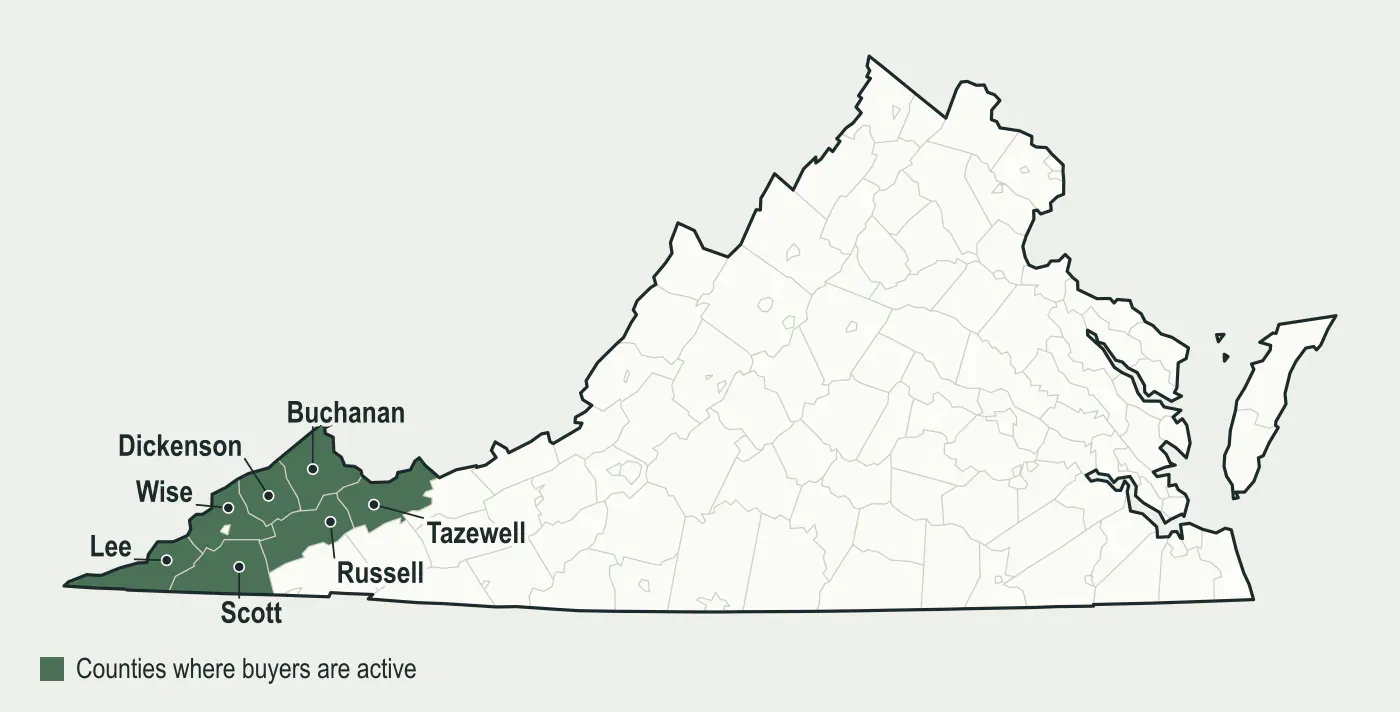
Gas is produced in seven Virginia counties: Buchanan, Dickenson, Russell, Lee, Scott, Tazewell and Wise (Virginia Department of Energy). Buchanan and Dickenson, on the Kentucky and West Virginia line, hold the densest coalbed methane development, with Wise, Russell and Tazewell next. The state lists 17 producing companies and 8,387 permitted gas wells (Virginia Department of Energy). Virginia mineral rights outside these counties rarely draw an offer.
Statewide output is falling slowly. The 74.9 billion cubic feet reported for 2025 was about 5 percent below 2024, and EIA put 2024 gross withdrawals at 80,896 million cubic feet (EIA, 2024). Oil is a footnote: 8,156 barrels in 2025 from 49 wells in Lee and Wise counties, against a 1983 peak of 65,400 barrels (Virginia Department of Energy). Buyers of Virginia mineral rights are buying gas royalty from vertical wells drilled years ago, not acreage waiting on a rig.
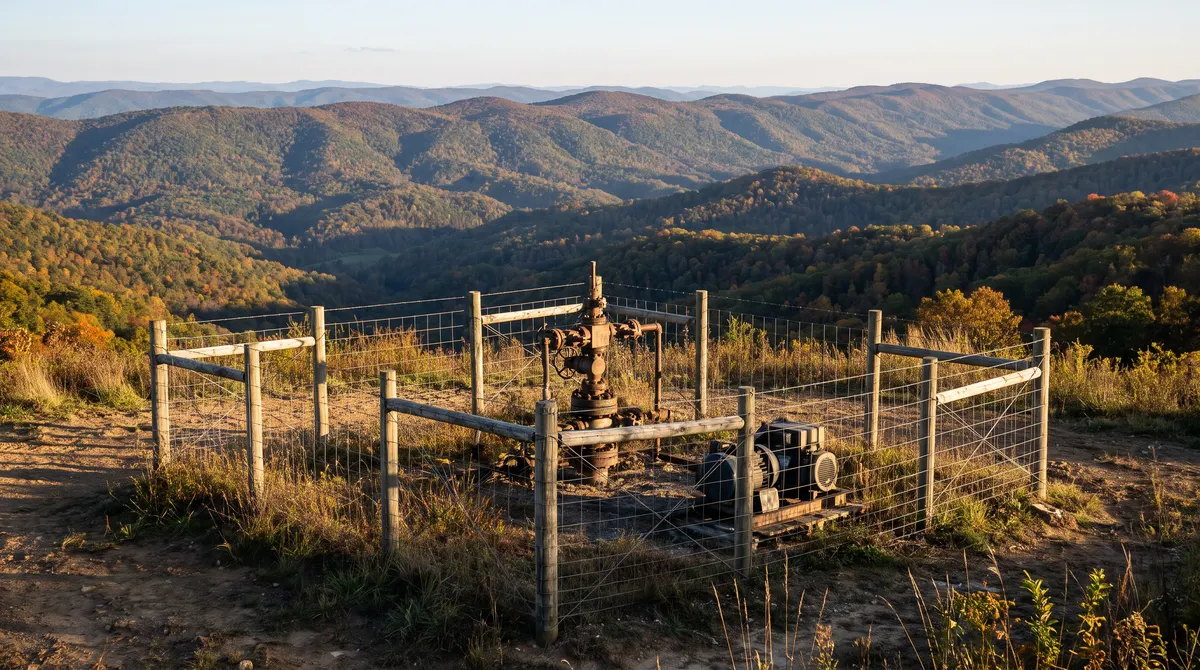
What buyers check before a Virginia mineral rights offer
Buyers go to the Division of Gas and Oil first. The Virginia Department of Energy regulates gas and oil operations on and below the surface, issues permits, inspects wells and gathering lines, and keeps well records in its public Data Information System and GIS map (Virginia Department of Energy). The Virginia Gas and Oil Board issues the spacing and pooling orders that decide how production from each unit is shared.
A Virginia mineral rights offer rests on three records: the well file, the pooling order and your royalty history. The pooling order shows the drilling unit your mineral rights are in, your share of it and whether anyone else has claimed the same gas. The royalty statements show what the operator has paid and deducted. Buyers value mineral rights on net income from the past year or two, discounted for the decline of older coalbed methane wells.
Local taxes come out before you see the check. Counties and cities may charge a license tax of up to 1 percent of gross receipts on severing gas (Code of Virginia 58.1-3712), plus a local gas road improvement tax of up to another 1 percent, which cannot be imposed on or after January 1, 2028 (Code of Virginia 58.1-3713). Buyers net these out when they price mineral rights.
Coalbed methane ownership, forced pooling and escrow
Virginia's coalbed methane fights shaped how mineral rights are bought here. The Virginia Gas and Oil Act now settles it: no conveyance, reservation or exception of coal is deemed to include coalbed methane gas, apart from the coal operator's right to vent gas for safety, and without disturbing settlements and orders made before April 13, 2010 (Code of Virginia 45.2-1621). If your deed gives you the gas, the coalbed methane goes with it.
Forced pooling is routine. When owners in a drilling unit have not agreed to pool, the Board must enter a pooling order after notice and a hearing (Code of Virginia 45.2-1620). An owner who does not join the well can sell or lease to the operator, agree a sharing deal, or be carried until the well pays out a set multiple of that owner's share of costs. An owner who makes no election is deemed to have leased on the order's terms, and proceeds for owners who cannot be found go into escrow.
For coalbed methane units with conflicting claims, the Board pools all interests and the operator deposits one-eighth of the proceeds from the disputed interests, plus any excess, into escrow until a court, an arbitrator or an agreement settles ownership (Code of Virginia 45.2-1622). Escrow balances are a common reason Virginia mineral rights come up for sale, because a buyer with a title team may pay for the claim and the escrow together. Before you sell mineral rights in Virginia with money in escrow, ask an oil and gas attorney what the claim alone is worth.
Selling Virginia mineral rights: records, taxes and closing
Deeds are recorded with the clerk of the circuit court for the county or city where the land lies, once the signer has acknowledged the writing or two witnesses have proved the signature (Code of Virginia 55.1-600). Your mineral deed, any coal severance in the chain of title and the pooling order are the papers a buyer of Virginia mineral rights will ask for.
Virginia taxes income at 5.75 percent above $17,000 (Code of Virginia 58.1-320), so a sale of mineral rights can be taxed by the state as well as the federal government. Ask a tax professional before choosing a lump sum over royalty income on your mineral rights. At closing, the buyer prepares the deed, you sign before a notary, and payment follows recording. Owners who use this site compare up to three offers, and none has to be accepted.
How to get offers for Virginia mineral rights
Tell us your county and what you own. We send your request to up to 3 buyers who purchase in that part of Virginia. They review the public records and contact you with offers, and you choose whether to sell, sell part, or keep.
Virginia mineral rights sources
- Virginia Department of Energy: Division of Gas and Oil
- Virginia Department of Energy: natural gas in Virginia
- Virginia Department of Energy: oil in Virginia
- Code of Virginia, Title 45.2, Chapter 16: Virginia Gas and Oil Act
- Code of Virginia 58.1-3713: local gas road improvement tax
- Code of Virginia 58.1-320: individual income tax rates
Last reviewed October 13, 2026. This page is general information, not legal or tax advice. Facts come from the official sources listed above; confirm anything that matters to your sale with a qualified professional.
Where Virginia mineral rights buyers are active
Buyers concentrate on the counties below, where drilling is heaviest. Minerals elsewhere in Virginia can still sell; send the details and we'll tell you if a buyer covers your area.
What you can sell in Virginia
- Mineral rightsProducing or non-producing minerals, all or part of your interest.
- Royalty interestsWant to sell oil and gas royalties? See how buyers value a royalty interest or NPRI, what to have ready, and get offers from up to 3 buyers in your county.
- Overriding royalties (ORRI)Own an overriding royalty interest? Learn how ORRIs work, why lease expiry changes the price, which documents buyers need, and how to get offers.
- Inherited mineral rightsInherited mineral rights or oil and gas royalties? Learn how to get title in your name, why royalties go into suspense, and how to get buyer offers.
Virginia mineral rights questions
What are Virginia mineral rights worth if the wells are coalbed methane?
They are priced on the royalty the wells pay now and how fast it is declining. Coalbed methane wells produce for a long time at low rates, so buyers usually offer a multiple of recent annual royalty rather than a price per acre. Mineral rights in a unit with a dispute or an escrow balance sell for less until the claim is resolved.
Who regulates gas and oil in Virginia?
The Virginia Department of Energy's Division of Gas and Oil permits and inspects wells, and the Virginia Gas and Oil Board issues spacing and pooling orders. Well records and pooling files are public through the Division's Data Information System, and buyers use them to check the wells on your Virginia mineral rights.
How do I sell mineral rights in Virginia through this site?
Fill in the form with your county and what you own, such as a gas royalty under a pooling order or inherited mineral rights. Up to three independent buyers active in that county receive the request and can each make an offer. You pay nothing, and you can turn every offer down.
Get offers for your Virginia mineral rights
Free to you, no obligation. Your details go only to buyers active in your county.
Other states
Sell mineral rights in Texas, Sell mineral rights in Oklahoma, Sell mineral rights in New Mexico, Sell mineral rights in North Dakota, Sell mineral rights in Ohio, Sell mineral rights in Pennsylvania, Sell mineral rights in West Virginia, Sell mineral rights in Colorado, Sell mineral rights in Louisiana, Sell mineral rights in Wyoming, Sell mineral rights in Alabama, Sell mineral rights in Alaska, Sell mineral rights in Arkansas, Sell mineral rights in California, Sell mineral rights in Florida, Sell mineral rights in Illinois, Sell mineral rights in Indiana, Sell mineral rights in Kansas, Sell mineral rights in Kentucky, Sell mineral rights in Michigan, Sell mineral rights in Mississippi, Sell mineral rights in Montana, Sell mineral rights in Nebraska, Sell mineral rights in New York, Sell mineral rights in South Dakota, Sell mineral rights in Tennessee, Sell mineral rights in Utah