Sell mineral rights in Mississippi
Mississippi is a conventional oil state with a small horizontal shale play on its southwest edge. Most of its oil wells are in the southern half of the state, and the state produces about 0.3 percent of U.S. crude oil (EIA, 2025). Output has fallen since 2015 and reached 12.1 million barrels in 2024, well below the 1970 peak of 65 million barrels (EIA, 2025). Mississippi mineral rights still attract buyers because the fields are long-lived and the records are easy to check. When you sell mineral rights in Mississippi, the county and the field name tell a buyer most of the story.
Where Mississippi mineral rights buyers are most active
The southeast is the oil core. In the Oil and Gas Board's 2001 annual report, the county totals republished by the state's Office of Geology, Jasper County produced 4,181,608 barrels, Jones County 3,533,155 and Wayne County 3,413,806, with Clarke, Lincoln, Adams, Simpson, Lamar and Pike counties each above 600,000 barrels (Mississippi Department of Environmental Quality, 2001 data). Volumes have fallen since, but these counties are where Mississippi mineral rights draw the most offers.
The southwest corner is different. The Tuscaloosa Marine Shale is drilled horizontally, and nearly all of the active Tuscaloosa Marine Shale wells in Mississippi are in Amite and Wilkinson counties, with 58 of the play's 75 active wells on the Mississippi side as of 2021 (AAPG Wiki, IHS Markit 2021 data). The U.S. Geological Survey estimated mean undiscovered, technically recoverable resources of 1.5 billion barrels of oil and 4.6 trillion cubic feet of gas in the formation (USGS, 2018), so non-producing Mississippi mineral rights in Amite, Wilkinson and Pike counties carry drilling upside the rest of the state lacks. Natural gas is minor statewide: the state produces about 0.1 percent of U.S. marketed gas and its output in 2024 was less than half of 2014 (EIA, 2025).
What buyers check before a Mississippi mineral rights offer
Mineral rights buyers use the Mississippi State Oil and Gas Board's online tools: well search, permit search, production search, production charts by field and operator, section and township production, and a map-based data explorer. The Board also keeps a Tuscaloosa Marine Shale page with maps of wells being drilled, completed or producing and monthly production for the horizontal oil wells. A buyer will pull your wells, the operator and the production history before pricing Mississippi mineral rights.
For producing interests the buyer values the recent royalty stream and the field's decline. For shale acreage the buyer looks at permits, unit size and whether the operator is still drilling nearby. Mississippi's severance tax shapes those numbers: oil is taxed at 6 percent of value at the point of production, with 3 percent for approved carbon dioxide enhanced recovery and 1.3 percent for horizontally drilled wells for 30 months or until payout, a reduced rate scheduled to end in 2028 (Miss. Code 27-25-503).
Mississippi mineral rights records and ownership
Conveyances of land, including mineral deeds and leases, are lodged with the clerk of the chancery court of the county where the land is situated, and a conveyance is not good against a later purchaser for value without notice until it is filed there; after filing, priority runs by the time of filing (Miss. Code 89-5-1). Your chain of title to Mississippi mineral rights therefore runs through the chancery clerk's land records, and that is where buyers start.
Severed minerals are common in the older oil counties, and many interests have passed through two or three estates without a recorded probate. If you inherited an interest, record the judgment of heirship or the probate order with the chancery clerk before you ask for offers. An oil and gas attorney can confirm your decimal interest, which matters because if your Mississippi mineral rights sit in a unit, your share of that unit is what a buyer pays for.
Selling Mississippi mineral rights: closing and taxes
To sell mineral rights in Mississippi, gather the recorded deed or heirship judgment, any lease and your last 12 months of royalty statements. Buyers verify the well and unit names against Oil and Gas Board production records. Closing is a mineral deed recorded with the chancery clerk, payment, and a transfer order so the operator pays the new owner.
Mississippi has a state income tax, so the gain on a sale is taxed by the state as well as federally. Ask a tax professional how a stepped-up basis on inherited mineral rights affects that gain before you sign. Collect several written mineral rights offers and compare each one against a year of royalty income; the spread between buyers is often wider than owners expect.
How to get offers for Mississippi mineral rights
Tell us your county and what you own. We send your request to up to 3 buyers who purchase in that part of Mississippi. They review the public records and contact you with offers, and you choose whether to sell, sell part, or keep.
Mississippi mineral rights sources
- U.S. Energy Information Administration, Mississippi State Profile and Energy Estimates (updated December 2025)
- Mississippi State Oil and Gas Board
- Mississippi Department of Environmental Quality, Office of Geology, county oil and gas production index maps (Oil and Gas Board 2001 annual report data)
- AAPG Wiki, Tuscaloosa Marine Shale, Gulf Coast Basin, Louisiana and Mississippi
- Mississippi Code 27-25-503, Oil severance tax rate (FindLaw, current as of January 2025)
- Mississippi Code 89-5-1, Recording of conveyances with the chancery clerk (FindLaw, current as of January 2025)
Last reviewed October 13, 2026. This page is general information, not legal or tax advice. Facts come from the official sources listed above; confirm anything that matters to your sale with a qualified professional.
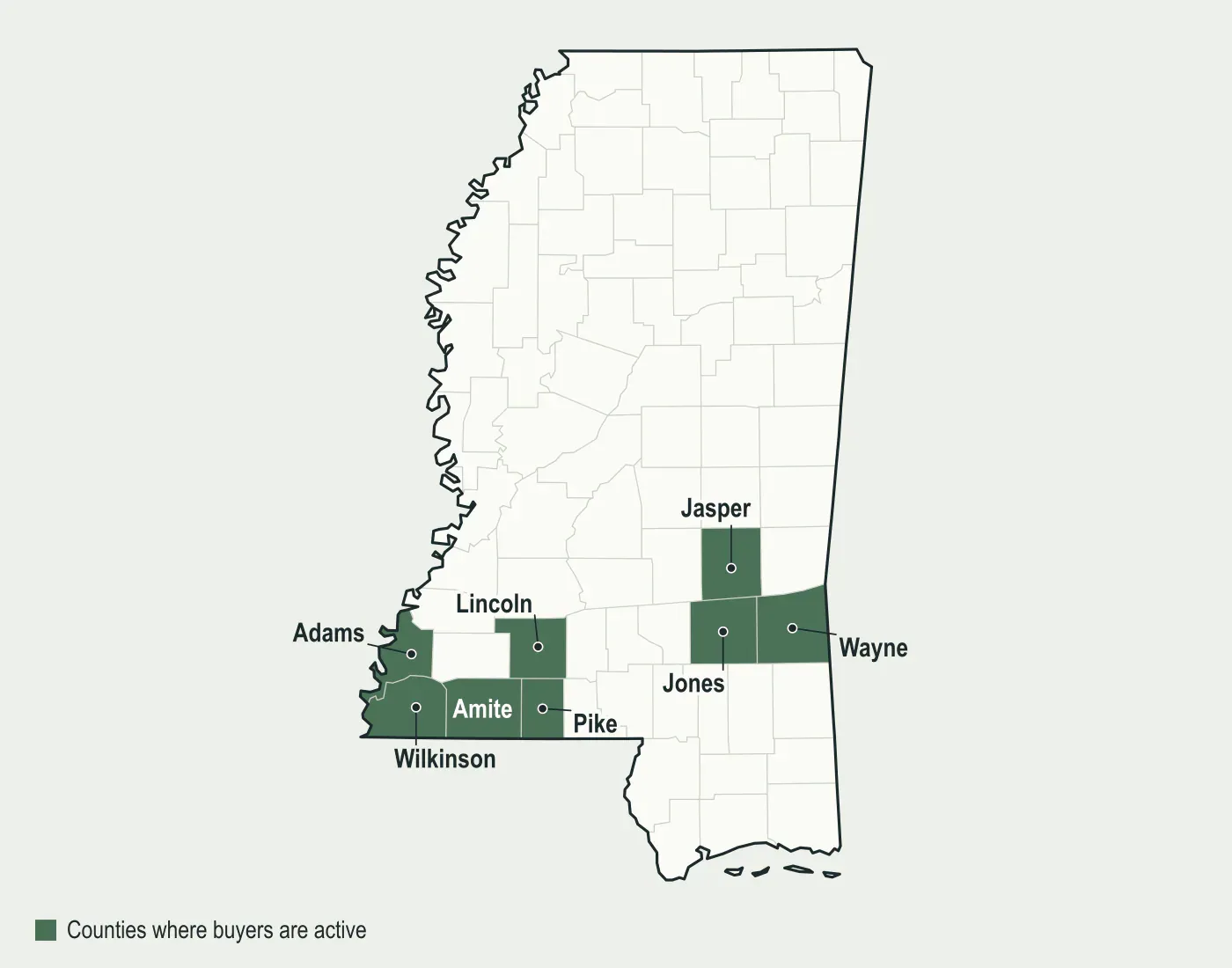
Where Mississippi mineral rights buyers are active
Buyers concentrate on the counties below, where drilling is heaviest. Minerals elsewhere in Mississippi can still sell; send the details and we'll tell you if a buyer covers your area.
What you can sell in Mississippi
- Mineral rightsProducing or non-producing minerals, all or part of your interest.
- Royalty interestsWant to sell oil and gas royalties? See how buyers value a royalty interest or NPRI, what to have ready, and get offers from up to 3 buyers in your county.
- Overriding royalties (ORRI)Own an overriding royalty interest? Learn how ORRIs work, why lease expiry changes the price, which documents buyers need, and how to get offers.
- Inherited mineral rightsInherited mineral rights or oil and gas royalties? Learn how to get title in your name, why royalties go into suspense, and how to get buyer offers.
Mississippi mineral rights questions
Are Tuscaloosa Marine Shale mineral rights worth more than conventional Mississippi mineral rights?
Sometimes. Non-producing acreage in Amite, Wilkinson and Pike counties can draw offers based on drilling potential, while conventional interests elsewhere are priced on current royalty income. The USGS estimate of 1.5 billion barrels of undiscovered oil in the formation (USGS, 2018) is why buyers watch those counties, but the play is small, with 58 active wells on the Mississippi side in 2021.
Where do I find my Mississippi mineral rights deed?
In the chancery clerk's land records for the county where the land lies. Mineral deeds, leases and probate judgments are recorded there, and a buyer will search the same index. If the last recorded owner is a deceased relative, record the heirship judgment before you sell.
How do I sell mineral rights in Mississippi through this site?
Send one request with your county, the field or unit name if you know it, and a recent royalty statement. Up to three independent buyers active in your county make offers, and you choose one or keep your mineral rights. Owners pay nothing; the buyers pay for the introduction.
Get offers for your Mississippi mineral rights
Free to you, no obligation. Your details go only to buyers active in your county.
Other states
Sell mineral rights in Texas, Sell mineral rights in Oklahoma, Sell mineral rights in New Mexico, Sell mineral rights in North Dakota, Sell mineral rights in Ohio, Sell mineral rights in Pennsylvania, Sell mineral rights in West Virginia, Sell mineral rights in Colorado, Sell mineral rights in Louisiana, Sell mineral rights in Wyoming, Sell mineral rights in Alabama, Sell mineral rights in Alaska, Sell mineral rights in Arkansas, Sell mineral rights in California, Sell mineral rights in Florida, Sell mineral rights in Illinois, Sell mineral rights in Indiana, Sell mineral rights in Kansas, Sell mineral rights in Kentucky, Sell mineral rights in Michigan, Sell mineral rights in Montana, Sell mineral rights in Nebraska, Sell mineral rights in New York, Sell mineral rights in South Dakota, Sell mineral rights in Tennessee, Sell mineral rights in Utah, Sell mineral rights in Virginia