Sell mineral rights in the Barnett Shale
The Barnett Shale is a natural gas play under Fort Worth, its suburbs and the ranch country to the west, and it is where modern shale development began. Barnett Shale mineral rights pay royalties from a field where more than 20,000 wells have been drilled (USGS, 2015).
This page covers where the Barnett lies, what its wells produce, how output has changed, how buyers price Barnett Shale mineral rights, and how to get written offers from buyers active in your county.
Where the Barnett Shale lies and which counties matter
The Barnett Shale lies in the Bend Arch–Fort Worth Basin of north-central Texas (USGS, 2015). The Railroad Commission of Texas estimates that the productive part stretches west and south from Dallas across about 5,000 square miles and at least 18 counties. The RRC names it the Newark, East (Barnett Shale) Field.
Four counties form the core: Denton, Johnson, Tarrant and Wise, as identified by the Railroad Commission. Each produced more than 240 million cubic feet of gas per day in the fourth quarter of 2025 (Federal Reserve Bank of Dallas). Barnett Shale mineral rights also sit in Parker, Hood, Jack, Palo Pinto and Erath counties, which lie west of the core and appear on the RRC's list of 25 affected counties.
The core counties sit inside the Dallas–Fort Worth–Arlington metro area (Federal Reserve Bank of Dallas). The City of Fort Worth permits gas wells inside city limits and notifies property owners within 1,000 feet of a proposed well site. The city also warns that mineral ownership may differ from surface ownership. Owning a house doesn't prove you own the mineral rights under it, so check your deed and the county records first.
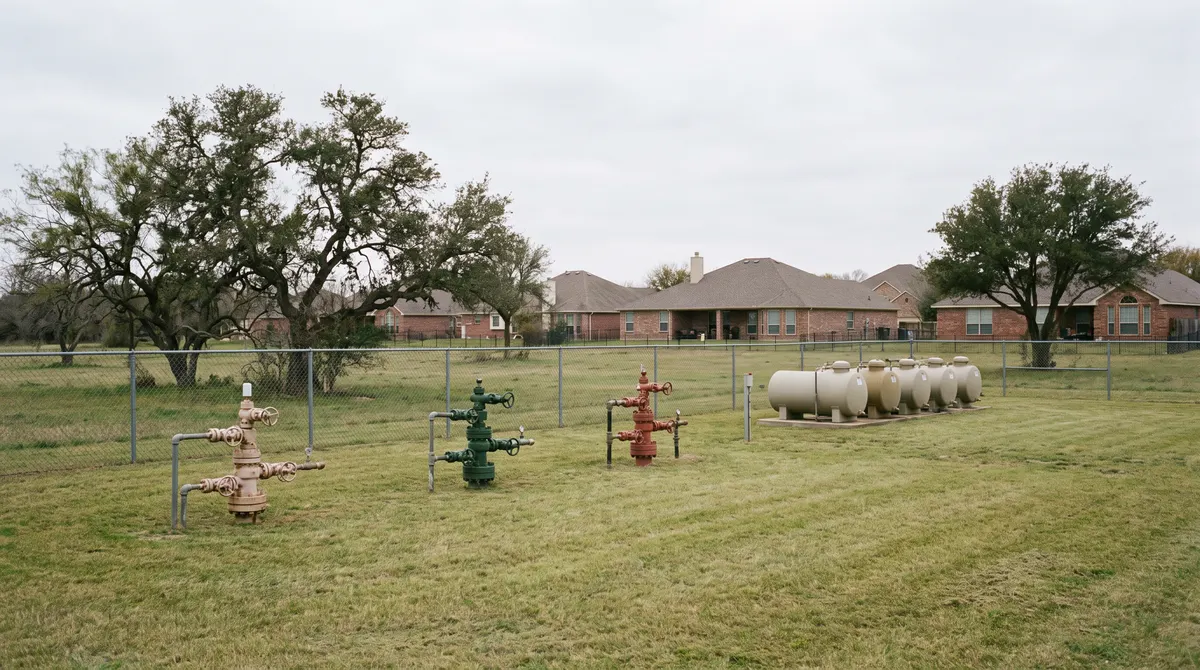
What Barnett Shale wells produce
Barnett wells produce mostly natural gas. The USGS maps gas in the east of the play, a mixed gas-and-oil area beside it and an oil area farther west (USGS, 2015). In 2025, Barnett gas wells reported about 746 billion cubic feet of gas and oil wells about 402,000 barrels of oil (Railroad Commission of Texas, 2026).
This is where shale drilling took its modern form. George Mitchell of Mitchell Energy spent nearly two decades looking for an economical way to get gas out of shale, and modern hydraulic fracturing was developed here (Federal Reserve Bank of Dallas). Horizontal drilling reached the Barnett in 2002. By 2015, more than 16,000 horizontal and 4,700 vertical wells had been drilled into the formation (USGS, 2015).
That history matters to mineral rights owners. Most producing mineral rights here are tied to wells with years of reported output, so the decline pattern on your check stub is already well established.
How Barnett Shale production has changed
Production peaked more than a decade ago and has declined since. Dry gas output topped out in late 2011 at slightly above 5 billion cubic feet per day (Federal Reserve Bank of Dallas). Railroad Commission data show gas-well production of about 2.09 trillion cubic feet in 2012 and about 746 billion cubic feet in 2025, a little over a third of that volume (Railroad Commission of Texas, 2026).
Drilling slowed too. The rig count has fallen since the start of 2011 (Federal Reserve Bank of Dallas), and the RRC's permit chart for the field shows thousands of new permits a year in the late 2000s against fewer than 100 in most recent years. Still, the Barnett supplied 5 percent of Texas natural gas in the Dallas Fed's review of fourth-quarter 2025 data, so Barnett Shale mineral rights remain a real source of income.
What Barnett Shale mineral rights are worth
Buyers look at the Barnett for steady, measurable gas income rather than a drilling boom. Producing tracts have years of public production history, which makes mineral rights income easier to forecast than in a newer play. The USGS also estimated mean undiscovered resources of 53 trillion cubic feet of gas and 176 million barrels of natural gas liquids in the Barnett (USGS, 2015), so some buyers price in future wells.
Producing mineral rights are usually priced from recent royalty income, adjusted for how fast the wells decline and where the buyer expects gas prices to go. Because most Barnett wells are gas wells, your offer moves with gas prices more than oil. Non-producing mineral rights are priced per net mineral acre, based on distance to recent permits and whether the tract is leased.
Buyers check before they offer on mineral rights. They pull your lease's monthly production from the Railroad Commission, look for recent permits and read your deed, lease and division order. See Texas mineral rights value for how offers are built and the oil and gas royalties guide for reading the check stub a buyer will ask for.
How to sell Barnett Shale mineral rights
Fill in the short form with your county, your interest type and whether it produces. Your request goes to up to three independent mineral rights buyers active in that county, and each makes its own written offer. Compare them, then accept one, counter, or keep your Barnett Shale mineral rights. Owners pay nothing; buyers pay for the introduction. For statewide context, see selling mineral rights in Texas.
A sale is final and can change your taxes for the year, so talk to a tax professional before you close. When you are ready to sell mineral rights, get your free cash offers with no fees, no commissions and no obligation.
How to get offers for Barnett Shale mineral rights
Tell us the state and county and what you own. We send your request to up to 3 mineral rights buyers who purchase in that part of the Barnett Shale. They review the public records and contact you with offers, and you choose whether to sell, sell part, or keep.
Barnett Shale mineral rights questions
Where is the Barnett Shale?
It lies in north-central Texas, in the Bend Arch–Fort Worth Basin. The Railroad Commission of Texas says the productive part runs west and south from Dallas across about 5,000 square miles. Denton, Johnson, Tarrant and Wise are the core counties, and Barnett Shale mineral rights there carry most of the field's gas production.
I own a house lot in Tarrant County. Do I own the mineral rights?
Maybe. Minerals are often severed from the surface, and the City of Fort Worth notes that mineral ownership may differ from surface ownership. Read your deed for a reservation of minerals, then search the county clerk's records. If you receive royalty checks or a division order, you likely own an interest in the mineral rights under your lot.
Is it worth selling Barnett Shale mineral rights now?
It depends on your plans and how much drilling is left near your tract. Owners sell to get a lump sum, settle an estate or stop tracking small checks from aging gas wells. Compare several written offers first, so you know what buyers will pay for your mineral rights.
Barnett Shale mineral rights sources
- Railroad Commission of Texas, Barnett Shale information and statistics
- Railroad Commission of Texas, Barnett Shale production 2008 to current (extract August 2026, XLSX)
- Railroad Commission of Texas, Newark, East (Barnett Shale) drilling permits issued 2000 through July 2026 (PDF)
- USGS Fact Sheet 2015–3078, Assessment of undiscovered shale gas and shale oil resources in the Mississippian Barnett Shale (December 2015)
- Federal Reserve Bank of Dallas, Barnett Shale
- City of Fort Worth, Gas well drilling
Last reviewed October 14, 2026. This page is general information, not legal or tax advice. Facts come from the official sources listed above; confirm anything that matters to your sale with a qualified professional.
Get offers for your Barnett Shale mineral rights
Free to you, no obligation. Your details go only to buyers active in your county.
Other basins and plays
Sell mineral rights in the Permian Basin, Sell mineral rights in the Midland Basin, Sell mineral rights in the Delaware Basin, Sell mineral rights in the Bakken, Sell mineral rights in the Eagle Ford, Sell mineral rights in the SCOOP and STACK, Sell mineral rights in the DJ Basin, Sell mineral rights in the Powder River Basin, Sell mineral rights in the Marcellus and Utica, Sell mineral rights in the Anadarko Basin, Sell mineral rights in the San Joaquin Basin, Sell mineral rights in the Haynesville