Pooling and unitization combine separately owned mineral rights so one well, or one project, can drain a reservoir while every owner gets a share. Pooling joins tracts into a drilling or spacing unit, through your lease's pooling clause or, in many states, a regulator's order even if you never signed a lease. Unitization does the same across a field, usually for secondary recovery such as a waterflood.
What is a spacing unit, and why does it lead to pooling and unitization?
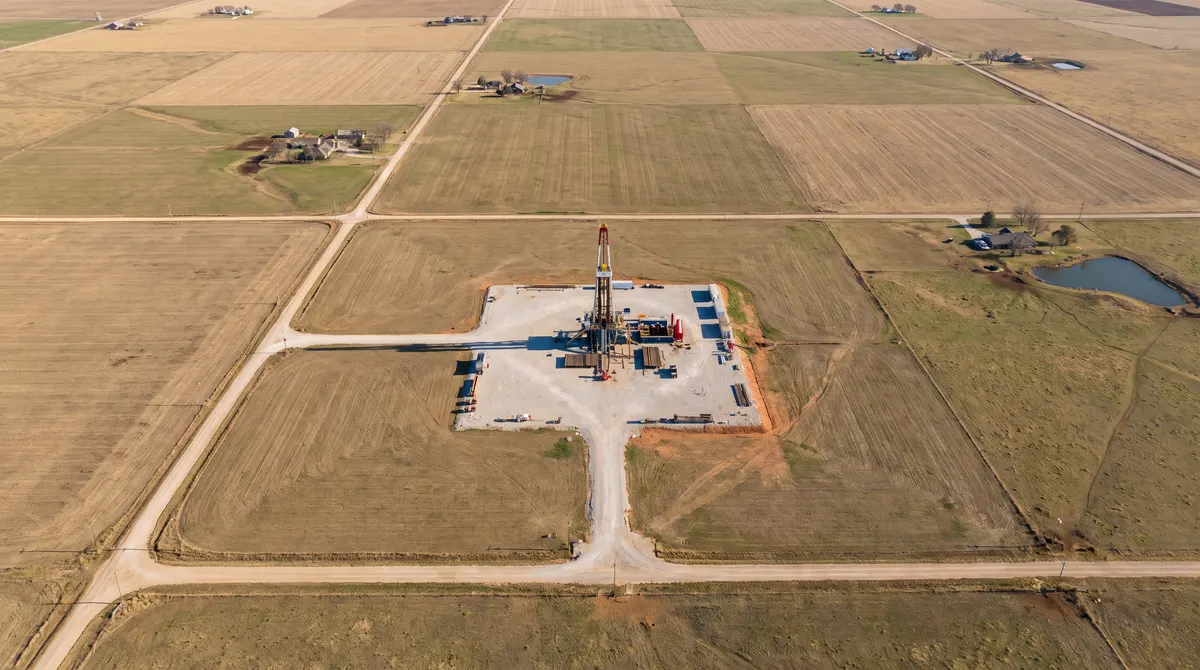
A spacing unit is the area a state allows one well to drain from a formation, and operators pool because they need every tract of mineral rights in it accounted for. The Oklahoma Corporation Commission's royalty owner booklet (2022) says a spacing order "establishes a geographical area in which only one oil and/or gas well can be initially drilled and produced." It adds that Oklahoma now allows horizontal spacing units of up to 1,280 acres (52 O.S. §87.1(f)).
Your mineral rights rarely sit right under the well. Pooling and unitization solve that by sharing production across the unit, usually in proportion to acreage, wherever the hole is drilled.
What does the pooling clause in your lease do?
The pooling clause lets the operator combine your leased mineral rights with neighboring tracts without asking you again. That is voluntary pooling: by signing the lease, you agreed in advance. Our guide to oil and gas lease basics explains the clause with the other lease terms.
What is forced pooling?
Forced pooling, also called compulsory pooling, is a state order that places unleased or unwilling owners of mineral rights into a unit so a well can be drilled. State rules on pooling and unitization differ sharply.
| State | Forced pooling allowed? | Regulator | What an unleased owner can choose |
|---|---|---|---|
| Oklahoma | Yes, by pooling order | Oklahoma Corporation Commission | Within 20 days: pay a share of well costs, or take the order's cash bonus and royalty |
| North Dakota | Yes, within spacing units | North Dakota Industrial Commission | Statutory royalty; join in costs or face a 50% risk penalty |
| Texas | Limited, only after a fair voluntary offer | Railroad Commission of Texas | Not verified |
| Ohio | Yes, for tracts too small or oddly shaped for spacing | Ohio Division of Oil and Gas Resources Management | Participate, or be carried while costs (capped at 200%) come out of production |
| Pennsylvania | Only for wells that penetrate the Onondaga horizon | Not verified | Not verified |
| Colorado | Yes, with more than 45% of interests behind the application | Colorado Energy & Carbon Management Commission | Lease on a good-faith offer, or take a 13% (gas) or 16% (oil) royalty during cost recovery |
Oklahoma
The Oklahoma Corporation Commission's 2022 booklet says owners named in a pooling order have 20 days to elect in writing: participate by paying a share of the estimated well costs, or take a cash bonus and royalty option. An owner who does not elect, or elects to participate and then does not pay, is usually deemed to have taken a cash bonus and royalty. You may still lease your mineral rights until the 20 days run out.
North Dakota
The North Dakota Industrial Commission can pool all mineral rights in a spacing unit when owners have not pooled voluntarily (N.D. Cent. Code §38-08-08). Unleased mineral rights pooled after July 31, 2009 get a cost-free royalty equal to the leased tracts' acreage-weighted average or, at the operator's election, 16%. If the owner does not join in the well's costs, the operator recovers them plus a 50% risk penalty from production.
Texas
Texas has a narrow law, the Mineral Interest Pooling Act (Natural Resources Code chapter 102). The Railroad Commission can pool mineral rights only if the applicant made a fair and reasonable offer to pool voluntarily, and a forced unit cannot exceed 160 acres for an oil well or 640 acres for a gas well, plus 10% tolerance (§§102.011, 102.013). The Texas Supreme Court said in 2024 (Ammonite Oil & Gas v. Railroad Commission) that the act exists "to encourage voluntary pooling."
Ohio, Pennsylvania and Colorado
Ohio allows mandatory pooling when a tract of mineral rights is too small or oddly shaped to meet spacing rules and its owner could not form a unit by agreement (Ohio Revised Code §1509.27). An owner who does not share the cost is carried: the operator recovers costs from that owner's production, excluding the royalty share, up to 200% of that owner's share.
Pennsylvania's version, called integration, sits in the 1961 Oil and Gas Conservation Law, which covers only wells that penetrate the Onondaga horizon. The USGS geologic names database places the Marcellus Shale above the Onondaga, so a Marcellus well that stops short of it falls outside the act.
Colorado's Energy & Carbon Management Commission can pool only when the applicant owns, or has consent from, more than 45% of the mineral interests (C.R.S. §34-60-116). Unleased mineral rights can't be pooled over protest without a good-faith lease offer made at least 60 days before the hearing. If you stay unleased and nonconsenting, you receive a 13% royalty on a gas well or 16% on an oil well until the others recover your share of costs plus penalties.
What is the difference between pooling and unitization?
Pooling and unitization differ in scale and purpose. Pooling combines tracts into one drilling or spacing unit. Unitization combines all or part of a reservoir, and the mineral rights in it, so it runs as one project. The Kansas Geological Survey's glossary defines unitization as running a reservoir for "pressure maintenance, repressuring, waterflood, or other cooperative form to increase ultimate recovery."
Because unitization binds a whole field, it takes a vote. In Ohio, an applicant needs consent from owners of at least 65% of the land area over the pool, and the order takes effect only once owners paying 65% of the costs and royalty owners of 65% of the acreage approve (Ohio Revised Code §1509.28). Unit operation does not transfer title to your mineral rights.
What are correlative rights?
Correlative rights are each owner's right to a fair chance to recover the oil and gas under their land without drilling needless wells. Ohio's statute calls them the "reasonable opportunity" to recover the oil and gas under your tract "without having to drill unnecessary wells" (§1509.01).
The correlative rights doctrine is the legal reason behind pooling and unitization. Ohio may issue a pooling order only if it is "necessary to protect correlative rights," and the Texas and North Dakota statutes name the same aim. In plain words, the owner with the well does not take everything, and the owner of mineral rights next door is not left with nothing.
How do pooling and unitization change your decimal interest?
Pooling spreads your mineral rights across the unit, so your decimal is net mineral acres ÷ unit acres × royalty rate. Under pooling and unitization alike, a bigger unit means a smaller decimal, applied to production from a bigger area.
- 10 net mineral acres at a 3/16 royalty in a 640-acre unit: 10 ÷ 640 × 0.1875 = 0.00293
- The same mineral rights in a 1,280-acre unit: 10 ÷ 1,280 × 0.1875 = 0.00146
If your mineral rights were force pooled without a lease, the royalty in that formula comes from the order or statute. Our guide to net mineral acres vs net royalty acres shows the arithmetic, how to read a royalty check shows where the decimal appears, and our guide to oil and gas royalties covers how it is paid.
What does a pooling notice mean if you want to sell?
A pooling notice means an operator plans to drill a well that includes your mineral rights, and it often brings buyers. Filings on pooling and unitization are public, so mineral buyers who track drilling can see them, and offer letters often follow. In Oklahoma, missing the 20-day election leaves you with the order's default option. An oil and gas attorney can review the order with you.
Our page on mineral rights buyers explains who these buyers are, and our state pages cover Oklahoma and North Dakota. When you're ready, get free cash offers on your mineral rights from up to three independent buyers active in your county, with no fees, no commissions and no obligation.
This guide is general information, not legal advice. State law, any pooling order and your lease control how pooling and unitization apply to your mineral rights.