Sell mineral rights in the DJ Basin
The DJ Basin, short for Denver-Julesburg, is the oil and gas basin under northeast Colorado that reaches into southeast Wyoming and the Nebraska Panhandle, and DJ Basin mineral rights draw strong buyer interest. The USGS calls it the Denver Basin Province and maps it across Colorado, Kansas, Nebraska, South Dakota and Wyoming (USGS, 2002). Weld County, Colorado, produced nearly 90% of the state's crude oil in 2019 (EIA, 2020), and it is where most buyer interest sits.
This page covers where the basin lies, what its wells produce, why buyers compete for DJ Basin mineral rights, how they value them, and how to get competing offers for yours.
Where the DJ Basin lies and which counties matter
Weld County, north of Denver, grew from 58,000 barrels of oil per day in 2010 to about 465,000 in 2019, almost all of Colorado's growth (EIA, 2020). The Wattenberg field lies in Colorado's Denver Basin and produces from the Codell-Niobrara interval and the deeper Dakota J interval (USGS, 2011). The EIA's Niobrara region, which takes in the DJ Basin and other Rocky Mountain counties, includes Weld, Adams, Arapahoe and Broomfield in Colorado, Laramie County in Wyoming, and Cheyenne, Deuel and Garden counties in Nebraska (EIA, 2024).
Colorado wells are regulated by the Colorado Energy and Carbon Management Commission, formerly the Oil and Gas Conservation Commission, which publishes well records through COGIS, production by county and a GIS map. Wyoming wells fall under the Wyoming Oil and Gas Conservation Commission, which offers well and production data through its WYDE data explorer.
Activity thins out away from Weld County. Adams, Arapahoe and Broomfield lie south of it on the edge of the Denver suburbs, Laramie County holds the Wyoming end of the play, and the EIA's region reaches only three Nebraska Panhandle counties. DJ Basin mineral rights are priced accordingly, so the county on your deed matters as much as the acreage.
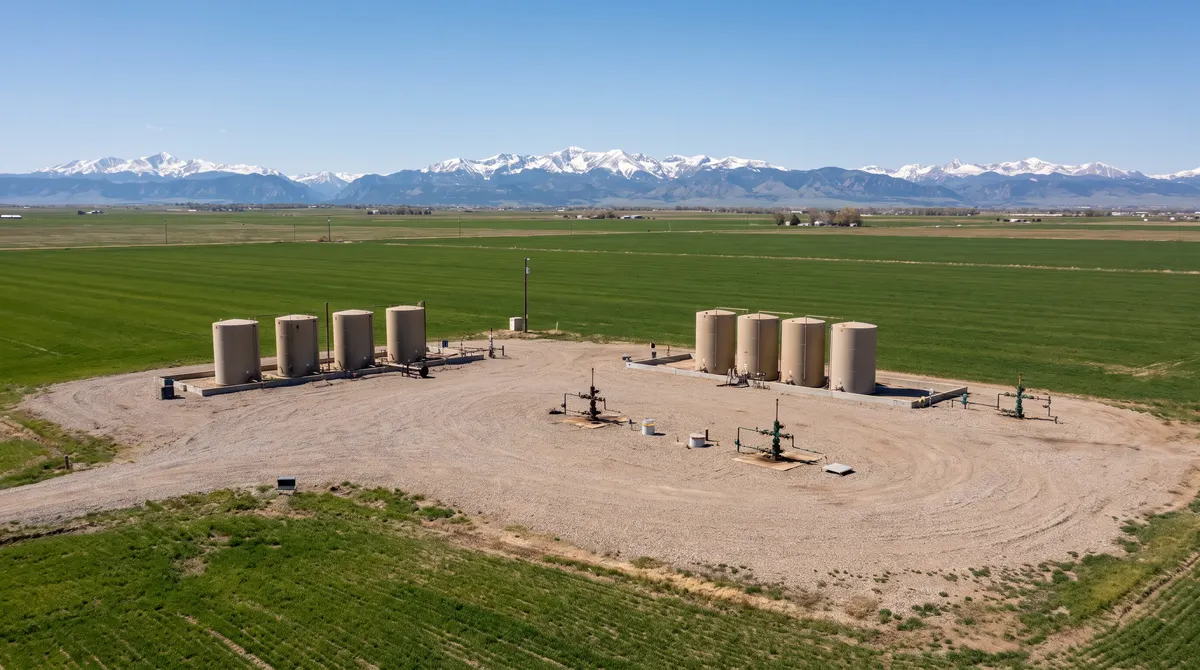
What DJ Basin wells produce
DJ Basin wells produce crude oil, natural gas and natural gas liquids. The EIA's Niobrara region produced about 697,000 barrels of oil per day and 5.3 billion cubic feet of natural gas per day in June 2024 (EIA, 2024). That region is wider than the DJ Basin, but Weld County alone supplied nearly half of Colorado's natural gas in 2019 (EIA, 2020).
The main targets are the Niobrara Formation and the Codell Sandstone, a member of the Carlile Shale beneath it (USGS, 2011). Operators drill them with long horizontal wells, and the USGS treats the Niobrara-Codell in the Wattenberg area as a single continuous accumulation (USGS, 2002). Older vertical wells, many drilled in the 1990s, produced from the Codell-Niobrara and the Dakota J, and some still pay royalty on the same mineral rights (USGS, 2011).
In the eastern third of the basin the Niobrara holds biogenic gas rather than oil (USGS, 2002). Royalty from DJ Basin mineral rights therefore ranges from oil-heavy checks in Wattenberg to small gas checks on the plains.
Why mineral rights buyers compete in the DJ Basin
Buyers compete here because the targets are stacked. Niobrara and Codell wells sit side by side under one unit, operators drill many wells from a single pad, and each new well adds royalty to the same mineral rights. A buyer of DJ Basin mineral rights pays for the infill wells it expects as much as for the wells already producing.
The second reason is open records. Colorado's regulator publishes permits, well records and production by county, so a buyer can see which units are being developed before calling. Many independent mineral rights buyers work Weld County alone, and when several of them want the same mineral rights, the owner sets the price.
What DJ Basin mineral rights are worth
Producing DJ Basin mineral rights are usually priced as a multiple of recent monthly royalty income, adjusted for how fast the wells are declining and how many undrilled Niobrara and Codell locations remain in the unit. A unit with new permits or a pad under construction draws stronger offers than a drilled-out unit.
Non-producing mineral rights are quoted per net mineral acre. Buyers weigh distance to active drilling, whether the tract is leased and at what royalty rate, and whether there is room for new well pads, a real constraint on mineral rights in the suburban parts of Adams, Arapahoe and Broomfield counties.
Buyers verify everything. They pull well records from the Colorado Energy and Carbon Management Commission or the Wyoming Oil and Gas Conservation Commission, read the county clerk and recorder's deed records, and ask for your lease and division orders. For an inherited interest with gaps in the chain of title, talk to an oil and gas attorney before you sign.
How to sell DJ Basin mineral rights
The short form asks for your county, your interest type and whether it produces. Your details go to up to three independent buyers who already work that county. Each one bids independently, and you weigh the offers against each other.
The choice is yours. Take the strongest offer, counter it, or hold on to your mineral rights if none of them is right. There is no cost to owners; buyers pay for the introduction. We are a matching service, not a buyer, so there is no house offer in the mix. When you are ready to sell mineral rights, competition between buyers is the quickest way to find the market price.
How to get offers for DJ Basin mineral rights
Tell us the state and county and what you own. We send your request to up to 3 mineral rights buyers who purchase in that part of the DJ Basin. They review the public records and contact you with offers, and you choose whether to sell, sell part, or keep.
DJ Basin mineral rights questions
Should I sell DJ Basin mineral rights or wait for more Niobrara wells?
Buyers already build the wells they expect into their offers, so waiting only pays if drilling comes faster than they assume. Selling can make sense if you need a lump sum, want to simplify an estate, or hold a small interest. Compare several offers first, so the number you weigh is a real market price for your mineral rights.
Can I sell part of my DJ Basin mineral rights and keep the rest?
Yes. Many owners sell a share and keep the remainder, or sell the royalty on current Niobrara and Codell wells and keep the deeper rights. Tell each buyer what stays with you and ask for a price on that basis.
How long does it take to sell mineral rights in the DJ Basin?
Offers normally arrive within days. Closing takes longer because the buyer runs title on your mineral rights at the county clerk and recorder and checks production with the state regulator. Clean title and current division orders keep closing short.
DJ Basin mineral rights sources
- USGS, 2002 Assessment of Oil and Gas Resource Potential of the Denver Basin Province of Colorado, Kansas, Nebraska, South Dakota, and Wyoming (Fact Sheet 002-03)
- USGS, Gas, oil, and water production from Wattenberg Field in the Denver Basin, Colorado (Open-File Report 2011-1175)
- EIA, Today in Energy on Colorado crude oil and natural gas production and Weld County (July 2020)
- EIA, Drilling Productivity Report, Niobrara region data through June 2024
- Colorado Energy and Carbon Management Commission
- Wyoming Oil and Gas Conservation Commission
Last reviewed October 13, 2026. This page is general information, not legal or tax advice. Facts come from the official sources listed above; confirm anything that matters to your sale with a qualified professional.
Get offers for your DJ Basin mineral rights
Free to you, no obligation. Your details go only to buyers active in your county.
Other basins and plays
Sell mineral rights in the Permian Basin, Sell mineral rights in the Midland Basin, Sell mineral rights in the Delaware Basin, Sell mineral rights in the Bakken, Sell mineral rights in the Eagle Ford, Sell mineral rights in the SCOOP and STACK, Sell mineral rights in the Powder River Basin, Sell mineral rights in the Marcellus and Utica, Sell mineral rights in the Anadarko Basin, Sell mineral rights in the San Joaquin Basin, Sell mineral rights in the Haynesville, Sell mineral rights in the Barnett Shale