Sell mineral rights in the Midland Basin
The Midland Basin is the eastern sub-basin of the Permian and lies entirely within Texas (EIA, 2021). It accounted for 15% of US crude oil production in 2020, at 1.68 million barrels per day (EIA, 2021), and it has been a drilling target since the 1940s (EIA, 2021). Midland Basin mineral rights are among the most traded in the country because the rock has produced for decades and still has undrilled benches.
This page explains which counties matter, what the Spraberry and Wolfcamp produce, how buyers price Midland Basin mineral rights, and how to collect competing offers without paying a fee.
Where the Midland Basin lies and which counties matter
The Midland Basin is bounded by the Eastern Shelf to the east, the Northwest Shelf to the north and the uplifted Central Basin Platform to the west, which separates it from the Delaware Basin (EIA, 2022). To the south its formations thin out into the Ozona Arch (EIA, 2022). The Railroad Commission of Texas describes the basin's Spraberry and Wolfcamp pairing as the "Wolfberry".
The counties with the most activity are Midland, Martin, Howard, Glasscock, Reagan and Upton. Martin and Midland counties together added 0.40 million barrels per day of oil between 2020 and 2024, 21% of all US growth, and Glasscock, Howard and Reagan were also among the ten Permian counties that drove 93% of that growth (EIA, 2025). The Spraberry itself spans 16 counties in western Texas (EIA, 2022), so mineral rights in Dawson, Borden, Irion and Sterling counties also draw interest, usually at lower prices than the core.
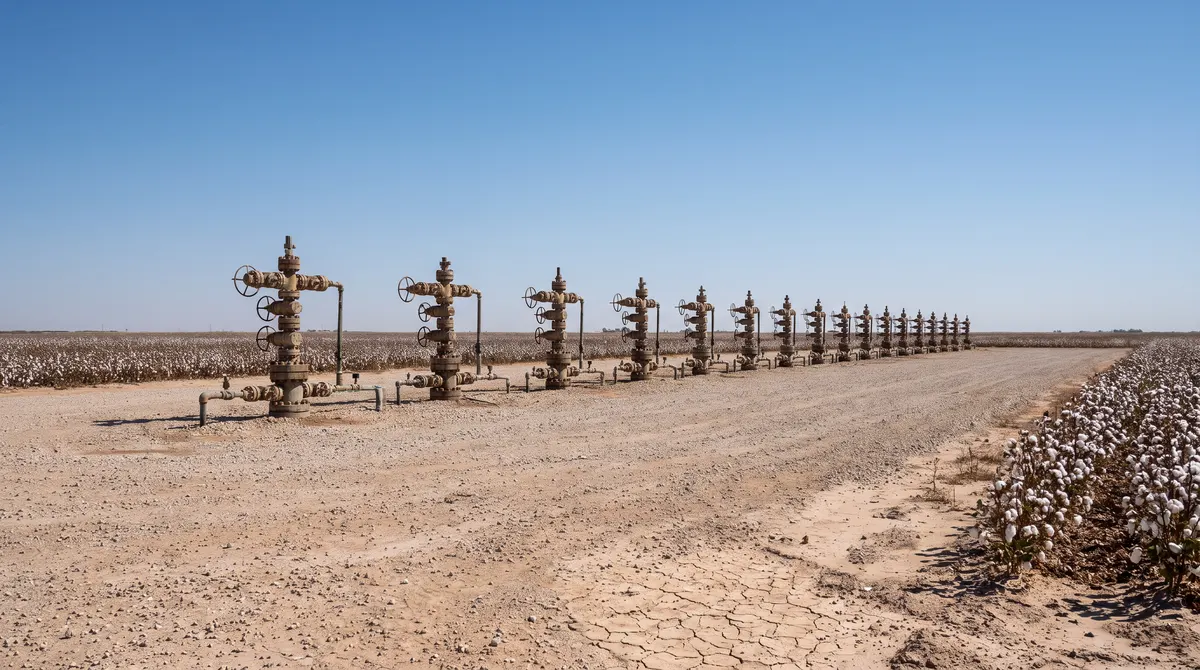
What Midland Basin wells produce
Midland Basin wells produce oil with a meaningful cut of associated gas and natural gas liquids. The Spraberry alone produced more than 1.3 million barrels of crude oil and 2.2 billion cubic feet of natural gas per day in April 2022 (EIA, 2022). Its measured depth ranges from 2,000 to 7,000 feet and its thickness from 1,200 to 3,000 feet, split into Upper, Middle and Lower benches (EIA, 2022).
Below the Spraberry sits the thin Dean formation, and below that the Wolfcamp, which is divided into the Wolfcamp A, B, C and D benches (EIA, 2022). Most current drilling in the basin targets the organic-rich Wolfcamp interval (EIA, 2022). The US Geological Survey estimated a mean of 20 billion barrels of undiscovered, technically recoverable oil and 16 trillion cubic feet of gas in the Midland Basin Wolfcamp (USGS, 2016).
Older vertical wells still matter. Vintage vertical wells made up about 6% of the basin's production in 2020 (EIA, 2021), and many owners receive small checks from decades-old Spraberry wells while new horizontals are drilled under the same section. Mineral rights that look tired on paper can therefore carry real upside.
Why mineral rights buyers compete in the Midland Basin
Buyers like the Midland Basin because it is dense, well mapped and all in one state. EIA had access to more than 24,000 well logs from the basin when it built its 2022 maps (EIA, 2022), and operators hold similar data. That makes future drilling easier to forecast than in younger plays, so a buyer can price undrilled Wolfcamp benches with some confidence.
Stacked targets add to that. A single section can host horizontal wells in the Lower Spraberry, the Wolfcamp A and the Wolfcamp B, each paying royalty to the same mineral rights owner. Buyers who expect that build-out will pay more for mineral rights today, which is why several of them chase the same tracts in Martin and Midland counties.
What Midland Basin mineral rights are worth
If your mineral rights produce, buyers start from your last several months of royalty checks and apply a multiple that reflects decline, commodity prices and the number of undrilled benches under the tract. Recent permits, a new pad or an operator with a stated drilling plan for your section push the multiple up.
If your mineral rights are not producing, offers are quoted per net mineral acre. Core counties with thick Wolfcamp A and B sections command more than fringe counties, leased acreage with a high royalty rate commands more than unleased acreage, and tracts next to active rigs command the most.
Every buyer checks the Railroad Commission of Texas before offering: drilling permits, production data from the Production Data Query system and the public GIS viewer, all covering Districts 7C, 08 and 8A where the Permian's fields sit. They also search county deed records to confirm your net acres and read your lease and division orders. Mineral rights with clean, documented title close faster and attract fewer price cuts.
How to sell Midland Basin mineral rights
Fill in the form with your county, the type of interest you own and whether it is producing. We send that request to up to three independent buyers who already work in your county, and each one sends an offer directly to you.
Compare the offers, negotiate with the buyer you prefer, or keep your mineral rights if nothing meets your number. There is no fee for owners; buyers pay for the introduction. Owners who sell mineral rights after seeing three competing offers know what their tract is worth, which is the whole point.
How to get offers for Midland Basin mineral rights
Tell us the state and county and what you own. We send your request to up to 3 mineral rights buyers who purchase in that part of the Midland Basin. They review the public records and contact you with offers, and you choose whether to sell, sell part, or keep.
Midland Basin mineral rights questions
What are Midland Basin mineral rights worth per acre?
There is no single number. Price per net mineral acre depends on the county, whether the tract is leased, how close it is to permits and rigs, and how many Spraberry and Wolfcamp benches remain undrilled. The only reliable way to find your price is to compare written offers from buyers active in your county.
Can I sell mineral rights in Midland County but keep royalty on existing wells?
Yes, that structure is common. You can sell the deeper or undrilled rights and keep income from current wells, or the reverse. State what you want to keep when you submit the form so buyers price the right package.
Who regulates Midland Basin wells?
The Railroad Commission of Texas regulates drilling, production and plugging across the Midland Basin, and its online records are the same ones buyers use. You can check your well's production and permits yourself before you accept any offer for your mineral rights.
Midland Basin mineral rights sources
- EIA, Texas's Midland Basin accounted for 15% of U.S. crude oil production in 2020 (August 2021)
- EIA, EIA updated geologic maps of the hydrocarbon-rich Midland Basin Spraberry formation (July 2022)
- EIA, Ten counties in the Permian Basin account for 93% of U.S. oil production growth since 2020 (September 2025)
- EIA, Permian Basin Part 2: Wolfcamp and Spraberry shale plays of the Midland sub-basin, geology review (March 2022)
- USGS, Assessment of undiscovered continuous oil resources in the Wolfcamp shale of the Midland Basin, Permian Basin Province, Texas, 2016
- Railroad Commission of Texas, Permian Basin information
Last reviewed October 13, 2026. This page is general information, not legal or tax advice. Facts come from the official sources listed above; confirm anything that matters to your sale with a qualified professional.
Get offers for your Midland Basin mineral rights
Free to you, no obligation. Your details go only to buyers active in your county.
Other basins and plays
Sell mineral rights in the Permian Basin, Sell mineral rights in the Delaware Basin, Sell mineral rights in the Bakken, Sell mineral rights in the Eagle Ford, Sell mineral rights in the SCOOP and STACK, Sell mineral rights in the DJ Basin, Sell mineral rights in the Powder River Basin, Sell mineral rights in the Marcellus and Utica, Sell mineral rights in the Anadarko Basin, Sell mineral rights in the San Joaquin Basin, Sell mineral rights in the Haynesville, Sell mineral rights in the Barnett Shale