Sell mineral rights in the Delaware Basin
The Delaware Basin is the western sub-basin of the Permian and spans from southeast New Mexico into West Texas (EIA, 2019). It holds the Wolfcamp and the entire Bone Spring, which together carry mean undiscovered resources of 46.3 billion barrels of oil and 281 trillion cubic feet of gas (USGS, 2018). Delaware Basin mineral rights therefore sit under some of the most active drilling in the country, in Lea and Eddy counties in New Mexico and in Reeves, Loving, Ward, Winkler, Culberson and Pecos counties in Texas.
Below you will find where the basin lies, what its wells produce, why buyers chase Delaware Basin mineral rights, how offers are built and how to get several of them at once.
Where the Delaware Basin lies and which counties matter
The Delaware Basin is bounded to the north by the Northwestern Shelf, to the south by the Marathon-Ouachita fold belt, to the west by the Diablo Platform and to the east by the Central Basin Platform, which separates it from the Midland Basin (EIA, 2020). Its rocks run deep: Paleozoic strata exceed 29,000 feet in combined thickness in the southern part of the basin (EIA, 2020).
Lea and Eddy counties in New Mexico are the heart of it. Together they added about 1.0 million barrels of oil per day between 2020 and 2024, 52% of all US production growth in that period (EIA, 2025). Loving and Ward counties in Texas were also among the ten Permian counties responsible for 93% of that growth (EIA, 2025). Reeves, Winkler, Culberson and Pecos complete the Texas side, with activity thinning toward the western and southern margins.
Because the basin crosses a state line, mineral rights here fall under two regulators: the Railroad Commission of Texas on the Texas side and the New Mexico Oil Conservation Division on the New Mexico side. A buyer who works both sides of the line is used to both sets of records.
What Delaware Basin wells produce
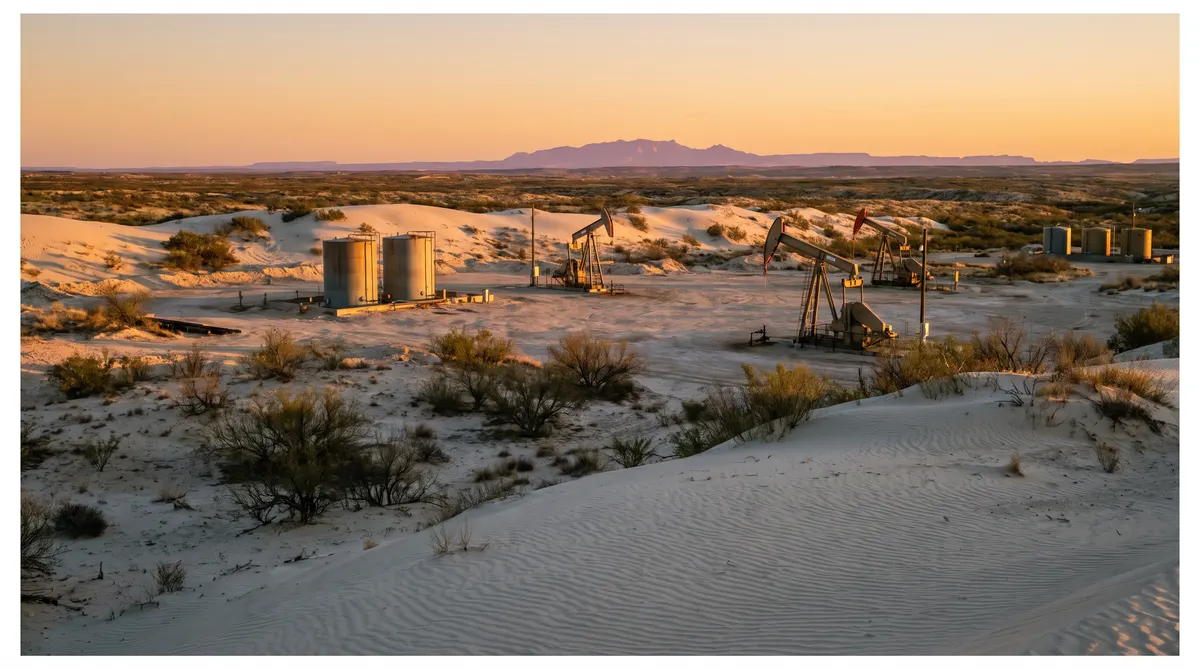
Delaware Basin wells produce oil, associated gas and natural gas liquids from a stack that runs, top to bottom, through the Delaware Mountain Group, the Bone Spring and the Wolfcamp (EIA, 2019). The Bone Spring is up to 4,000 feet of siliciclastic, carbonate and shale rock divided into four intervals: the Avalon shale within the First Bone Spring carbonate, then the First, Second and Third Bone Spring (EIA, 2019).
Horizontal drilling transformed the Bone Spring. Producing wells grew from 436 in January 2005 to 4,338 in mid-2019, and the average initial oil rate per well rose from 67 to 770 barrels per day over the same period (EIA, 2019). By August 2019 the formation was producing 0.6 million barrels of oil and 1.7 billion cubic feet of gas per day (EIA, 2019).
Beneath it, the Wolfcamp is the Permian's most prolific tight oil and shale gas formation and is mapped in the Delaware Basin as the Wolfcamp A and B benches (EIA, 2020). The Railroad Commission of Texas groups the Wolfcamp and Bone Spring together as the "Wolfbone". For a mineral rights owner, that stack means several producing zones can pay royalty on one tract.
Why mineral rights buyers compete in the Delaware Basin
The Delaware Basin offers buyers more drillable intervals per section than any other part of the Permian: the Avalon, three Bone Spring intervals and two or more Wolfcamp benches can each take their own horizontal wells. Mineral rights under a section that has only seen a few wells may still have most of their value ahead of them, and buyers price that inventory.
Deep, high-pressure wells here also tend to produce a lot of gas and liquids alongside oil, so royalty checks carry several revenue streams. The flip side is cost: wells are expensive and operators concentrate on the best rock, so mineral rights buyers pay sharply different prices from one county, or even one township, to the next.
What Delaware Basin mineral rights are worth
For producing mineral rights, buyers multiply recent monthly royalty income by a factor that reflects decline, prices and how many undrilled Bone Spring and Wolfcamp intervals remain under the unit. Horizontal wells here decline quickly in their first years, so a tract with new wells is priced differently from one with wells that have flattened out.
Non-producing mineral rights are quoted per net mineral acre, and the spread is wide. Acreage in the core of Lea, Eddy, Loving or Reeves counties, inside a drilling unit with permits on file, draws the strongest offers. Acreage on the western and southern margins, where the rock is deeper and less drilled, draws far less. Lease terms, royalty rate and whether the tract is held by production all move the number.
Verification is split by state. For Texas tracts, buyers search Railroad Commission drilling permits, production data and the GIS viewer. For New Mexico tracts, they use the Oil Conservation Division, which regulates oil and gas activity in the state, permits new wells and collects well production data. In both states they check county deed records and your division orders to confirm net acres and decimal interest before they commit to a price for your mineral rights.
How to sell Delaware Basin mineral rights
Submit the form with your county and state, your interest type and whether it is producing. The request goes to up to three independent buyers who are already active in that county, on whichever side of the state line your tract sits.
The buyers send offers straight to you, and you choose: accept one, negotiate, or keep your mineral rights. You pay nothing; the buyers pay for the introduction. Owners who sell mineral rights this way see the spread between buyers before they sign anything.
How to get offers for Delaware Basin mineral rights
Tell us the state and county and what you own. We send your request to up to 3 mineral rights buyers who purchase in that part of the Delaware Basin. They review the public records and contact you with offers, and you choose whether to sell, sell part, or keep.
Delaware Basin mineral rights questions
Are Delaware Basin mineral rights in New Mexico sold differently from Texas?
The sale itself works the same way, by mineral deed recorded in the county. The difference is the records buyers check: the Oil Conservation Division in New Mexico, the Railroad Commission in Texas. Our form routes your request to buyers active in your specific county, so each one already knows that state's records.
My Delaware Basin minerals have no wells yet. Can I still sell?
Yes. Non-producing mineral rights are bought and sold constantly in Lea, Eddy, Reeves and Loving counties. Offers are quoted per net mineral acre and depend on how close you are to permits and rigs and whether the tract is leased.
Should I sell mineral rights before or after a new well is drilled?
Neither answer is always right. Before drilling, you carry the risk that the well is never drilled but keep the upside if it is; after drilling, income is proven and the multiple is clearer. Collecting offers at both points, with no obligation, is the practical way to decide.
Delaware Basin mineral rights sources
- EIA, EIA updates geologic maps of the Delaware Basin's Bone Spring formation (December 2019)
- EIA, Permian Basin Part 1: Wolfcamp, Bone Spring, Delaware shale plays of the Delaware Basin, geology review (February 2020)
- EIA, Ten counties in the Permian Basin account for 93% of U.S. oil production growth since 2020 (September 2025)
- USGS, Assessment of undiscovered continuous oil and gas resources in the Wolfcamp shale and Bone Spring Formation of the Delaware Basin, Permian Basin Province, New Mexico and Texas, 2018
- Railroad Commission of Texas, Permian Basin information
- New Mexico Energy, Minerals and Natural Resources Department, Oil Conservation Division
Last reviewed October 13, 2026. This page is general information, not legal or tax advice. Facts come from the official sources listed above; confirm anything that matters to your sale with a qualified professional.
Get offers for your Delaware Basin mineral rights
Free to you, no obligation. Your details go only to buyers active in your county.
Other basins and plays
Sell mineral rights in the Permian Basin, Sell mineral rights in the Midland Basin, Sell mineral rights in the Bakken, Sell mineral rights in the Eagle Ford, Sell mineral rights in the SCOOP and STACK, Sell mineral rights in the DJ Basin, Sell mineral rights in the Powder River Basin, Sell mineral rights in the Marcellus and Utica, Sell mineral rights in the Anadarko Basin, Sell mineral rights in the San Joaquin Basin, Sell mineral rights in the Haynesville, Sell mineral rights in the Barnett Shale