Sell mineral rights in Nebraska
Nebraska is a small oil state, and it is better to say so plainly. The whole state produced about 1.6 million barrels of oil from 1,406 producing wells in 2024, with 24 new wells spudded all year (Nebraska Oil and Gas Conservation Commission, 2024). That is less than a single busy county makes in Texas or North Dakota. There is still a market for Nebraska mineral rights, mostly for producing royalties in the Panhandle and the southwest, and buyers do make offers on them. If you want to sell mineral rights in Nebraska, this page explains where the wells are, what buyers check and what a realistic sale looks like.
Where buyers are most active in Nebraska
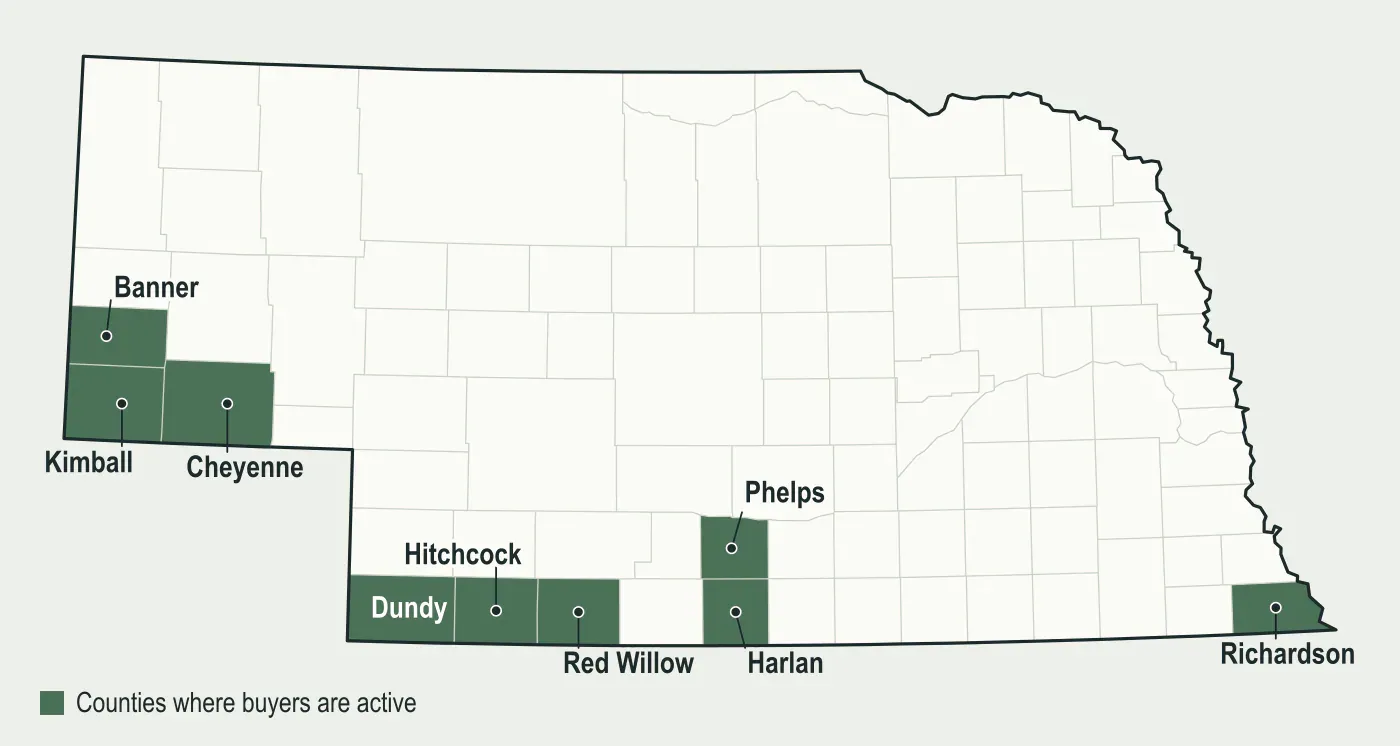
Southwest Nebraska produced the most oil in 2024. Hitchcock County led the state with 487,081 barrels, Dundy County produced 302,130 and Red Willow County 148,545 (Oil and Gas Conservation Commission, 2024). These are conventional vertical wells in small fields, many on waterflood, and Nebraska mineral rights here are mostly royalties on wells that have produced for years.
The Panhandle is the second area. Kimball County produced 190,151 barrels, Cheyenne County 116,241, Banner County 74,418 and Morrill County about 25,000 in 2024. Cheyenne County is also the state's only meaningful gas county, with 279,913 mcf of dry gas, and only 96 gas wells were producing statewide at the end of 2024 (Oil and Gas Conservation Commission, 2024). Gas-only mineral rights in Nebraska are a very small market.
South-central and southeastern counties round out the map. Richardson County produced 72,148 barrels, Phelps County 45,535 and Harlan County 44,916 (Oil and Gas Conservation Commission, 2024). Elsewhere, Nebraska mineral rights almost never have a well on them, and non-producing acreage far from any field draws little interest at any price.
What buyers check before a Nebraska mineral rights offer
Buyers start with the Oil and Gas Conservation Commission, which has regulated the industry since 1959. Its GIS data mining site shows permitted wells with scanned drilling permits and well details, and the Commission publishes annual production by county and by operator. A buyer can confirm which wells sit on your tract, who operates them and whether they are active or inactive, and 265 oil wells were inactive at the end of 2024 (Oil and Gas Conservation Commission, 2024).
Severance tax is the second check. Nebraska taxes oil and gas at 3% of value, with a 2% rate for stripper oil from properties producing 10 barrels a day or less, plus a conservation tax of 7.0 mills since May 1, 2022 (Nebraska Department of Revenue, Form 61). Nebraska also has an individual income tax. Both reduce what Nebraska mineral rights pay each month, and buyers price them in.
Ownership is the third, and Nebraska has a rule that catches absent owners. Buyers verify your net mineral acres and decimal interest against recorded deeds and the operator's division order, and they check whether your mineral rights could be challenged under the abandonment statute described below.
Nebraska mineral rights records and ownership
Nebraska law treats a severed mineral interest as abandoned unless the record owner has exercised ownership within the 23 years before a surface owner sues. Qualifying acts include selling, leasing or mortgaging the interest by a recorded instrument, drilling or producing from it, or recording a verified claim of interest in the county that describes the land, names the owner and states an intent to keep the interest (Nebraska Revised Statutes 57-229). Each qualifying act extends the interest for another 23 years. The surface owner may sue in equity in the county where the land lies to terminate and cancel an abandoned interest (Nebraska Revised Statutes 57-228). If your family has held non-producing Nebraska mineral rights without recording anything for a long time, record a claim of interest before you decide whether to sell.
Mineral deeds, royalty deeds, leases and claims of interest are recorded in the county where the land lies, and a buyer traces title from the last recorded instrument to you. For inherited mineral rights, that means probate records or an affidavit of heirship.
Producing Nebraska mineral rights are valued on months of royalty income and the chance of more wells. Non-producing mineral rights in Nebraska are priced on net mineral acres and nearness to a field. With only 24 wells spudded in 2024, the drilling outlook adds little to a Nebraska offer, so the royalty history does most of the work.
Selling Nebraska mineral rights: leases, closing and taxes
A sale closes with a recorded mineral or royalty deed. An existing lease stays in force and the buyer takes over your royalty; unleased acreage passes with the right to lease. Ask a tax professional how a lump sum compares with continuing royalty income, and whether a stepped-up basis applies to inherited mineral rights.
To sell mineral rights in Nebraska through this site, tell us the county, the lease or well name if you know it, and your most recent royalty amount. We send the request to up to three independent buyers active in that county. They make offers, you compare, and you accept one or keep your mineral rights. You pay nothing.
How to get offers for Nebraska mineral rights
Tell us your county and what you own. We send your request to up to 3 buyers who purchase in that part of Nebraska. They review the public records and contact you with offers, and you choose whether to sell, sell part, or keep.
Nebraska mineral rights sources
- Nebraska Oil and Gas Conservation Commission
- Nebraska Oil and Gas Conservation Commission, 2024 Annual Activity Summary (production by county)
- Nebraska Department of Water, Energy, and Environment, crude oil production in Nebraska
- Nebraska Revised Statutes 57-229, severed mineral interests and the 23-year rule
- Nebraska Revised Statutes 57-228, surface owner's action to terminate
- Nebraska Department of Revenue, Form 61 severance and conservation tax
Last reviewed October 13, 2026. This page is general information, not legal or tax advice. Facts come from the official sources listed above; confirm anything that matters to your sale with a qualified professional.
Where Nebraska mineral rights buyers are active
Buyers concentrate on the counties below, where drilling is heaviest. Minerals elsewhere in Nebraska can still sell; send the details and we'll tell you if a buyer covers your area.
Nebraska basins and plays
Buyers price Nebraska mineral rights by the basin they sit in. These pages cover the counties, formations and drilling outlook of each play that reaches into Nebraska.
What you can sell in Nebraska
- Mineral rightsProducing or non-producing minerals, all or part of your interest.
- Royalty interestsWant to sell oil and gas royalties? See how buyers value a royalty interest or NPRI, what to have ready, and get offers from up to 3 buyers in your county.
- Overriding royalties (ORRI)Own an overriding royalty interest? Learn how ORRIs work, why lease expiry changes the price, which documents buyers need, and how to get offers.
- Inherited mineral rightsInherited mineral rights or oil and gas royalties? Learn how to get title in your name, why royalties go into suspense, and how to get buyer offers.
Nebraska mineral rights questions
Is it worth trying to sell Nebraska mineral rights at all?
If they pay a royalty, yes. Buyers make offers on producing interests in Hitchcock, Dundy, Kimball, Red Willow, Cheyenne and Banner counties. Non-producing Nebraska mineral rights far from any field are hard to sell, and we will tell you if no buyer in our network covers your county.
How do I find out whether there are wells on my Nebraska minerals?
Use the Oil and Gas Conservation Commission's GIS data mining site to search permitted wells by location, or check the operator and lease named on your royalty statement against the Commission's annual production by operator.
How long does it take to sell mineral rights in Nebraska?
Offers usually arrive within days when a buyer covers your county. Closing takes a few weeks when the deed is in your name and longer when heirship has to be proved. Buyers of Nebraska mineral rights handle most of the paperwork.
Get offers for your Nebraska mineral rights
Free to you, no obligation. Your details go only to buyers active in your county.
Other states
Sell mineral rights in Texas, Sell mineral rights in Oklahoma, Sell mineral rights in New Mexico, Sell mineral rights in North Dakota, Sell mineral rights in Ohio, Sell mineral rights in Pennsylvania, Sell mineral rights in West Virginia, Sell mineral rights in Colorado, Sell mineral rights in Louisiana, Sell mineral rights in Wyoming, Sell mineral rights in Alabama, Sell mineral rights in Alaska, Sell mineral rights in Arkansas, Sell mineral rights in California, Sell mineral rights in Florida, Sell mineral rights in Illinois, Sell mineral rights in Indiana, Sell mineral rights in Kansas, Sell mineral rights in Kentucky, Sell mineral rights in Michigan, Sell mineral rights in Mississippi, Sell mineral rights in Montana, Sell mineral rights in New York, Sell mineral rights in South Dakota, Sell mineral rights in Tennessee, Sell mineral rights in Utah, Sell mineral rights in Virginia