
Free written cash offers in 28 states
Sell your mineral rights and oil and gas royalties for cash
GoSellMineralRights gets you free, written cash offers for mineral rights and producing royalty interests in 28 states, from Texas and Oklahoma to the Appalachian Basin. No fees, no commissions, no pressure: compare up to 3 offers from buyers active in your county and sell only if the price is right.
- Up to 3 written cash offers from buyers active in your county, not one letter in the mail.
- $0 to you, ever: no fees, no commissions, no listing charges.
- Sell all, sell part, or keep. You close directly with the buyer you choose.
How selling mineral rights works here What are your mineral rights worth? All 28 states
- 28 statesWhere our buyers purchase mineral rights and royalties
- Up to 3 offersWritten cash offers per request, from buyers active in your county
- $0 to ownersNo fees, no commissions, no listing charges, ever
- No obligationSell all, sell part, or keep your mineral rights
How to sell mineral rights here, in three steps
Tell us where your mineral rights are
State and county are enough to start. A royalty check stub or acreage helps mineral buyers make firmer offers.
Mineral rights buyers active there contact you
We send your request to up to 3 mineral buyers who purchase in your county. They review public well and title records, then make cash offers.
Compare offers and decide
Choose the best offer, sell part of your mineral rights, or keep everything. You deal and close directly with the buyer.

Three ways to sell mineral rights, compared
Most mineral owners sell mineral rights one of three ways. The route decides how many offers you see, who pays the fees, and how fast it closes.
| What matters | GoSellMineralRights | Answering one offer letter | Broker, listing site or auction |
|---|---|---|---|
| Offers you can compare | Up to 3 cash offers from mineral buyers active in your county, side by side | One. The letter is the whole market as far as you can see | Bids after a listing period, if the interest draws them |
| What you pay | Nothing. Buyers pay us for the introduction, and it never comes out of your price | Nothing | A commission or listing fee, usually a percentage of the sale |
| Time to a decision | We send your request within one business day; buyers reply with offers after checking records | Fast, often with a deadline on the letter | Weeks to months: listing, marketing, then bids |
| Who you deal with | The buyer you choose, directly. We're not a mineral buyer | That one buyer | The broker or platform, under a listing agreement |
| Obligation | None. Sell all, sell part, or keep everything | None, though the deadline adds pressure | Often an exclusive listing term |
Whichever route you take, compare offers on the same basis: what exactly is bought, the price per net mineral acre or months of income, who pays closing costs, and when you're paid.
What you can sell
Sell oil rights, gas royalties or a full mineral estate: our buyers purchase more than whole mineral rights. Whatever interest you hold, the process is the same: tell us where it is and buyers active there make written offers.
- Mineral rightsProducing or non-producing minerals, all of your interest or part of it.
- Royalty interestsWant to sell oil and gas royalties? See how buyers value a royalty interest or NPRI, what to have ready, and get offers from up to 3 buyers in your county.
- Overriding royalties (ORRI)Own an overriding royalty interest? Learn how ORRIs work, why lease expiry changes the price, which documents buyers need, and how to get offers.
- Inherited mineral rightsInherited mineral rights or oil and gas royalties? Learn how to get title in your name, why royalties go into suspense, and how to get buyer offers.
Why it pays to sell mineral rights to the best of several offers
Mineral buyers don't agree on what a tract is worth. Each one has its own forecast for oil and gas prices, its own view of which wells will be drilled next, and its own reasons to want acreage in your area. Two buyers looking at the same royalty statement can be thousands of dollars apart.
Offer letters usually arrive one at a time, often right after a permit or pooling notice near you. Answering the first one means you never see the rest of the market. Comparing offers side by side is the simplest way to know you're getting a fair price when you sell mineral rights.
If you're still deciding whether to sell at all, our guide on when selling makes sense and when to keep walks through it. New to the terms? Start with what mineral rights are and how a royalty interest differs.
Sell mineral rights by state
We work with buyers across the major producing states. Pick yours to see where buyers are active and what they check before making an offer.
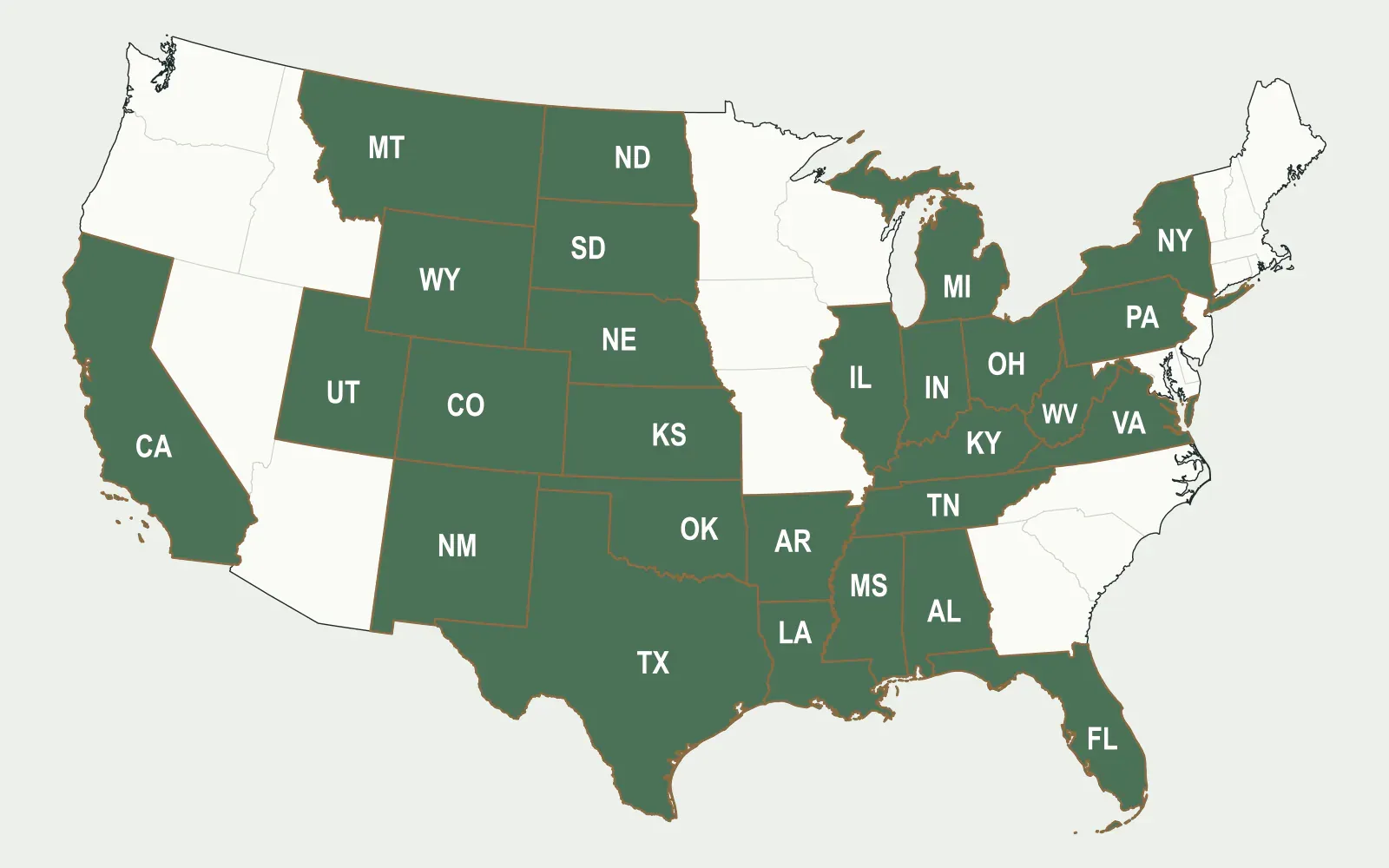
- Sell mineral rights in TexasPermian Basin (Midland and Delaware), Eagle Ford Shale, Haynesville Shale, Barnett Shale, Anadarko Basin
- Sell mineral rights in OklahomaSCOOP and STACK (Anadarko Basin), Arkoma Basin, Hugoton field (Panhandle)
- Sell mineral rights in New MexicoDelaware Basin (Permian), San Juan Basin
- Sell mineral rights in North DakotaBakken and Three Forks (Williston Basin)
- Sell mineral rights in OhioUtica and Point Pleasant shale (Appalachian Basin)
- Sell mineral rights in PennsylvaniaMarcellus Shale, Utica Shale
- Sell mineral rights in West VirginiaMarcellus Shale, Utica Shale
- Sell mineral rights in ColoradoDJ Basin (Denver-Julesburg), Piceance Basin
- Sell mineral rights in LouisianaHaynesville Shale
- Sell mineral rights in WyomingPowder River Basin, Green River Basin, DJ Basin, Wind River Basin
- Sell mineral rights in AlabamaBlack Warrior Basin, Gulf Coast Salt Basin
- Sell mineral rights in AlaskaNorth Slope (Colville Basin), Cook Inlet Basin
- Sell mineral rights in ArkansasFayetteville Shale (Arkoma Basin), South Arkansas Smackover trend
- Sell mineral rights in CaliforniaSan Joaquin Basin, Los Angeles Basin, Ventura Basin, Sacramento Basin
- Sell mineral rights in FloridaJay field area (western Panhandle), Sunniland trend (South Florida Basin)
- Sell mineral rights in IllinoisIllinois Basin
- Sell mineral rights in IndianaIllinois Basin
- Sell mineral rights in KansasCentral Kansas uplift, Hugoton Gas Area, Nemaha uplift
- Sell mineral rights in KentuckyAppalachian Basin, Illinois Basin
- Sell mineral rights in MichiganMichigan Basin, Antrim Shale, Niagaran reef trend
- Sell mineral rights in MississippiMississippi Interior Salt Basin, Tuscaloosa Marine Shale
- Sell mineral rights in MontanaWilliston Basin (Bakken), Cedar Creek Anticline, Powder River Basin, Central and northern Montana fields
- Sell mineral rights in NebraskaNebraska Panhandle fields, Southwest Nebraska fields, Southeast Nebraska fields
- Sell mineral rights in New YorkAppalachian Basin
- Sell mineral rights in South DakotaWilliston Basin, Denver-Julesburg Basin
- Sell mineral rights in TennesseeAppalachian Basin, Cumberland Plateau
- Sell mineral rights in UtahUinta Basin, Paradox Basin, Central Utah thrust belt
- Sell mineral rights in VirginiaAppalachian Basin
See all 28 states where you can sell mineral rights through us
Sell mineral rights by basin
Mineral rights buyers price by play before they price by state. Start with your basin if you know it.
What sets the price when you sell mineral rights
Royalty income now
For producing minerals, offers start from your average monthly check over the last 6 to 12 months.
How fast the wells decline
Shale wells produce most in their first years. Older, flattening wells are valued differently from new ones.
Permits and planned wells
New drilling permits near your tract usually raise offers, because they point to more royalty income.
Your share of the unit
Your decimal interest and net mineral acres decide how much of each well's production is yours.
Lease terms and deductions
Your royalty rate and the deductions taken before payment change what an interest actually earns.
Clean title
Clear ownership records make closing faster. Inherited minerals may need title work first.
What could your royalty checks sell for?
Buyers often pay 36 to 60 months of income
$43,200 to $72,000
A rule-of-thumb range for minerals that pay royalties now. New wells planned nearby can push offers higher; fast-declining wells can pull them lower.
Sell mineral rights or keep them? Both can be the right call
Keeping makes sense when
- New wells are permitted or planned in your unit
- You rely on the income and can ride out price swings
- You want to pass the minerals to your family
Selling makes sense when
- Production is declining and no new drilling is planned
- An estate needs to be split among several heirs
- You'd rather have cash to invest, pay debt or retire on
You can also sell mineral rights in part and keep the rest.
Guides before you sell mineral rights
- Should I sell my mineral rights? When to sell and when to keepA plain guide to the question "should I sell my mineral rights?": the case for keeping, the good reasons to sell, selling part, and how to judge an offer.
- Who owns the mineral rights to my property? How to find outAnswer "who owns the mineral rights to my property?" by reading your deed, tracing the chain of title and checking royalty and unclaimed property records.
- How to read a royalty check and division order for your mineral rightsRead every line of a royalty check stub, work out the decimal interest on your mineral rights, review a division order and spot payment errors.
- How a mineral rights sale closes: title, mineral deed and paymentEach step of a mineral rights sale: purchase agreement, title opinion, curative work, signing the mineral deed, recording and getting paid safely.
- Mineral rights tax: how a sale is taxed, cost basis and 1031 exchangesHow mineral rights tax works when you sell: capital gains vs royalty income, cost basis for bought, gifted and inherited minerals, and 1031 exchanges.
- Mineral rights vs royalty interests: the types of mineral interests explainedWhat a mineral interest includes, how it differs from a royalty interest, NPRI, ORRI and working interest, and how to tell which you own from your deed.
- Net mineral acres vs net royalty acres: how to calculate what you ownHow to calculate net mineral acres from gross acres and your fraction, convert them to net royalty acres, and check both against your division order.
- What are mineral rights? Definition, what you own, and how they're soldA plain mineral rights definition: what the mineral estate is, how it splits from the surface, who owns it under your property, and how a sale works.
- Do you need a mineral rights attorney? When to hire one, and when a buyer's title review is enoughWhen a mineral rights attorney is worth hiring, what one does, how fees work, and the state bar lawyer referral services in 11 oil and gas states.
- Oil and gas severance tax by state: what comes out of your royalty checkOil and gas severance tax rates in 28 states, who pays it, how it shows on your royalty check stub, whether it is deductible and how it affects offers.
- Taxes on oil and gas royalties: Schedule E, depletion and your 1099Oil and gas royalties and taxes explained: Schedule E, the 15% depletion allowance, deductible costs, your 1099-MISC and estimated tax payments.
- Oil and gas lease basics for mineral owners: bonus, royalty, term, and sell vs leaseWhat an oil and gas lease gives a mineral owner: bonus, royalty fraction, primary term, held by production, Pugh clause, and when selling beats leasing.
- Oil and gas royalties: how they're calculated, paid, and why checks changeHow oil and gas royalties are calculated and paid, what can be deducted, why your royalty check goes down, and what to do when you inherit or sell.
- Pooling and unitization: what happens to your mineral rights in a drilling unitPooling and unitization explained: spacing units, lease pooling clauses, forced pooling rules by state, correlative rights and what a pooling notice means.
- Ad valorem tax on mineral rights: how counties tax oil and gas mineralsHow ad valorem tax on mineral rights works: Texas appraisal, the $500 exemption, bills, penalties and protests, and how other oil states tax minerals.
- How to transfer mineral rights: deeds, wills, gifts and trustsHow to transfer mineral rights by mineral deed, gift, will, transfer on death deed or trust, what a deed must say, and how to record it.
- Oil and gas glossary for mineral owners: 62 terms in plain EnglishOil and gas glossary for mineral owners: 62 terms in plain English, from take or pay and OGM to spud date, shut-in royalty, NPRI and division orders.
Questions owners ask before they sell mineral rights
Does it cost anything to get mineral rights offers?
No. Mineral rights buyers pay us when we introduce an owner to them. You pay nothing, and asking for offers never obliges you to sell your mineral rights.
Are you a mineral rights buyer?
No. We match you with independent mineral rights buyers who are active in your state and county. You talk to them directly, compare what they offer for your mineral rights, and sign only with the buyer you choose.
How many mineral rights buyers will contact me?
Up to three, chosen by your state and county. If no buyer we work with covers your area, we tell you rather than passing your details on.
What do I need to get an offer on my mineral rights?
Your state and county are enough to start. Buyers can make firmer mineral rights offers if you also have a recent royalty check stub or owner statement, your net mineral acres, or a deed or legal description.
How are mineral rights valued?
For mineral rights that pay royalties, buyers start from your monthly income and how fast the wells are declining. A common rule of thumb is three to five years of current royalty income. For mineral rights that don't pay yet, value depends on drilling activity nearby, lease status and location. Our mineral rights value calculator gives a rough range; real offers can land above or below it.
Can I sell only part of my mineral rights?
Yes. Many mineral rights buyers will purchase a portion, such as half of your interest, so you take some cash now and keep royalty income from the rest.
Get offers for your mineral rights
Three short steps. We send your request to up to 3 buyers active in your county, usually within one business day.