Sell mineral rights in the San Joaquin Basin
The San Joaquin Basin holds California's biggest oil fields, and San Joaquin Basin mineral rights are concentrated in one county above all: Kern. In 2018, 65.7 percent of California's oil came from Kern County fields (California Energy Commission, 2020). Its wells are old and heavy-oil, and most need steam to flow, which makes valuing them different from valuing a Permian or Bakken interest.
This page covers where the basin lies, which fields and counties matter, what the wells produce, how buyers value San Joaquin Basin mineral rights under California's permitting rules, and how to get offers from buyers who already work here.
Where the San Joaquin Basin lies and which counties matter
The basin fills the southern half of California's Central Valley, with Bakersfield at its center. Commercial production here dates to 1887, and thermal recovery arrived in the 1960s (CEC, 2021). Kern County carries almost all of it: the Kern River and Kern Front fields sit just east of central Bakersfield, while South Belridge, Cymric, McKittrick and Midway-Sunset run north to south along the county's western side, with Elk Hills next to them (CEC, 2021).
The biggest fields are large by any measure. In 2020, Midway-Sunset produced about 16.5 million barrels, Kern River 15.9 million and South Belridge 15.8 million, with Cymric and Lost Hills above 8 million each (CEC analysis of CalGEM data, 2021). Midway-Sunset, near Taft, is California's largest and most productive oil field (California State Senate, 2025).
Outside Kern, activity is thin. Fresno County had 1,254 steam wells in 2020, nearly all in the Coalinga field (CEC, 2021). Mineral rights in those two counties attract a smaller pool of buyers, usually ones already active in Kern.
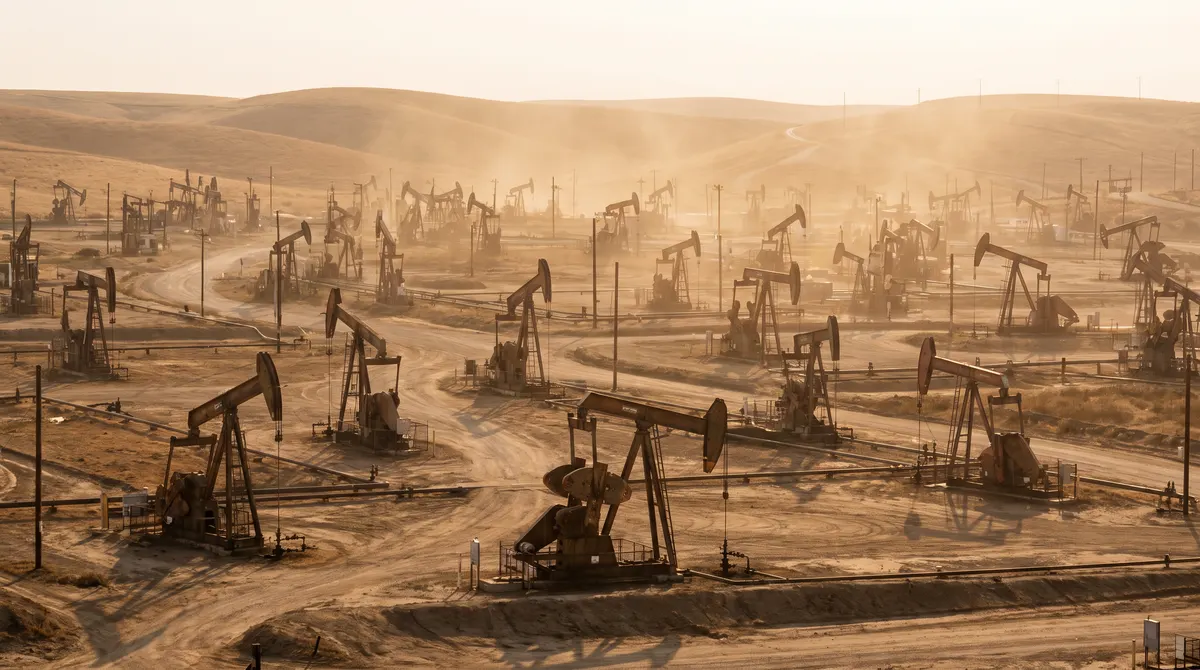
What San Joaquin Basin wells produce
San Joaquin wells produce heavy crude oil, most of it with steam. In 2020, more than 100 million barrels of California's roughly 130 million barrels of crude came from fields with steam wells, and Kern County alone had just under 22,300 steam wells (CEC, 2021). Elk Hills is the exception: it has no active steam wells and, in addition to oil, supplied 53.5 percent of in-state natural gas production (CEC, 2021).
Production is declining but long-lived. The basin's onshore proved crude reserves stood at 1,075 million barrels at the end of 2021, after 99 million barrels of production that year (EIA). The USGS estimated in 2003 that reserve growth in existing fields could add about 4,000 million barrels, much of it from improved recovery in the Monterey Formation's diatomite reservoirs (USGS, 2007).
For a mineral rights owner this means royalty from wells that may be decades old, often with small monthly checks spread across many wells, and the steam and power costs that operators sometimes deduct from them.
Why mineral rights buyers are active in the San Joaquin Basin
Buyers are active here because the fields are enormous and well understood. Nine major San Joaquin fields could yield about 6.5 billion barrels more with improved recovery methods (USGS, 2012), so a buyer of San Joaquin Basin mineral rights is pricing slow, steady production rather than a drilling rush.
Permitting is the variable. In September 2025 the Governor signed SB 237, which certifies Kern County's environmental impact report and allows the county to approve up to 2,000 new well drilling permits a year for ten years, effective January 1, 2026 (California State Senate, 2025; CEC, 2026). Buyers read that as more infill wells in Kern, and interest in Kern mineral rights has picked up with it.
The third reason is simplicity. Most mineral rights sit in one of a handful of fields with one operator, so a buyer can check the field's history and decline in an afternoon.
What San Joaquin Basin mineral rights are worth
Producing mineral rights are priced as a multiple of recent monthly royalty income, adjusted for decline, heavy-oil price discounts and whether the operator is adding wells under the new permits. A tract inside Midway-Sunset or South Belridge with steady checks draws stronger offers than one with a few stripper wells.
Non-producing San Joaquin Basin mineral rights are priced per net mineral acre, and the number depends on whether the tract lies inside a producing field boundary, how close it is to active steam projects, and whether it falls within Kern County's permitting area. Acreage far from existing fields draws little interest.
Buyers check the California Geologic Energy Management Division (CalGEM), the Department of Conservation division that permits and tracks every well, using its Well Finder map and WellSTAR records. They also read county recorder documents, your lease and your division orders. Clean title speeds up every offer on your mineral rights.
How to sell San Joaquin Basin mineral rights
Tell us your county, your interest type and whether it is producing. Your request goes to up to three independent buyers who work in California, and each makes its own offer on your mineral rights.
Weigh the offers, then accept, counter or keep your mineral rights. Nothing is charged to owners; buyers pay for the introduction. When you decide to sell mineral rights, competing offers tell you more than any online estimate, and a tax professional can help you weigh the lump sum against years of royalty.
How to get offers for San Joaquin Basin mineral rights
Tell us the state and county and what you own. We send your request to up to 3 mineral rights buyers who purchase in that part of the San Joaquin Basin. They review the public records and contact you with offers, and you choose whether to sell, sell part, or keep.
San Joaquin Basin mineral rights questions
Are San Joaquin Basin mineral rights worth less because California limits drilling?
Permitting limits lower the value of undrilled acreage more than they lower the value of producing royalty. Existing steam floods keep producing under current rules, and SB 237 now allows Kern County to approve up to 2,000 new well permits a year (California State Senate, 2025). Offers for Kern mineral rights reflect both facts.
I inherited mineral rights in Kern County and get tiny checks. Can I sell?
Yes. Small, divided mineral rights in old Kern fields are common, and buyers who already own in the same field will still make offers. Gather the last twelve months of royalty statements and the deed or probate order that put the interest in your name before you request offers.
Who regulates San Joaquin Basin oil wells?
The California Geologic Energy Management Division, known as CalGEM, part of the state Department of Conservation. It issues well permits and keeps well records and production reports that buyers use to check your mineral rights before they bid.
San Joaquin Basin mineral rights sources
- California Energy Commission, Petroleum Watch (February 2020): California oil field production by county
- California Energy Commission, Petroleum Watch (December 2021): Kern County thermal EOR oil fields
- EIA, California San Joaquin Basin onshore crude oil proved reserves and production
- USGS, Petroleum systems and geologic assessment of oil and gas in the San Joaquin Basin Province (Professional Paper 1713)
- California State Senate, Senator Grove on the signing of SB 237 (September 2025)
- California Energy Commission, FAQ: California gas prices and the impacts of the Iran war (2026)
Last reviewed October 13, 2026. This page is general information, not legal or tax advice. Facts come from the official sources listed above; confirm anything that matters to your sale with a qualified professional.
Get offers for your San Joaquin Basin mineral rights
Free to you, no obligation. Your details go only to buyers active in your county.
Other basins and plays
Sell mineral rights in the Permian Basin, Sell mineral rights in the Midland Basin, Sell mineral rights in the Delaware Basin, Sell mineral rights in the Bakken, Sell mineral rights in the Eagle Ford, Sell mineral rights in the SCOOP and STACK, Sell mineral rights in the DJ Basin, Sell mineral rights in the Powder River Basin, Sell mineral rights in the Marcellus and Utica, Sell mineral rights in the Anadarko Basin, Sell mineral rights in the Haynesville, Sell mineral rights in the Barnett Shale