Sell mineral rights in Alaska
Alaska mineral rights are a special case, and this page says so plainly. The state produced 154,033 thousand barrels of crude oil in 2025 (EIA, 2025), yet almost none of the minerals under that oil belong to private individuals. The subsurface is owned by the State of Alaska, the federal government and Alaska Native regional corporations. What a private person usually holds is a royalty or overriding royalty interest carved out of a lease, not the mineral rights themselves. Those interests can be sold. When you sell mineral rights in Alaska through this site, or a royalty interest, your request goes to up to three independent buyers, and you pay nothing.
Who owns Alaska mineral rights, and what a private owner can hold
The State of Alaska keeps the mineral rights when it sells land. Most contracts, leases and deeds for state land must contain an express reservation to the state of all oil, gas, coal, minerals and geothermal resources under AS 38.05.125(a) (Alaska Department of Law opinion, 1993). The state's land entitlement at statehood was 104.5 million acres (BLM Alaska). The Alaska Native Claims Settlement Act added a second large owner: Congress conveyed title to 44 million acres, and the twelve regional corporations obtained fee title to the subsurface estate of all of those lands (US House Report 112-736). In 2016 the Alaska Supreme Court held that the minerals under a Kenai tract belonged to the State and Cook Inlet Region, Inc. because of those reservations (City of Kenai v. Cook Inlet Natural Gas Storage Alaska, 2016).
So private Alaska mineral rights in fee are rare. What private people and small companies do own are interests created on top of state and Native leases: overriding royalty interests kept by an early leaseholder, net profits interests, and working interests in a unit. A few families hold mineral rights under land patented before statehood without a reservation. If you receive checks from an Alaska operator, the assignment in your files says which of these you hold, and that document is what a buyer prices.
Where buyers are most active in Alaska
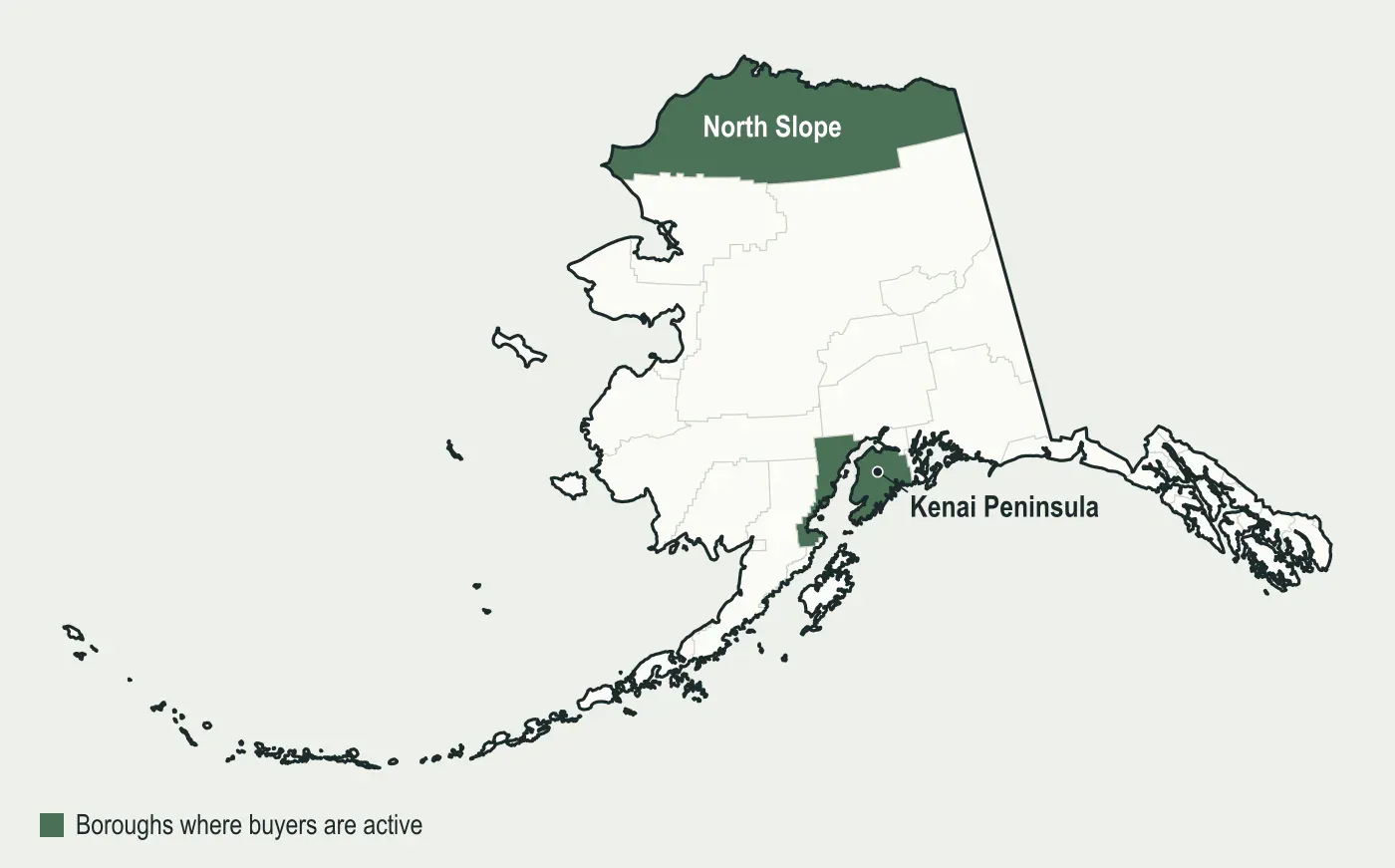
Alaska mineral rights with value sit over two basins. The large majority of oil has come from the Colville Basin on the North Slope, with some oil and gas from the Cook Inlet Basin in south-central Alaska (US Department of Energy state profile, data through 2018). The North Slope Borough holds the big fields; the Kenai Peninsula Borough holds the Cook Inlet fields that supply gas to Anchorage and the Kenai area. The Alaska Division of Oil and Gas runs the state's competitive lease sales, with 2026 sales set for the Beaufort Sea and the North Slope (Alaska Division of Oil and Gas).
Gas numbers need care. EIA counted 3,546,110 million cubic feet of gross withdrawals in Alaska in 2025 but only 368,956 million cubic feet marketed (EIA, 2025); the rest is largely returned to the reservoirs. Buyers of Alaska mineral rights are usually specialist royalty funds, and there are fewer of them than in the Lower 48, so expect fewer offers and still compare the ones that come.
What buyers check before an Alaska mineral rights offer
The Alaska Oil and Gas Conservation Commission is an independent, quasi-judicial state agency under the Alaska Oil and Gas Conservation Act, AS 31.05; it regulates wells and pools and prohibits waste of oil and gas, including venting or flaring without its authorization (US Department of Energy). Its well and production records show a buyer what the wells covering your mineral rights produce. The Division of Oil and Gas keeps the lease, unit and royalty records for state land and monitors collection of the money owed under its leases (US Department of Energy).
For a royalty or overriding royalty, the buyer reads the assignment that created it: the fraction, the leases it burdens, and whether it survives a unit expansion or a lease renewal. Then the buyer reads a year or two of check detail. Alaska mineral rights offers are built from that income, the decline of the wells and the operator's plans.
Deeds and assignments are recorded with the State of Alaska, not a county. The Recorder's Office keeps the Official Records of the State of Alaska through two offices and 34 recording districts, and deeds, assignments and modifications are among the documents it records (Alaska Department of Natural Resources). A buyer will check that your mineral rights and every earlier assignment are of record in the right district.
Selling Alaska mineral rights: taxes and closing
Alaska's Tax Division lists the taxes it collects, from the oil and gas production tax to the oil and gas property tax, and an individual income tax is not among them (Alaska Department of Revenue). A sale of mineral rights or a royalty interest is still a federal taxable event, so ask a tax professional how a lump sum compares with continued royalty income.
Closing takes a recorded assignment or mineral deed, signed before a notary and filed in the recording district where the property lies, and payment follows recording. If the mineral rights came through an estate, the buyer will ask for the probate order that connects you to the assignment. Owners who sell mineral rights in Alaska through this site compare up to three offers first, and no offer has to be accepted.
How to get offers for Alaska mineral rights
Tell us your borough and what you own. We send your request to up to 3 buyers who purchase in that part of Alaska. They review the public records and contact you with offers, and you choose whether to sell, sell part, or keep.
Alaska mineral rights sources
- Alaska Division of Oil and Gas
- Alaska Department of Law: reservation of mineral rights to Alaska (1993 opinion)
- BLM Alaska: land transfer program (state and ANCSA entitlements)
- Alaska Department of Natural Resources: Recorder's Office
- US Department of Energy: Alaska natural gas flaring and venting regulations (state profile)
- EIA: crude oil production by state
Last reviewed October 13, 2026. This page is general information, not legal or tax advice. Facts come from the official sources listed above; confirm anything that matters to your sale with a qualified professional.
Where Alaska mineral rights buyers are active
Buyers concentrate on the boroughs below, where drilling is heaviest. Minerals elsewhere in Alaska can still sell; send the details and we'll tell you if a buyer covers your area.
What you can sell in Alaska
- Mineral rightsProducing or non-producing minerals, all or part of your interest.
- Royalty interestsWant to sell oil and gas royalties? See how buyers value a royalty interest or NPRI, what to have ready, and get offers from up to 3 buyers in your county.
- Overriding royalties (ORRI)Own an overriding royalty interest? Learn how ORRIs work, why lease expiry changes the price, which documents buyers need, and how to get offers.
- Inherited mineral rightsInherited mineral rights or oil and gas royalties? Learn how to get title in your name, why royalties go into suspense, and how to get buyer offers.
Alaska mineral rights questions
Do I own Alaska mineral rights if I own land in Alaska?
Usually not. Most state land was sold with the mineral rights reserved to the State of Alaska, and under ANCSA the subsurface of Native lands belongs to the regional corporations. Check your deed for a mineral reservation. If the minerals were reserved, you own the surface only, and there are no mineral rights to sell.
Can I sell an overriding royalty interest in an Alaska lease?
Yes. An overriding royalty is a recorded interest that pays a share of production, and it can be assigned like any other property. Buyers value it on recent check history, the wells and units it covers, and whether it ends when the underlying lease ends. Mineral rights buyers who work in Alaska usually look at overriding royalties too.
How do I sell mineral rights in Alaska through this site?
Fill in the form with your borough and what you hold: a royalty, an overriding royalty, a working interest or fee mineral rights. Up to three independent buyers receive the request and can each send an offer. You pay nothing, and you can decline every offer. Because Alaska is a small market for private mineral rights, you may hear from fewer than three.
Get offers for your Alaska mineral rights
Free to you, no obligation. Your details go only to buyers active in your borough.
Other states
Sell mineral rights in Texas, Sell mineral rights in Oklahoma, Sell mineral rights in New Mexico, Sell mineral rights in North Dakota, Sell mineral rights in Ohio, Sell mineral rights in Pennsylvania, Sell mineral rights in West Virginia, Sell mineral rights in Colorado, Sell mineral rights in Louisiana, Sell mineral rights in Wyoming, Sell mineral rights in Alabama, Sell mineral rights in Arkansas, Sell mineral rights in California, Sell mineral rights in Florida, Sell mineral rights in Illinois, Sell mineral rights in Indiana, Sell mineral rights in Kansas, Sell mineral rights in Kentucky, Sell mineral rights in Michigan, Sell mineral rights in Mississippi, Sell mineral rights in Montana, Sell mineral rights in Nebraska, Sell mineral rights in New York, Sell mineral rights in South Dakota, Sell mineral rights in Tennessee, Sell mineral rights in Utah, Sell mineral rights in Virginia