Sell mineral rights in the Permian Basin
The Permian Basin is the largest oil-producing region in the United States, and Permian Basin mineral rights attract more buyer attention than minerals in any other basin. The basin spans West Texas and southeast New Mexico and splits into two main sub-basins, the Midland Basin to the east and the Delaware Basin to the west, with the Central Basin Platform between them.
This page covers where the basin lies, what its wells produce, how buyers value Permian Basin mineral rights, and how to put your tract in front of buyers who already work in your county. If your minerals sit in one sub-basin, the Midland Basin and Delaware Basin pages go deeper on those counties and formations.
Where the Permian Basin lies and which counties matter
The Permian Basin underlies 66 counties in Texas and New Mexico (EIA, 2025). The Railroad Commission of Texas lists 61 Texas counties on its Permian Basin page and reports the basin's production through its Districts 7C, 08 and 8A. On the New Mexico side, the core counties are Lea and Eddy, and mineral rights there are regulated by the state's Oil Conservation Division.
Ten counties produced 93% of US oil production growth from 2020 to 2024: Lea and Eddy in New Mexico, and Andrews, Glasscock, Howard, Loving, Martin, Midland, Reagan and Ward in Texas (EIA, 2025). Lea and Eddy alone added about 1.0 million barrels per day, or 52% of that growth, while Martin and Midland added 0.40 million barrels per day (EIA, 2025). Mineral rights in these counties see the most permits, the most rigs and the most buyer activity.
The two sub-basins have different rock and different nicknames. The Delaware Basin runs from southeast New Mexico into Reeves, Loving, Ward, Winkler, Culberson and Pecos counties in Texas, where the Railroad Commission calls the stacked Wolfcamp and Bone Spring the "Wolfbone". The Midland Basin lies entirely in Texas and centers on Midland, Martin, Howard, Glasscock, Reagan and Upton counties, where the Spraberry and Wolfcamp pair is called the "Wolfberry".
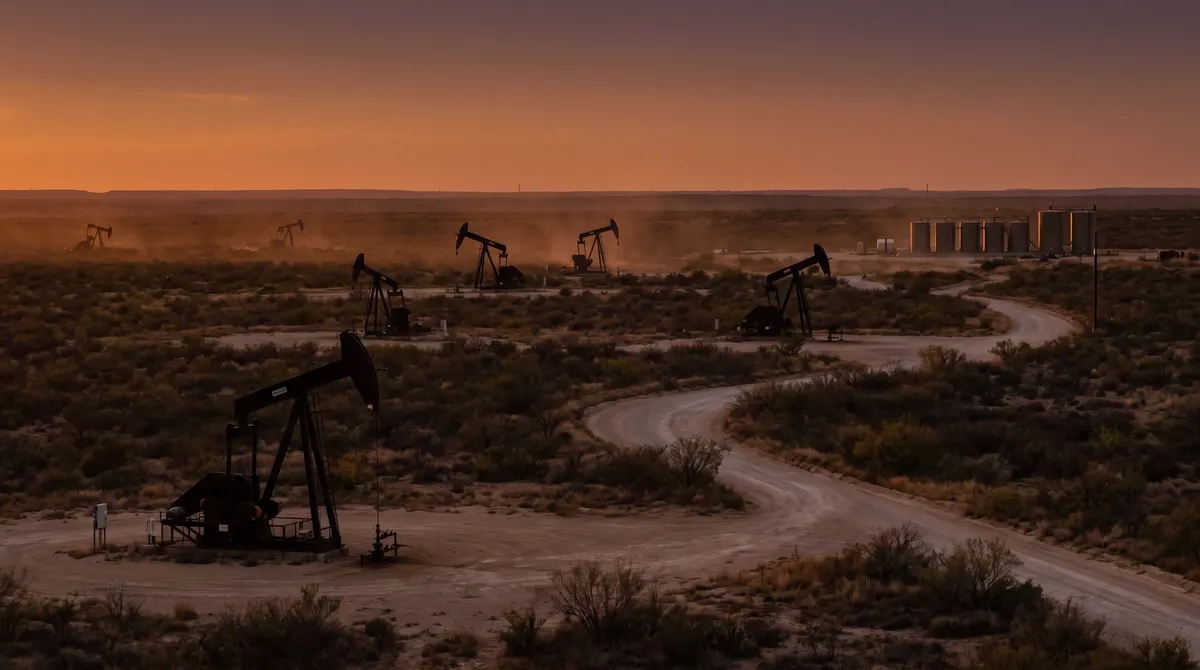
What Permian Basin wells produce
Permian wells produce crude oil first, with large volumes of associated natural gas and natural gas liquids. In December 2025, the basin's shale and tight formations produced 6.0 million barrels of oil per day, 44% of total US output, and 22.2 billion cubic feet of dry natural gas per day, 19% of US marketed gas (EIA, 2026). The Wolfcamp, Spraberry and Bone Spring together accounted for 5.7 million barrels per day of that oil (EIA, 2026).
The Wolfcamp is the largest single play and produced 3.4 million barrels per day in 2024 (EIA, 2025). It extends under all three subdivisions of the basin and is split into four benches, Wolfcamp A through D (EIA, 2022). The Spraberry sits above it in the Midland Basin, the Bone Spring above it in the Delaware Basin, and the thin Dean formation lies between the Spraberry and the Wolfcamp (EIA, 2026). Older conventional zones such as the San Andres, Clear Fork and Yates still produce from shallower depths, and the Railroad Commission notes that Permian production comes from a few hundred feet to about five miles down.
For a mineral rights owner, this means one tract can carry royalty from several zones and from wells of very different ages. Your royalty statement may show oil, gas and NGL line items from the same well.
Why mineral rights buyers compete in the Permian Basin
Buyers compete here because the rock gives them more wells per tract and a longer drilling runway than other basins. Stacked benches mean an operator can drill the Wolfcamp A, then come back for the Wolfcamp B, a Spraberry bench or a Bone Spring interval under the same acreage. Each new horizontal well adds royalty, so a buyer of Permian Basin mineral rights is paying for future wells as much as current ones.
The other draw is data. Permit filings, rig moves and production reports are public, so a buyer can see which tracts sit in the path of development. That transparency brings many independent mineral rights buyers into the same counties, which works in your favor if you let them compete for your mineral rights.
What Permian Basin mineral rights are worth
Producing mineral rights are usually priced as a multiple of recent monthly royalty income, adjusted for how fast the wells are declining and how many undrilled benches remain. A tract with new permits or a fresh pad under construction draws stronger offers than one where the operator has moved on.
Non-producing mineral rights are priced per net mineral acre. Buyers look at distance to active rigs, whether the tract is leased and at what royalty rate, which sub-basin and county it is in, and how thick the target benches are there. The same acreage can be worth far more in Loving County than in a county on the basin's edge.
Buyers verify everything before they offer. In Texas they pull drilling permits, production data and the public GIS viewer from the Railroad Commission of Texas; in New Mexico they use the Oil Conservation Division, which regulates oil and gas activity in the state, permits new wells and collects well production data. They also read county deed records, your lease and your division orders. Having those documents ready speeds up every offer on your mineral rights.
How to sell Permian Basin mineral rights
Start by filling in the short form with your county, your interest type and whether it produces. Your request goes to up to three independent buyers who are active in that county. Each buyer makes an offer on its own, and you compare them side by side.
You decide what happens next. Accept the strongest offer, counter it, or keep your mineral rights if none of the numbers is right. Owners pay nothing to use the service; buyers pay for the introduction. We do not buy minerals ourselves, so there is no house offer to steer you toward. When you are ready to sell mineral rights, competition is the simplest way to find out what they are worth.
How to get offers for Permian Basin mineral rights
Tell us the state and county and what you own. We send your request to up to 3 mineral rights buyers who purchase in that part of the Permian Basin. They review the public records and contact you with offers, and you choose whether to sell, sell part, or keep.
Permian Basin mineral rights questions
Should I sell Permian Basin mineral rights or keep them?
That depends on your royalty, your tax position and how much drilling is left under your tract. If you need a lump sum, want to simplify an estate, or own a small interest that costs more to track than it pays, selling can make sense. Compare several offers before deciding, so the number you are weighing is a real market price for your mineral rights.
Do I have to sell all of my mineral rights?
No. Many owners sell a share and keep the rest, or sell the royalty on current wells and keep the deeper rights. Tell buyers what you want to keep and ask them to price that structure.
How long does it take to sell mineral rights in the Permian?
Offers usually arrive within days of your request. Closing takes longer because the buyer runs title at the county clerk and checks production at the Railroad Commission or the New Mexico Oil Conservation Division. Clean title and current division orders shorten that step.
Permian Basin mineral rights sources
- EIA, EIA refines estimates for Permian tight oil and shale gas production (March 2026)
- EIA, Ten counties in the Permian Basin account for 93% of U.S. oil production growth since 2020 (September 2025)
- EIA, Tight oil production in Permian drives growth in onshore U.S. Lower 48 states production (June 2025)
- EIA, Permian Basin Part 2: Wolfcamp and Spraberry shale plays of the Midland sub-basin, geology review (March 2022)
- Railroad Commission of Texas, Permian Basin information
- New Mexico Energy, Minerals and Natural Resources Department, Oil Conservation Division
Last reviewed October 13, 2026. This page is general information, not legal or tax advice. Facts come from the official sources listed above; confirm anything that matters to your sale with a qualified professional.
Get offers for your Permian Basin mineral rights
Free to you, no obligation. Your details go only to buyers active in your county.
Other basins and plays
Sell mineral rights in the Midland Basin, Sell mineral rights in the Delaware Basin, Sell mineral rights in the Bakken, Sell mineral rights in the Eagle Ford, Sell mineral rights in the SCOOP and STACK, Sell mineral rights in the DJ Basin, Sell mineral rights in the Powder River Basin, Sell mineral rights in the Marcellus and Utica, Sell mineral rights in the Anadarko Basin, Sell mineral rights in the San Joaquin Basin, Sell mineral rights in the Haynesville, Sell mineral rights in the Barnett Shale