Sell mineral rights in Arkansas
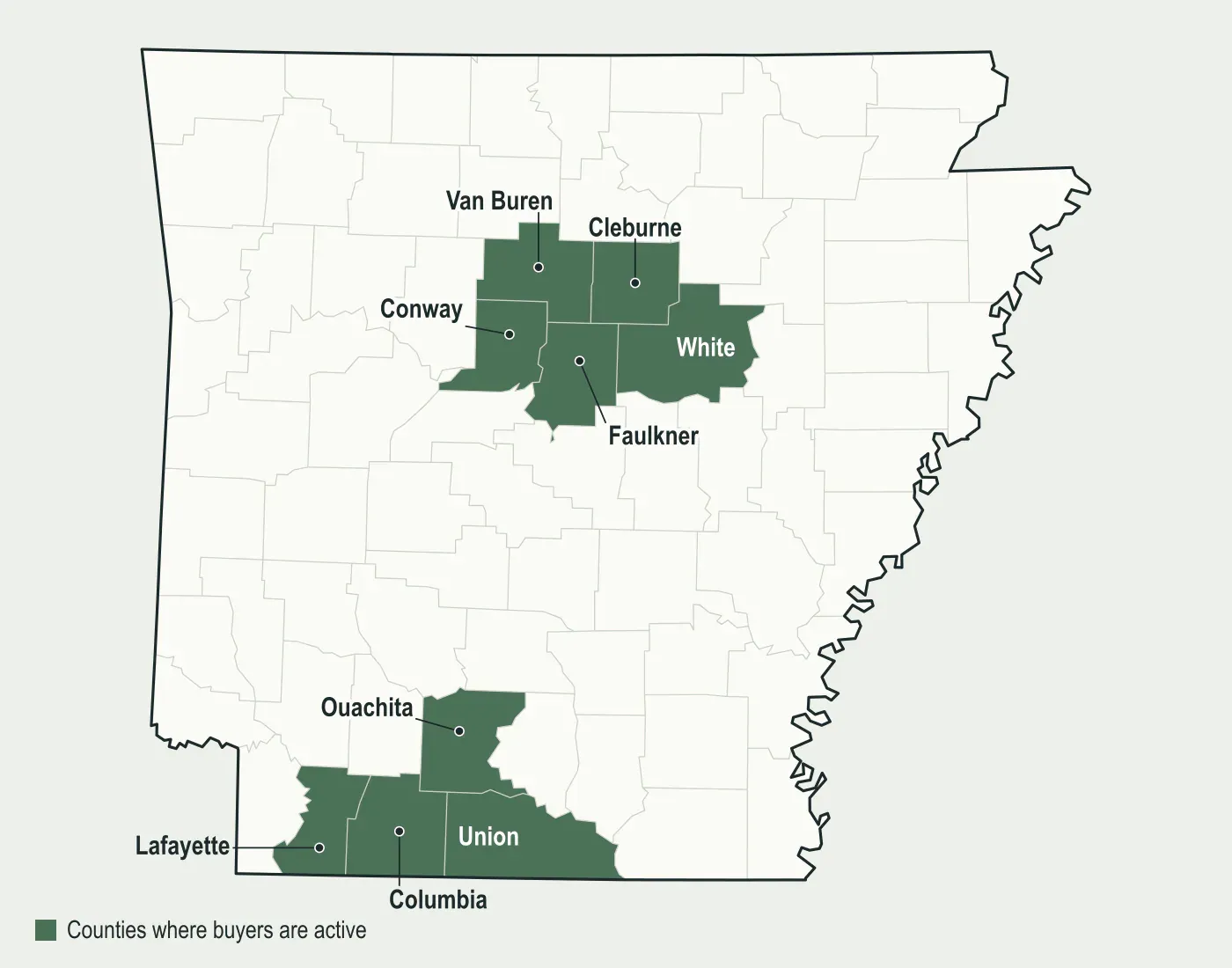
Arkansas has two separate mineral markets. North-central Arkansas is gas country: the Fayetteville Shale in Conway, Van Buren, White, Faulkner and Cleburne counties produced 745 billion cubic feet in 2016 (Arkansas Geological Survey) and still accounts for most of the state's 323 billion cubic feet of marketed gas in 2025 (EIA, 2025). South Arkansas is old oil country, where Union, Lafayette, Columbia and Ouachita counties have produced more than 85% of the state's oil (Arkansas Geological Survey). Buyers of Arkansas mineral rights treat the two very differently. If you want to sell mineral rights in Arkansas, here is what they look for in each.
Where buyers are most active in Arkansas
The Fayetteville Shale is the larger market by volume. The EIA assigns Cleburne, Conway, Faulkner, Independence, Searcy, Stone, Van Buren and White counties to the core of the play (EIA shale play county list), and the Arkansas Geological Survey dates its development to 2004, with 7.34 trillion cubic feet produced by 2016. Output has fallen since: Arkansas shale gas production dropped from 733 billion cubic feet in 2016 to 387 billion in 2021 (EIA). Fayetteville wells are horizontal dry-gas wells, so Arkansas mineral rights here pay royalties tied to gas prices and to how fast each well declines.
South Arkansas is the second market. Union, Lafayette, Columbia and Ouachita counties sit on the Smackover trend, where the Smackover field, discovered in 1922, had produced 606.6 million barrels by 2016 and the Magnolia field, discovered in 1938, 173.1 million (Arkansas Geological Survey). Most wells are stripper wells making under 10 barrels a day, and in 2016 the region's 356 fields produced 5.5 million barrels of oil. Statewide crude output was 4.0 million barrels in 2025 (EIA, 2025). Mineral rights here are mostly small royalties on long-lived wells.
The Arkoma Basin west of the Fayetteville counties produces dry gas from the Atoka Formation across 150 conventional gas fields (Arkansas Geological Survey). The Oil and Gas Commission also regulates brine production in south Arkansas alongside oil and gas. Outside these areas, Arkansas mineral rights rarely have wells on them, and offers for them are small.
What buyers check before an Arkansas mineral rights offer
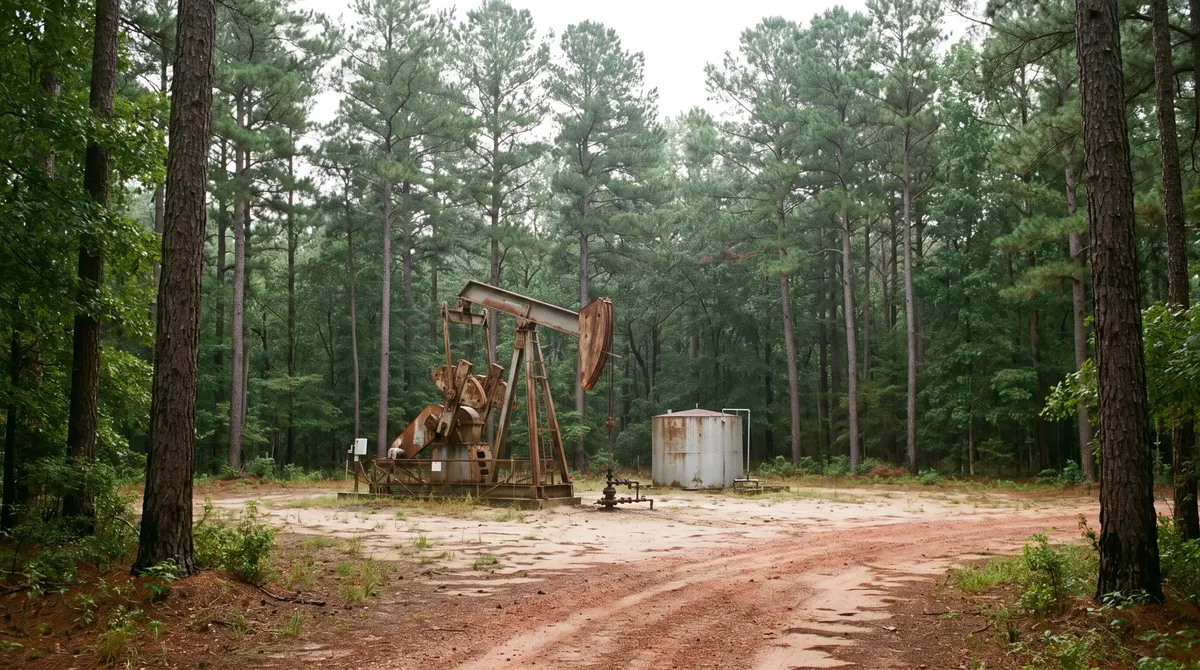
Buyers start with the Arkansas Oil and Gas Commission, which now sits inside the Arkansas Department of Energy and Environment. The Commission issues permits to drill, operate, produce and plug wells, and its online well data lets anyone look up a well by county, field, operator or well name and see its history and production. A buyer will check how many wells drain your tract, who operates them and how their output is trending before pricing your mineral rights.
Severance tax is the second check, because it comes out of royalty income. Arkansas taxes oil at 4% of market value when a well averages 10 barrels a day or less and 5% above that, plus small per-barrel charges (Arkansas Department of Finance and Administration). Natural gas is taxed at 1.25%, 1.5% or 5% depending on how the Commission classifies the well, and the first purchaser withholds it when the producer has no severance permit (Department of Finance and Administration). Arkansas also has an individual income tax.
Ownership is the third. In the Fayetteville counties, horizontal units pool many small tracts, so your decimal interest in the unit matters more than your acreage. In south Arkansas, decades of inheritance have split Arkansas mineral rights into tiny fractions, and buyers verify each one against recorded deeds and the operator's division order.
Arkansas mineral rights records and ownership
Mineral deeds, royalty deeds and oil and gas leases are recorded in the county where the land lies, and the chain of title has to reach you. For inherited Arkansas mineral rights, that means probate records or an affidavit of heirship connecting you to the last recorded owner. Many south Arkansas interests have passed through three or four generations, so this step is where sales slow down.
Your royalty statement and division order are the quickest proof of what you own. They name the operator, the unit or lease and your decimal interest, which is what every buyer needs to make a firm offer on mineral rights.
Non-producing mineral rights are valued on net mineral acres and nearness to activity. Producing mineral rights are valued on months of royalty income and the chance of more wells. In the Fayetteville Shale that chance depends on gas prices, which is why offers there move with the market.
Selling Arkansas mineral rights: leases, closing and taxes
The sale itself is a mineral or royalty deed recorded in the county. If your tract is leased or in a producing unit, the lease stays in place and the buyer takes over your royalty. Unleased acreage passes with the right to lease. Check the legal description so you convey only the tracts you intend to sell.
Ask a tax professional how a lump sum compares with years of royalty income taxed as ordinary income, especially for inherited mineral rights, where a stepped-up basis can reduce the gain.
To sell mineral rights in Arkansas through this site, tell us the county, the unit or well name if you know it, and your most recent royalty amount. We forward it to up to three independent buyers who work that county. Each one makes an offer, you compare them, and you take one or keep your mineral rights. You pay nothing.
How to get offers for Arkansas mineral rights
Tell us your county and what you own. We send your request to up to 3 buyers who purchase in that part of Arkansas. They review the public records and contact you with offers, and you choose whether to sell, sell part, or keep.
Arkansas mineral rights sources
- Arkansas Oil and Gas Commission (Department of Energy and Environment)
- Arkansas Geological Survey, Crude Oil in Arkansas
- Arkansas Geological Survey, Natural Gas in Arkansas
- EIA, shale play county list (Fayetteville counties)
- EIA, shale gas production by state
- Arkansas Department of Finance and Administration, oil severance tax
Last reviewed October 13, 2026. This page is general information, not legal or tax advice. Facts come from the official sources listed above; confirm anything that matters to your sale with a qualified professional.
Where Arkansas mineral rights buyers are active
Buyers concentrate on the counties below, where drilling is heaviest. Minerals elsewhere in Arkansas can still sell; send the details and we'll tell you if a buyer covers your area.
What you can sell in Arkansas
- Mineral rightsProducing or non-producing minerals, all or part of your interest.
- Royalty interestsWant to sell oil and gas royalties? See how buyers value a royalty interest or NPRI, what to have ready, and get offers from up to 3 buyers in your county.
- Overriding royalties (ORRI)Own an overriding royalty interest? Learn how ORRIs work, why lease expiry changes the price, which documents buyers need, and how to get offers.
- Inherited mineral rightsInherited mineral rights or oil and gas royalties? Learn how to get title in your name, why royalties go into suspense, and how to get buyer offers.
Arkansas mineral rights questions
Are Fayetteville Shale mineral rights still worth selling?
Yes, if they produce. The play's output has declined since 2016, but thousands of wells still pay royalties, and buyers make offers on them. Non-producing Arkansas mineral rights outside existing units draw little interest at current gas prices.
How do I find out whether there are wells on my Arkansas minerals?
Use the Oil and Gas Commission's online well data to search by county and operator, or by the well or unit name on your royalty statement. Each well record shows its status, history and production.
How long does it take to sell mineral rights in Arkansas?
Offers tend to arrive within days. Closing runs a few weeks if the deed is already in your name, longer if heirship must be proved first. Buyers of Arkansas mineral rights handle most of that paperwork.
Get offers for your Arkansas mineral rights
Free to you, no obligation. Your details go only to buyers active in your county.
Other states
Sell mineral rights in Texas, Sell mineral rights in Oklahoma, Sell mineral rights in New Mexico, Sell mineral rights in North Dakota, Sell mineral rights in Ohio, Sell mineral rights in Pennsylvania, Sell mineral rights in West Virginia, Sell mineral rights in Colorado, Sell mineral rights in Louisiana, Sell mineral rights in Wyoming, Sell mineral rights in Alabama, Sell mineral rights in Alaska, Sell mineral rights in California, Sell mineral rights in Florida, Sell mineral rights in Illinois, Sell mineral rights in Indiana, Sell mineral rights in Kansas, Sell mineral rights in Kentucky, Sell mineral rights in Michigan, Sell mineral rights in Mississippi, Sell mineral rights in Montana, Sell mineral rights in Nebraska, Sell mineral rights in New York, Sell mineral rights in South Dakota, Sell mineral rights in Tennessee, Sell mineral rights in Utah, Sell mineral rights in Virginia