Sell mineral rights in the Marcellus and Utica
The Marcellus and Utica shales make Appalachia the largest natural gas region in the country, and Marcellus and Utica mineral rights are bought and sold across Pennsylvania, West Virginia and Ohio every week. In 2025, Appalachia produced 36.6 billion cubic feet of gas per day, 31 percent of all US marketed production (EIA, 2026). Most of it comes from two stacked formations, the Marcellus and the deeper Utica and Point Pleasant.
This page explains where each play lies, which counties carry the production, what the wells yield, how buyers price Marcellus and Utica mineral rights, and how to get offers from buyers already working in your county.
Where the Marcellus and Utica lie and which counties matter
The Marcellus runs under most of Pennsylvania and West Virginia and into eastern Ohio. Four Pennsylvania counties, Susquehanna, Washington, Bradford and Greene, produced 40 percent of Appalachian Basin gas in 2022, about 13.9 billion cubic feet per day (EIA, 2023). Susquehanna has led the four since 2014, and the other three each produced more than 3.0 billion cubic feet per day in 2022 (EIA, 2023). Marcellus mineral rights in those four counties change hands most often.
In West Virginia, horizontal Marcellus wells produced over 2.7 trillion cubic feet of gas in 2023, and Tyler County led with 659 billion cubic feet from 555 reporting wells (WVGES, 2024). Tyler and Marshall counties together supplied 49.2 percent of the state's Marcellus liquids that year, with Wetzel, Ohio, Doddridge, Brooke and Ritchie behind them (WVGES, 2024).
The Utica and Point Pleasant play covers about 60,000 square miles, with its most productive areas in eastern Ohio and western Pennsylvania (EIA, 2016). Ohio's horizontal wells reported about 2.1 trillion cubic feet of gas in 2025; Belmont, Jefferson, Harrison and Monroe supplied roughly four fifths of it, while Guernsey, Harrison and Carroll led on oil (ODNR, 2025). New York prohibited high-volume hydraulic fracturing in June 2015 (NY DEC), so Utica mineral rights there draw little buyer interest.
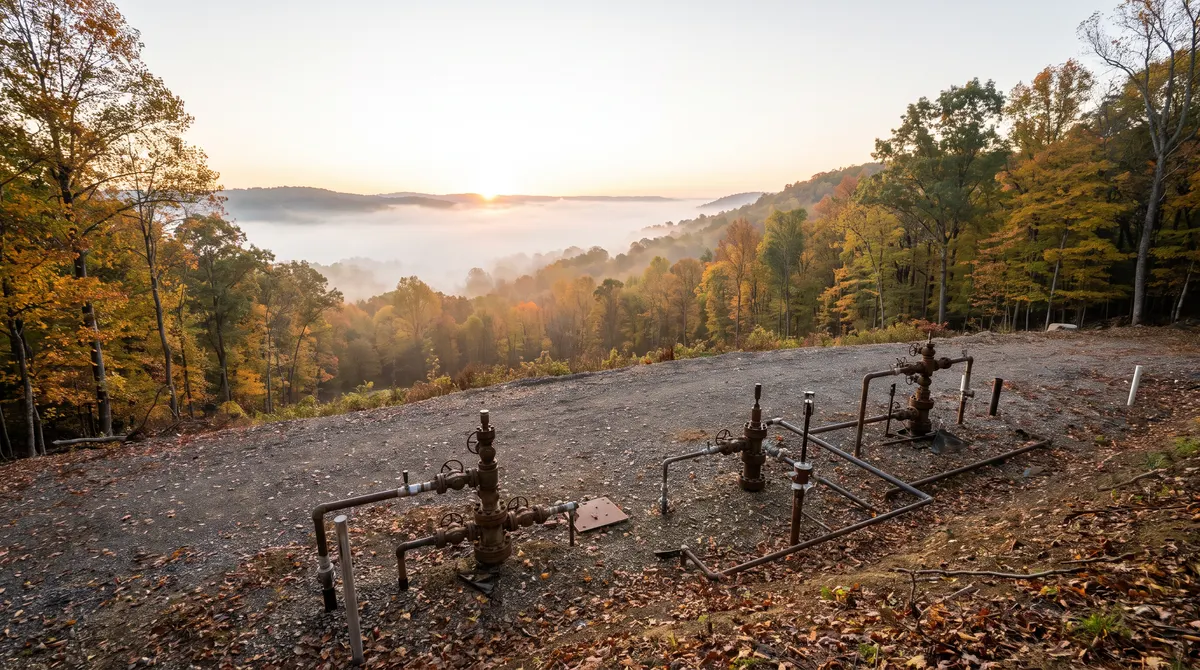
What Marcellus and Utica wells produce
Marcellus wells produce natural gas, and in some areas natural gas liquids. The formation is mainly dry gas in northeast Pennsylvania but turns liquids-rich in southwestern Pennsylvania, northern West Virginia and southeastern Ohio (EIA, 2017). A Susquehanna County royalty check is almost all gas; a Washington or Tyler County check often adds liquids.
The Utica and Point Pleasant interval sits below the Marcellus, and operators usually target the more productive Point Pleasant (EIA, 2016). Oil-rich wells lie in the shallower western part of the play and gas-rich wells in the deeper eastern part (EIA, 2017), which is why Guernsey and Carroll report oil and condensate while Belmont, Monroe and West Virginia's Marshall County wells are mostly dry gas (WVGES, 2024).
For an owner, this means Marcellus mineral rights under a tract can be leased, drilled and paid separately from the Utica below. Read your lease to see which depths it covers.
Why mineral rights buyers compete in the Marcellus and Utica
Buyers compete here because the wells are large and two formations can be drilled from one pad. A buyer of Marcellus and Utica mineral rights in Belmont County is pricing Point Pleasant laterals today and the Marcellus above them tomorrow.
Pipeline capacity is the other driver. Appalachian output grew only 46 million cubic feet per day in 2024 because of limited takeaway, then 1.1 billion cubic feet per day in 2025 after the Mountain Valley Pipeline opened and prices rose (EIA, 2026). When new capacity opens, drilling follows, and buyers try to pick up mineral rights ahead of it.
Data is the third reason. Every well, permit and production report is public, so a buyer can see which units are being drilled and which mineral rights are next.
What Marcellus and Utica mineral rights are worth
Producing mineral rights are priced as a multiple of recent monthly royalty income, adjusted for decline, the gas price the operator realizes after transport deductions, and whether more laterals are planned on the unit. Gas royalties swing with price, so buyers read a full year of checks.
Non-producing mineral rights trade per net mineral acre, and the price depends on the county, which window the tract sits in, whether it is already leased and at what royalty, and how close it is to active pads. Unleased Marcellus mineral rights in a core Susquehanna or Greene County unit price very differently from a tract on the play's edge.
Buyers check the records before they bid: in Pennsylvania the DEP Office of Oil and Gas Management's eFacts and mapping tools; in West Virginia the DEP Office of Oil and Gas well database and map search; in Ohio the DNR Division of Oil and Gas Resources Management, which posts horizontal well production every quarter. They also pull county deed records, your lease and your division orders, so have them ready before you sell mineral rights.
How to sell Marcellus and Utica mineral rights
Submit the short form with your county, interest type and whether it is producing. Your request goes to up to three independent buyers active in that county, and each sends its own offer.
Compare them side by side, then accept, counter or keep your mineral rights. You pay nothing at any stage; buyers cover the cost of the introduction. We never buy minerals ourselves, so competition between buyers is what sets the price. A tax professional can help you weigh a lump sum against years of royalty.
How to get offers for Marcellus and Utica mineral rights
Tell us the state and county and what you own. We send your request to up to 3 mineral rights buyers who purchase in that part of the Marcellus and Utica. They review the public records and contact you with offers, and you choose whether to sell, sell part, or keep.
Marcellus and Utica mineral rights questions
Are Marcellus mineral rights sold together with the Utica?
Often, but not always. Many owners sell all depths in one deed. Others sell the Marcellus royalty and keep the deeper Utica mineral rights, or the reverse. Say what you want to keep, and buyers will price the rest.
What are Marcellus and Utica mineral rights worth if my wells are only a few years old?
Younger wells usually draw stronger offers for mineral rights because less of the recoverable gas has been produced. The buyer will still discount for the steep early decline of shale wells, so expect offers based on a trailing year of royalty.
I own mineral rights in New York. Can I still sell?
You can sell, but demand is thin. New York's 2015 Findings Statement prohibits high-volume hydraulic fracturing, which is what shale wells need (NY DEC). Buyers who do look at New York mineral rights price them for conventional wells or option value.
Marcellus and Utica mineral rights sources
- EIA, U.S. natural gas production reached a new record in 2025 (March 2026)
- EIA, 2022 Appalachian natural gas production flat with productivity declines in key counties (July 2023)
- West Virginia Geological and Economic Survey, 2023 Marcellus Shale and Utica-Point Pleasant Production Summary (September 2024)
- Ohio DNR Division of Oil and Gas Resources Management, oil and gas production reports
- Pennsylvania DEP, Office of Oil and Gas Management
- New York DEC, High-volume hydraulic fracturing
Last reviewed October 13, 2026. This page is general information, not legal or tax advice. Facts come from the official sources listed above; confirm anything that matters to your sale with a qualified professional.
Get offers for your Marcellus and Utica mineral rights
Free to you, no obligation. Your details go only to buyers active in your county.
Other basins and plays
Sell mineral rights in the Permian Basin, Sell mineral rights in the Midland Basin, Sell mineral rights in the Delaware Basin, Sell mineral rights in the Bakken, Sell mineral rights in the Eagle Ford, Sell mineral rights in the SCOOP and STACK, Sell mineral rights in the DJ Basin, Sell mineral rights in the Powder River Basin, Sell mineral rights in the Anadarko Basin, Sell mineral rights in the San Joaquin Basin, Sell mineral rights in the Haynesville, Sell mineral rights in the Barnett Shale