Sell mineral rights in Utah
Utah is a growing oil state with one basin doing most of the work. Duchesne and Uintah counties in the Uinta Basin produced 63.3 million of the state's 67.9 million barrels in 2025 (Utah Division of Oil, Gas and Mining, 2025). That concentration shapes the market for Utah mineral rights. Buyers compete hard for private acreage in those two counties and look at everything else case by case. If you plan to sell mineral rights in Utah, here is where the activity is, what buyers verify and what the state's tax rules mean for your sale.
Where buyers are most active in Utah
Duchesne County leads, with 47.0 million barrels of oil in 2025, up from 29.1 million in 2022 (Division of Oil, Gas and Mining, 2025). Uintah County produced 16.3 million barrels and 196.9 million mcf of gas, making it the state's top gas county by a wide margin (Division of Oil, Gas and Mining, 2025). The Utah Geological Survey names Bluebell and Altamont as the basin's landmark oil fields, and the Bureau of Land Management describes the Uintah Basin as the main source of Utah's crude. Horizontal wells drove the recent growth, so Utah mineral rights near new permits in these two counties draw the strongest offers.
San Juan County in the Paradox Basin is the second oil area, with 3.2 million barrels in 2025 from older fields that include Greater Aneth (Utah Geological Survey). Grand County produced about 112,000 barrels and 3.3 million mcf of gas. Carbon and Emery counties produce gas rather than oil: 27.7 million and 4.7 million mcf in 2025 (Division of Oil, Gas and Mining, 2025). Mineral rights in these counties sell, but buyers price them on existing wells rather than on a drilling outlook.
Central and northern Utah have smaller pockets. Sevier County produced about 919,000 barrels in 2025 from the Covenant field area in the central Utah thrust belt, and Summit County about 140,000 barrels from the Anschutz Ranch East area (Division of Oil, Gas and Mining, 2025; Utah Geological Survey). Statewide marketed gas reached 336.5 billion cubic feet in 2025 (EIA, 2025). Outside the counties above, Utah mineral rights rarely have wells on them, and offers reflect that.
What buyers check before a Utah mineral rights offer
Buyers start with the Division of Oil, Gas and Mining's Data Explorer, which searches wells by API number, well name, operator, township or range, and its Well Production Information tool, which carries monthly oil and gas production back to 1984. Spacing orders and permits sit with the Board of Oil, Gas and Mining. Any buyer can see how many wells drain your mineral rights and what they made last month.
Ownership is the second check, and in Utah it is unusually mixed. The state's severance tax statute exempts production interests held by the United States, the state and qualifying Indian tribes (Utah Code 59-5-102, 2025), which tells you how much of the Uinta Basin is federal, state or tribal. Privately held mineral rights inside a unit with those neighbors are scarcer, and buyers verify your net mineral acres and decimal interest against the recorded deeds and the operator's division order before pricing.
Taxes are the third. Utah's severance tax is 3% of the taxable value of oil up to $13 per barrel and 5% above that, and 3% of gas up to $1.50 per mcf and 5% above, with stripper wells and the first months of new wells exempt (Utah Code 59-5-102, 2025). Utah also taxes personal income at a flat 4.5% for tax year 2025 (Utah State Tax Commission). Both come out of what Utah mineral rights earn, so buyers build them into offers.
Utah mineral rights records and ownership
Mineral deeds, royalty deeds and oil and gas leases are recorded with the county recorder in the county where the land lies (Utah Code 57-3-101). A buyer traces the chain of title from the last recorded deed to you. If you inherited Utah mineral rights, expect to supply the probate order or affidavit that connects you to the prior owner.
If you already receive royalty checks, the operator's payment statement is your fastest proof of ownership. The Division of Oil, Gas and Mining advises royalty owners to take payment questions to the operator first and to the Board of Oil, Gas and Mining for mediation if that fails. A buyer will ask for your last few statements to confirm which wells pay your mineral rights.
Non-producing mineral rights are valued on net mineral acres and nearness to permits; producing ones on months of royalty income and the drilling outlook. Identical mineral rights in Duchesne County can be worth far more than in Emery County for that reason alone.
Selling Utah mineral rights: leases, closing and taxes
A Utah sale closes when the buyer records a mineral or royalty deed. An existing lease stays in force and the buyer takes over your royalty; unleased acreage passes with the right to lease, which is why unleased Uinta Basin acreage draws stronger offers.
Ask a tax professional how a lump sum compares with years of royalty income taxed at ordinary rates, especially for inherited mineral rights, where a stepped-up basis can reduce the taxable gain.
To sell mineral rights in Utah through this site, tell us the county, the well or unit name if you know it, and your most recent royalty amount. Your request goes to up to three independent buyers working in that county. They make offers, you compare them, and you can accept one or keep your mineral rights. You pay nothing at any stage.
How to get offers for Utah mineral rights
Tell us your county and what you own. We send your request to up to 3 buyers who purchase in that part of Utah. They review the public records and contact you with offers, and you choose whether to sell, sell part, or keep.
Utah mineral rights sources
- Utah Division of Oil, Gas and Mining, Oil and Gas Program
- Utah Division of Oil, Gas and Mining, oil production by county
- Utah Division of Oil, Gas and Mining, gas production by county
- Utah Geological Survey, Crude Oil
- Utah Code 59-5-102, severance tax on oil and gas
- Utah State Tax Commission, income tax rates
Last reviewed October 13, 2026. This page is general information, not legal or tax advice. Facts come from the official sources listed above; confirm anything that matters to your sale with a qualified professional.
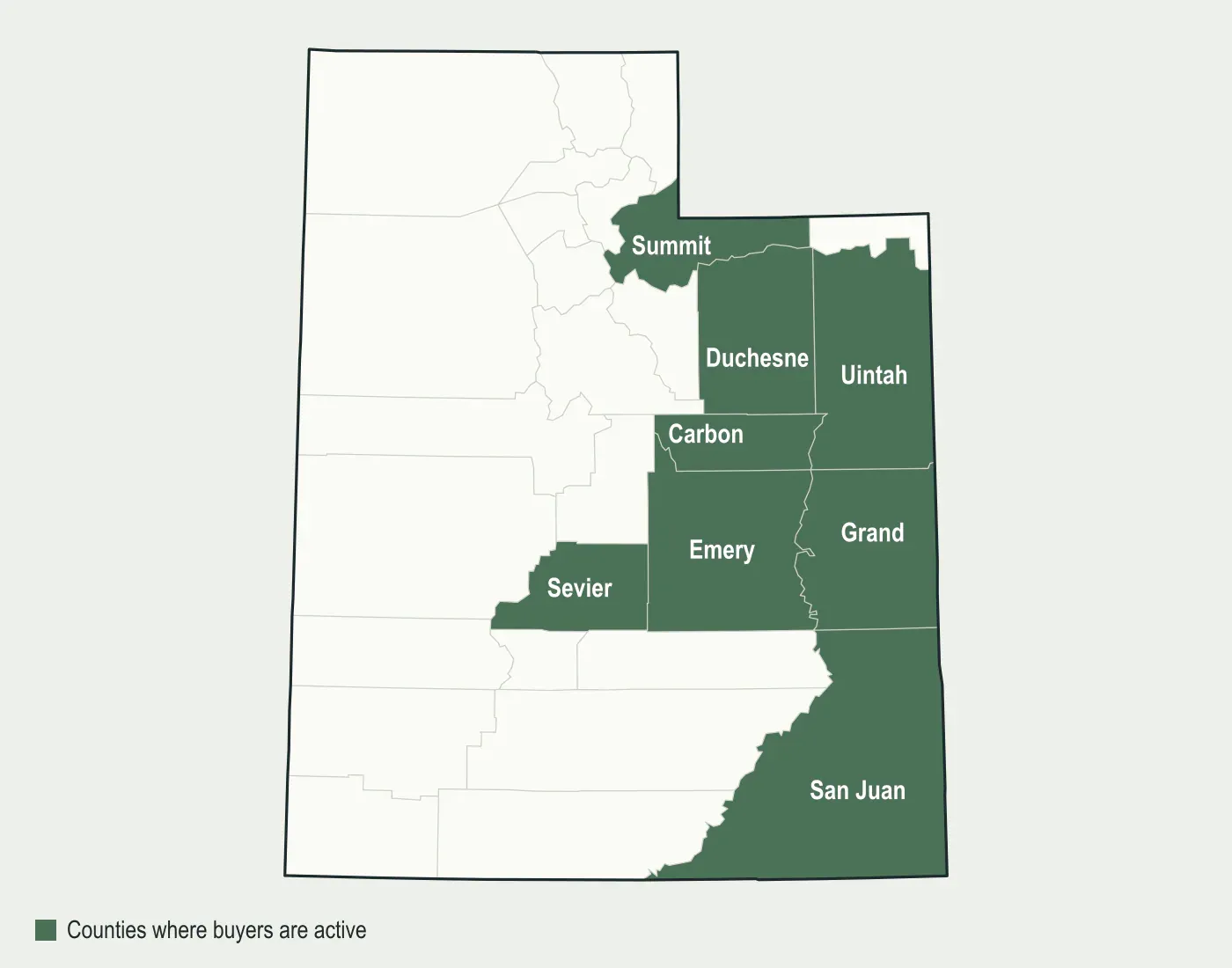
Where Utah mineral rights buyers are active
Buyers concentrate on the counties below, where drilling is heaviest. Minerals elsewhere in Utah can still sell; send the details and we'll tell you if a buyer covers your area.
What you can sell in Utah
- Mineral rightsProducing or non-producing minerals, all or part of your interest.
- Royalty interestsWant to sell oil and gas royalties? See how buyers value a royalty interest or NPRI, what to have ready, and get offers from up to 3 buyers in your county.
- Overriding royalties (ORRI)Own an overriding royalty interest? Learn how ORRIs work, why lease expiry changes the price, which documents buyers need, and how to get offers.
- Inherited mineral rightsInherited mineral rights or oil and gas royalties? Learn how to get title in your name, why royalties go into suspense, and how to get buyer offers.
Utah mineral rights questions
Are Utah mineral rights outside the Uinta Basin worth selling?
San Juan County minerals with producing wells sell readily. Carbon and Emery gas royalties and Sevier, Summit and Grand County mineral rights also get offers, but smaller ones. Non-producing acreage far from any permit is hard to sell at any price.
How do I see the wells on my Utah minerals?
Use the Division of Oil, Gas and Mining's Data Explorer to search by well name, operator or township and range, then open Well Production Information for monthly volumes. Your royalty statement lists the well names to look up.
How long does it take to sell mineral rights in Utah?
Offers usually come within days. Closing takes a few weeks when the deed is already in your name, and longer when probate or an affidavit of heirship is needed first. The buyer handles most of the paperwork, but gathering your documents early shortens the timeline for Utah mineral rights.
Get offers for your Utah mineral rights
Free to you, no obligation. Your details go only to buyers active in your county.
Other states
Sell mineral rights in Texas, Sell mineral rights in Oklahoma, Sell mineral rights in New Mexico, Sell mineral rights in North Dakota, Sell mineral rights in Ohio, Sell mineral rights in Pennsylvania, Sell mineral rights in West Virginia, Sell mineral rights in Colorado, Sell mineral rights in Louisiana, Sell mineral rights in Wyoming, Sell mineral rights in Alabama, Sell mineral rights in Alaska, Sell mineral rights in Arkansas, Sell mineral rights in California, Sell mineral rights in Florida, Sell mineral rights in Illinois, Sell mineral rights in Indiana, Sell mineral rights in Kansas, Sell mineral rights in Kentucky, Sell mineral rights in Michigan, Sell mineral rights in Mississippi, Sell mineral rights in Montana, Sell mineral rights in Nebraska, Sell mineral rights in New York, Sell mineral rights in South Dakota, Sell mineral rights in Tennessee, Sell mineral rights in Virginia