Sell mineral rights in New York
New York mineral rights come with a fact most other states do not have: high-volume hydraulic fracturing is prohibited. The Department of Environmental Conservation banned it in a Findings Statement on June 29, 2015, and the Legislature wrote the ban into law in 2020 (DEC; Environmental Conservation Law 23-0501). The Marcellus and Utica shales under the Southern Tier cannot be developed the way they are in Pennsylvania, so buyers price New York mineral rights on the conventional gas and oil wells that already exist. Those wells are real, mostly in the western counties, and mineral rights under them can be sold. When you sell mineral rights in New York through this site, your request goes to up to three independent buyers active in your county, and you pay nothing.
Where buyers are most active in New York
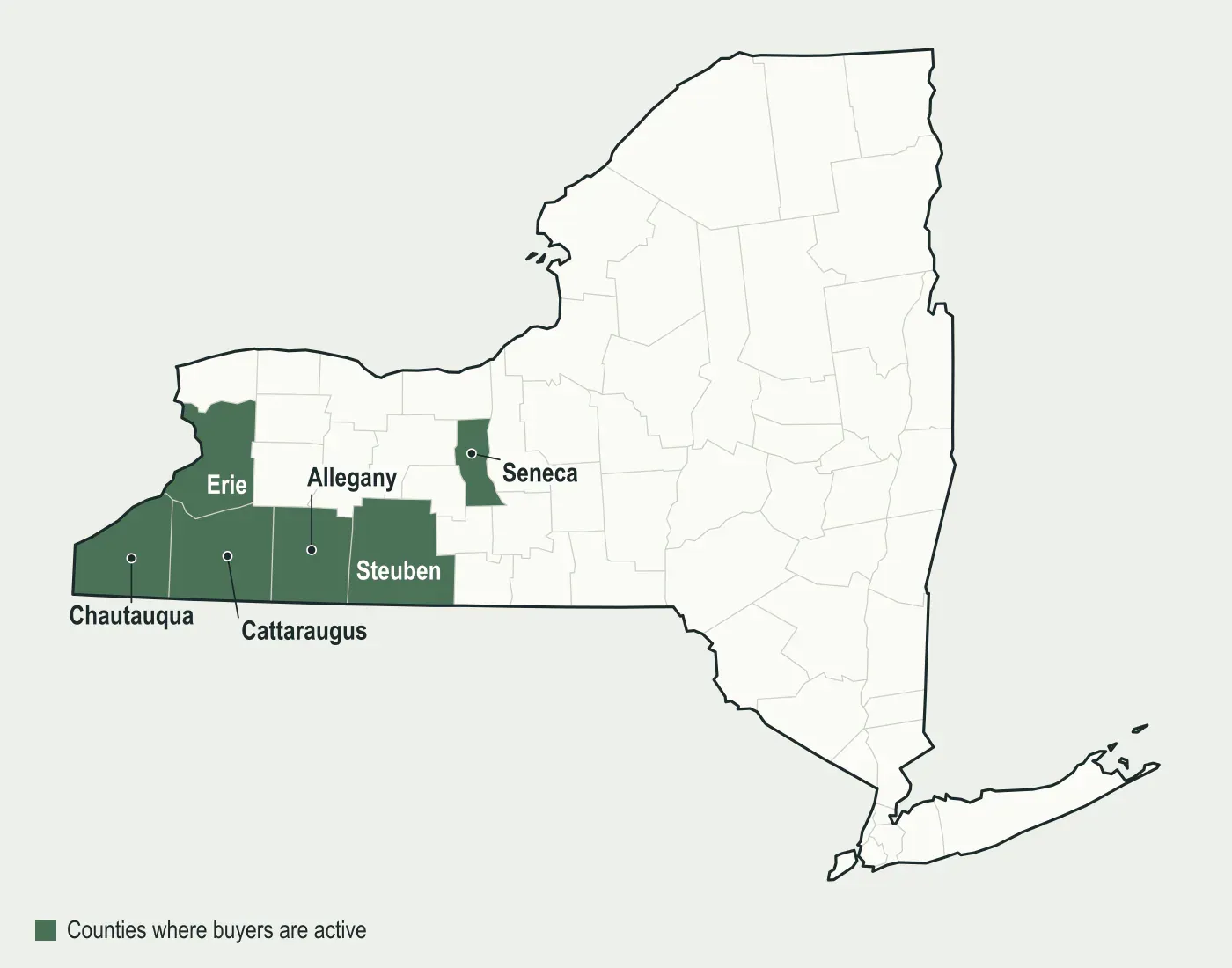
Western New York is where the wells are. In 2024, Chautauqua County's 4,291 reporting wells produced 3,011,853 thousand cubic feet of gas, the most in the state, followed by Steuben County at 1,307,590, Erie County at 1,054,131, Cattaraugus County at 858,028 and Seneca County at 527,999 thousand cubic feet (DEC annual production data on data.ny.gov, 2024). Cattaraugus County is also the oil county, with 163,422 barrels in 2024, far ahead of Chautauqua, Allegany and Steuben, which each produced between 12,000 and 16,000 barrels (DEC annual production data, 2024). Allegany County's 2,649 reporting wells are mostly old, shallow oil wells, and mineral rights there sell on small, steady checks.
The scale is small and falling. Statewide gas production was 8.29 billion cubic feet in 2023, down about 12.5 percent from the year before, and oil production was 251,397 barrels, down about 5.5 percent (DEC, 2023). The Medina Group supplied nearly 51 percent of 2023's gas and the Trenton-Black River about 18 percent (DEC, 2023). Buyers of New York mineral rights are therefore buying a known, declining royalty, which is why the market is narrow and offers are modest.
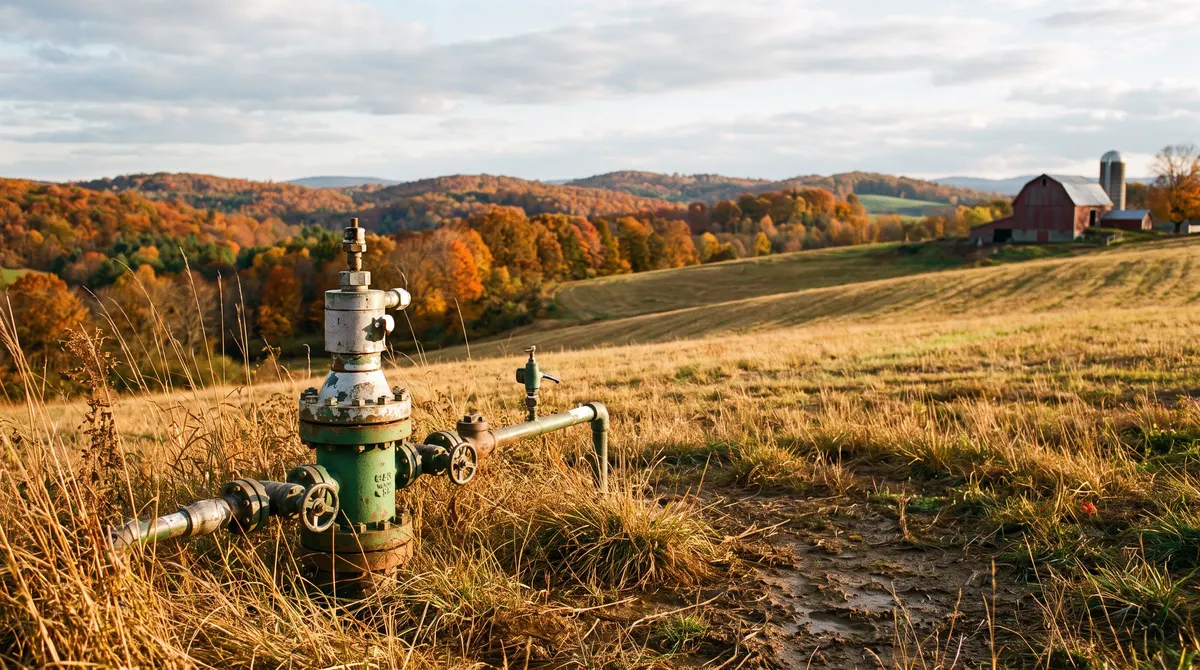
What buyers check before a New York mineral rights offer
Buyers start at the Division of Mineral Resources, the DEC unit that regulates the drilling and operation of oil, natural gas, underground gas storage and solution mining wells. Its DECinfo Locator map links each well to its records, and its annual production files list every well's gas, oil and water volumes by county, operator, field and formation (DEC). A buyer will find the wells on your mineral rights, read their production history and check whether the operator is plugging wells nearby.
Then comes your paperwork. A New York mineral rights offer depends on your lease royalty, whether the lease is held by production, and a year or two of check detail. If your mineral rights were never leased but sit inside a spacing unit, you were likely integrated under the state's compulsory integration law. Under Environmental Conservation Law 23-0901, an uncontrolled owner can elect to be an integrated participating owner, a non-participating owner or a royalty owner; an owner who makes no election becomes an integrated royalty owner and receives the lowest royalty in an existing lease in the unit, but no less than one-eighth (ECL 23-0901). That one-eighth is the floor a buyer will assume if your file is thin.
Buyers also ask what the fracking ban means for your acreage. Under ECL 23-0501, no permits may be issued for wells that use high-volume hydraulic fracturing, defined as 300,000 gallons or more of water as the base fluid, or carbon dioxide, to complete or recomplete gas or oil wells, and applications for gelled propane fracturing are on hold until DEC finishes an impact analysis (ECL 23-0501). Unleased Marcellus mineral rights in the Southern Tier, which had buyers lining up fifteen years ago, have little drilling value today, and an honest offer will say so.
New York mineral rights records and property tax
A conveyance of real property, including a mineral deed, is recorded in the office of the clerk of the county where the property is situated, once the signer has acknowledged it (Real Property Law 291). That county clerk's office is where a buyer checks the chain of title to your mineral rights, and where the deed you sign at closing is filed.
New York taxes producing wells as real property in an unusual way. Oil and gas economic units are assessed in the name of the producer, and each assessor computes the value by multiplying a state-set unit of production value by the unit's production (Real Property Tax Law 594). The producer is the taxpayer, but the cost reaches royalty owners through the economics of the well, so buyers of mineral rights read the assessment roll too.
Selling New York mineral rights: taxes and closing
New York taxes personal income at rates starting at 4 percent and rising to 10.9 percent on income over $25 million (Tax Law 601), so a sale of mineral rights can be taxed by the state as well as the federal government. Ask a tax professional how a lump sum compares with continued royalty income.
Closing is a normal deed transaction. The buyer prepares a mineral deed or an assignment of your royalty, you sign before a notary, the document is recorded with the county clerk, and payment follows recording. If you inherited the mineral rights, expect a request for the surrogate's court papers. Because the market is narrow, owners who sell mineral rights in New York through this site compare every offer before choosing, and no offer has to be accepted.
How to get offers for New York mineral rights
Tell us your county and what you own. We send your request to up to 3 buyers who purchase in that part of New York. They review the public records and contact you with offers, and you choose whether to sell, sell part, or keep.
New York mineral rights sources
- New York State DEC: oil and gas (Division of Mineral Resources)
- New York State DEC: 2023 summary and trends, oil, gas and solution mining
- New York State DEC: high-volume hydraulic fracturing in New York State
- Environmental Conservation Law 23-0501: prohibition on permits for high-volume hydraulic fracturing
- Environmental Conservation Law 23-0901: compulsory integration
- New York open data: oil and gas annual production, beginning 2001 (DEC)
Last reviewed October 13, 2026. This page is general information, not legal or tax advice. Facts come from the official sources listed above; confirm anything that matters to your sale with a qualified professional.
Where New York mineral rights buyers are active
Buyers concentrate on the counties below, where drilling is heaviest. Minerals elsewhere in New York can still sell; send the details and we'll tell you if a buyer covers your area.
What you can sell in New York
- Mineral rightsProducing or non-producing minerals, all or part of your interest.
- Royalty interestsWant to sell oil and gas royalties? See how buyers value a royalty interest or NPRI, what to have ready, and get offers from up to 3 buyers in your county.
- Overriding royalties (ORRI)Own an overriding royalty interest? Learn how ORRIs work, why lease expiry changes the price, which documents buyers need, and how to get offers.
- Inherited mineral rightsInherited mineral rights or oil and gas royalties? Learn how to get title in your name, why royalties go into suspense, and how to get buyer offers.
New York mineral rights questions
Are New York mineral rights worth anything now that fracking is banned?
Producing ones, yes. A royalty from a conventional Medina gas well in Chautauqua County or an oil lease in Cattaraugus County pays every month and can be sold for a multiple of that income. Unleased shale acreage with no wells has little drilling value under the ban, and most buyers will not make an offer on it.
Who regulates oil and gas wells in New York?
The Department of Environmental Conservation's Division of Mineral Resources. It permits and regulates oil, gas, storage and solution mining wells, publishes annual production by well, and runs the DECinfo Locator map buyers use to find the wells on your mineral rights.
How do I sell mineral rights in New York through this site?
Fill in the form with your county and what you own, such as a royalty under a producing lease or inherited mineral rights. Up to three independent buyers active in that county receive the request and can each send an offer. You pay nothing, and you can decline every offer.
Get offers for your New York mineral rights
Free to you, no obligation. Your details go only to buyers active in your county.
Other states
Sell mineral rights in Texas, Sell mineral rights in Oklahoma, Sell mineral rights in New Mexico, Sell mineral rights in North Dakota, Sell mineral rights in Ohio, Sell mineral rights in Pennsylvania, Sell mineral rights in West Virginia, Sell mineral rights in Colorado, Sell mineral rights in Louisiana, Sell mineral rights in Wyoming, Sell mineral rights in Alabama, Sell mineral rights in Alaska, Sell mineral rights in Arkansas, Sell mineral rights in California, Sell mineral rights in Florida, Sell mineral rights in Illinois, Sell mineral rights in Indiana, Sell mineral rights in Kansas, Sell mineral rights in Kentucky, Sell mineral rights in Michigan, Sell mineral rights in Mississippi, Sell mineral rights in Montana, Sell mineral rights in Nebraska, Sell mineral rights in South Dakota, Sell mineral rights in Tennessee, Sell mineral rights in Utah, Sell mineral rights in Virginia