Sell mineral rights in the Powder River Basin
The Powder River Basin is Wyoming's main oil basin, and Powder River Basin mineral rights draw buyers for a simple reason: horizontal wells keep opening new oil zones under the same acreage. The basin is an asymmetric trough about 250 miles long and 100 miles wide across northeast Wyoming and southeast Montana (Wyoming State Geological Survey). It has produced more than half of Wyoming's oil every year since 2014 and over 70 percent of it from 2022 through 2024 (WSGS).
This page covers where the basin lies, which counties see the drilling, what the wells produce, how buyers price Powder River Basin mineral rights, and how to get competing offers from buyers who already work in your county.
Where the Powder River Basin lies and which counties matter
The basin covers more than 43,000 square miles, with small corners in South Dakota and Nebraska, and the oil resurgence is concentrated in the Wyoming portion (EIA, 2014).
Converse and Campbell counties are the center of activity. In 2024, Converse County produced 40.5 percent of Wyoming's oil and Campbell County produced 23.0 percent, out of a state total of 106.6 million barrels (WSGS, 2024). Johnson County, on the west side of the basin, is managed with Campbell and Sheridan by the BLM Buffalo Field Office, which describes the area as holding vast deposits of oil, gas and coal. Mineral rights in Johnson County see fewer rigs but sit in the same fairway.
On the Montana side, production is small and conventional. Powder River County produced about 1.2 million barrels of oil in 2024, almost all from the Bell Creek field, which ranked second among Montana oil fields that year (Montana Board of Oil and Gas Conservation, 2024). Mineral rights there are priced on steady older wells, not new drilling.
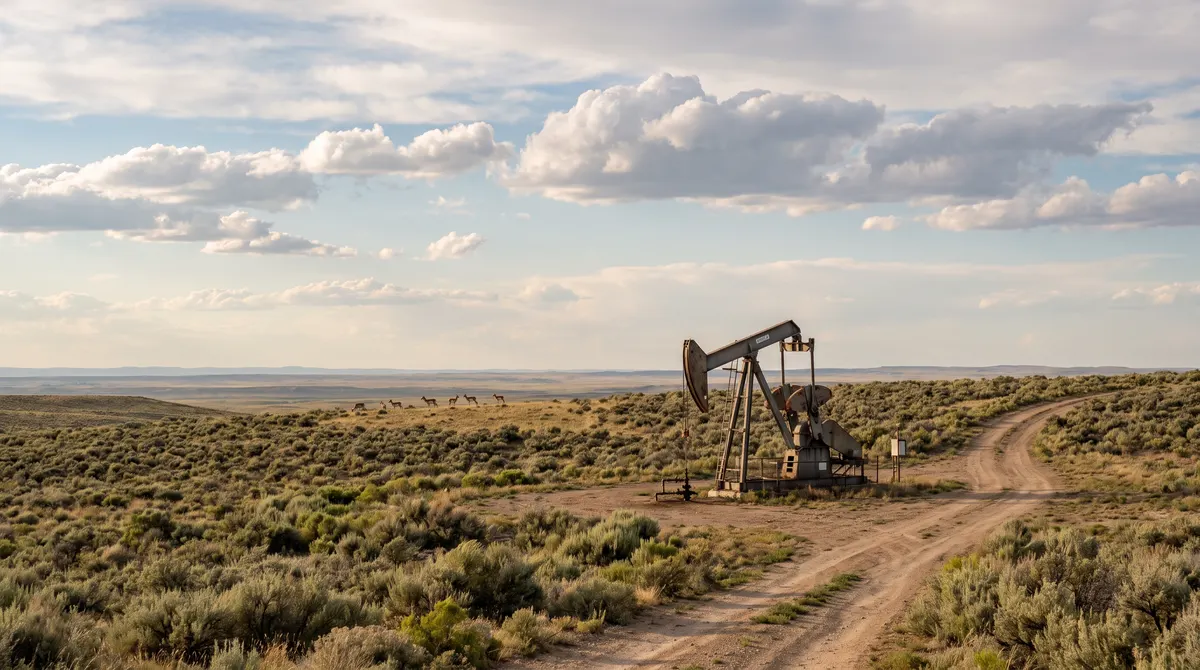
What Powder River Basin wells produce
Powder River wells produce oil first, with associated gas. In 2024, the five most productive reservoirs in the basin were the Frontier, Niobrara, Parkman and Turner sandstones and the Mowry Shale (WSGS). The Mowry is also the basin's main source rock, and the Shannon, Sussex, Teapot and Muddy are further horizontal targets. Older vertical wells still produce from conventional zones such as the Minnelusa and Tensleep, so mineral rights on one tract can carry royalty from wells of very different ages.
The turnaround came with horizontal drilling. Basin oil output rose from 38,000 barrels per day in 2009 to 78,000 in early 2014, with the Turner, Parkman and Niobrara growing from 12 to 46 percent of that output (EIA, 2014). Laterals now run past 2.5 miles (WSGS).
Gas is a smaller story. Coalbed natural gas output peaked above 584 billion cubic feet in 2009 and has declined since (WSGS). If your mineral rights carry an old coalbed lease, check whether those wells still produce.
Why mineral rights buyers compete in the Powder River Basin
Buyers compete here because the basin has stacked targets and many undrilled locations. An operator can land a lateral in the Turner, come back for the Parkman or Niobrara, and later test the Mowry under the same section, so a buyer of Powder River Basin mineral rights is pricing future wells as well as the ones already flowing.
The scale of planned drilling is public. The BLM's Converse County Oil and Gas Project, approved in December 2020, authorized up to 5,000 wells across about 1.5 million acres of mostly private surface over federal minerals (BLM, 2025). A court hold on new permits under that study was still in place in June 2025 (BLM, 2025). Buyers of mineral rights follow those filings closely.
One Wyoming detail matters more than elsewhere: much of the basin is split estate, where the surface is private but the minerals are federal. Before anyone makes an offer, confirm that your deed conveys private mineral rights, not just surface.
What Powder River Basin mineral rights are worth
Producing mineral rights are usually valued as a multiple of recent monthly royalty checks, adjusted for well age, decline and how many more laterals the operator can drill on the unit. Fresh permits lift the offer; a single older well does not.
Non-producing mineral rights are valued by the net mineral acre. Buyers weigh distance to active rigs, whether you are leased and at what royalty rate, which formations are proven nearby, and whether the acreage sits inside a planned development area.
Buyers verify everything before they bid. In Wyoming they use the Wyoming Oil and Gas Conservation Commission's data explorer for wells, permits and production; in Montana they use the Board of Oil and Gas Conservation's online data and GIS map. They also read county records, your lease and your division orders. Gather those documents first and every offer on your mineral rights arrives faster.
How to sell Powder River Basin mineral rights
Fill in the short form with your county, your interest type and whether it is producing. Your request goes to up to three independent buyers who are active in that county, and each one makes its own offer on your mineral rights.
You keep control. Take the best offer, negotiate, or keep your mineral rights if the numbers are not right. Owners never pay; the buyers pay us for the introduction. If you decide to sell mineral rights, letting several buyers compete is the fastest way to learn what the market will pay.
How to get offers for Powder River Basin mineral rights
Tell us the state and county and what you own. We send your request to up to 3 mineral rights buyers who purchase in that part of the Powder River Basin. They review the public records and contact you with offers, and you choose whether to sell, sell part, or keep.
Powder River Basin mineral rights questions
Are Powder River Basin mineral rights worth more in Converse County?
Usually, yes. Converse County produced 40.5 percent of Wyoming's oil in 2024 (WSGS) and holds the basin's largest planned drilling project. Unit status, lease terms and undrilled zones still shape each offer, so two Converse tracts can be priced very differently.
Can I sell mineral rights in the Powder River Basin if my wells are old coalbed gas wells?
Yes, but expect offers to focus on the deeper oil zones rather than the coalbed gas. A buyer will check whether the shallow wells still produce and whether your lease still covers the deeper formations. An oil and gas attorney can confirm what your lease holds before you sign.
How long does a Powder River Basin mineral rights sale take?
Offers usually arrive within days. Closing takes a few weeks because the buyer runs title at the county clerk, checks production with the state regulator, and confirms whether any of the mineral rights on the tract are federal.
Powder River Basin mineral rights sources
- Wyoming State Geological Survey, Powder River Basin
- Wyoming State Geological Survey, Oil and Gas Facts (2024 production by county)
- EIA, New petroleum technology revitalizes Powder River Basin oil production (September 2014)
- BLM, BLM updates analysis addressing Converse County oil and gas litigation (June 2025)
- Wyoming Oil and Gas Conservation Commission
- Montana Board of Oil and Gas Conservation, Annual Review 2024
Last reviewed October 13, 2026. This page is general information, not legal or tax advice. Facts come from the official sources listed above; confirm anything that matters to your sale with a qualified professional.
Get offers for your Powder River Basin mineral rights
Free to you, no obligation. Your details go only to buyers active in your county.
Other basins and plays
Sell mineral rights in the Permian Basin, Sell mineral rights in the Midland Basin, Sell mineral rights in the Delaware Basin, Sell mineral rights in the Bakken, Sell mineral rights in the Eagle Ford, Sell mineral rights in the SCOOP and STACK, Sell mineral rights in the DJ Basin, Sell mineral rights in the Marcellus and Utica, Sell mineral rights in the Anadarko Basin, Sell mineral rights in the San Joaquin Basin, Sell mineral rights in the Haynesville, Sell mineral rights in the Barnett Shale