Sell mineral rights in Montana
Montana is a mid-sized oil state with one dominant area. In 2024 Richland County alone produced 16.2 million of the state's 26.7 million barrels (Montana Board of Oil and Gas Conservation, 2024 Annual Review). Buyers of Montana mineral rights focus on that Bakken corridor, with steady interest in Fallon County on the Cedar Creek Anticline. If you want to sell mineral rights in Montana, this page covers where buyers are active, what they check and how to line up several offers without paying anyone.
Where buyers are most active in Montana
Richland and Roosevelt counties are where most Montana mineral rights change hands. Both sit in the Montana part of the Williston Basin, where horizontal wells in the Bakken Formation now account for just over half of the state's annual oil output (Montana Bureau of Mines and Geology). In 2024, operators completed 32 oil wells in Richland County and 12 in Roosevelt County, nearly all horizontal Bakken wells, and Roosevelt produced 4.3 million barrels (Board of Oil and Gas Conservation, 2024). Statewide crude output reached 28.8 million barrels in 2025 (EIA, 2025), so the trend is up.
Fallon County is the second cluster. Its fields along the Cedar Creek Anticline are older conventional reservoirs that produced 2.4 million barrels of oil and 3.9 million mcf of gas in 2024. Powder River County, on the Montana edge of the Powder River Basin, produced 1.2 million barrels that year, and Sheridan, Dawson and Wibaux counties each produced a few hundred thousand barrels (Board of Oil and Gas Conservation, 2024). Mineral rights in these counties draw fewer bidders than Bakken acreage, but producing royalties still sell.
Natural gas is a smaller story. Phillips, Blaine and Hill counties in north-central Montana produced the most non-associated gas in 2024, and Toole and Glacier counties produce both oil and gas. Musselshell and Petroleum counties in central Montana produce small volumes of oil. Montana's marketed gas was 43.7 billion cubic feet in 2025 (EIA, 2025), so gas-only mineral rights get modest offers.
What buyers check before a Montana mineral rights offer
Buyers start with the Board of Oil and Gas Conservation's online Data Miner. It lets anyone search wells by API number, operator, well name or county, pull monthly production for a well or field, and list horizontal permits and completions. The Board also sets spacing units and pools interests inside them, so a buyer can see which unit your mineral rights fall in and how many wells drain it.
Taxes come next. Montana's oil and natural gas production tax charges nonworking interest owners, which means royalty owners, 14.8% of the gross taxable value of production, adjusted by a further 0.3% privilege and license tax (Montana Code Annotated 15-36-304, 2025). That tax comes out of royalty income before it reaches you, so buyers price it into every Montana mineral rights offer. Montana also has a state individual income tax (Montana Department of Revenue).
Ownership is the third check. Montana acreage mixes private, state and federal minerals, and the Bureau of Land Management administers more than 5,000 federal leases across Montana and the Dakotas (BLM). Buyers want privately held mineral rights inside active spacing units, so they verify your net mineral acres and decimal interest against the recorded deeds and the operator's division order.
Montana mineral rights records and ownership
Mineral deeds, royalty deeds and oil and gas leases are recorded in the county where the minerals lie. If you inherited Montana mineral rights, the chain of title may run through several estates, and a buyer will ask for the probate or affidavit of heirship that connects you to the last recorded owner.
Montana has a legal route for scattered co-owners. Under Montana Code Annotated 82-1-302, a person who owns an interest in the minerals under a tract can petition the district court to create a trust for co-owners who cannot be located after a diligent search. The court appoints the clerk of court as trustee, who can then sign an oil and gas lease on terms the court approves. Many heirs first learn of a small inherited fraction this way and decide to sell mineral rights in Montana rather than manage it.
A producing royalty on Bakken wells and a non-producing interest in Petroleum County are both Montana mineral rights, but buyers value them differently. Producing interests are priced on months of income and the drilling outlook, non-producing ones on net mineral acres and nearness to permits.
Selling Montana mineral rights: leases, closing and taxes
A sale closes with a mineral deed or royalty deed recorded in the county. If your tract is leased, the lease stays in place and the buyer steps into your royalty. If it is unleased, the buyer also takes the right to lease, which is one reason unleased Bakken mineral rights draw stronger offers than a bare royalty. Check the legal description so you convey only the tracts you mean to sell.
Because Montana taxes income, ask a tax professional how a lump sum compares with years of royalty income taxed at ordinary rates plus the production tax. For inherited mineral rights, a stepped-up basis can make a sale close to tax-free.
The simplest way to sell mineral rights in Montana is to compare offers. Tell us the county, the well or unit name if you know it, and what your last royalty check showed. We pass the request to up to three independent buyers active in that county, they make offers on your mineral rights, and you choose one or keep everything. You pay nothing at any point.
How to get offers for Montana mineral rights
Tell us your county and what you own. We send your request to up to 3 buyers who purchase in that part of Montana. They review the public records and contact you with offers, and you choose whether to sell, sell part, or keep.
Montana mineral rights sources
- Montana Board of Oil and Gas Conservation
- Montana Board of Oil and Gas Conservation, 2024 Annual Review (county production and completions)
- Montana Bureau of Mines and Geology, Oil and Gas
- EIA, crude oil production by state (annual)
- Montana Code Annotated 15-36-304, oil and natural gas production tax rates
- Montana Code Annotated 82-1-302, trusts for unlocatable mineral owners
Last reviewed October 13, 2026. This page is general information, not legal or tax advice. Facts come from the official sources listed above; confirm anything that matters to your sale with a qualified professional.
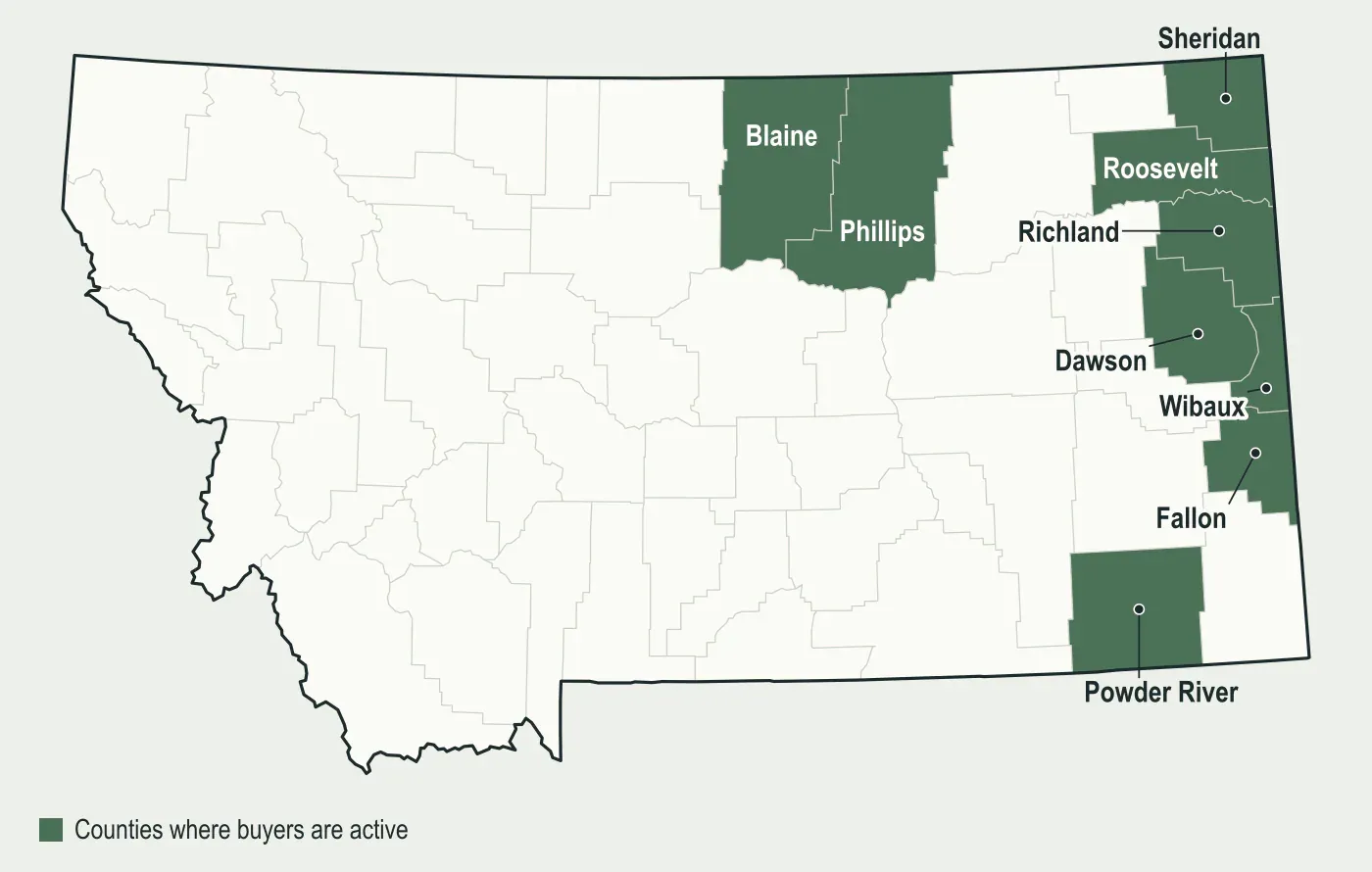
Where Montana mineral rights buyers are active
Buyers concentrate on the counties below, where drilling is heaviest. Minerals elsewhere in Montana can still sell; send the details and we'll tell you if a buyer covers your area.
Montana basins and plays
Buyers price Montana mineral rights by the basin they sit in. These pages cover the counties, formations and drilling outlook of each play that reaches into Montana.
- Sell mineral rights in the BakkenOwn Bakken mineral rights in North Dakota or Montana? Get offers from up to 3 independent buyers active in your county. Free for owners; accept or keep.
- Sell mineral rights in the Powder River BasinOwn Powder River Basin mineral rights in Converse, Campbell or Johnson County? Compare offers from up to 3 independent buyers. Free for owners.
What you can sell in Montana
- Mineral rightsProducing or non-producing minerals, all or part of your interest.
- Royalty interestsWant to sell oil and gas royalties? See how buyers value a royalty interest or NPRI, what to have ready, and get offers from up to 3 buyers in your county.
- Overriding royalties (ORRI)Own an overriding royalty interest? Learn how ORRIs work, why lease expiry changes the price, which documents buyers need, and how to get offers.
- Inherited mineral rightsInherited mineral rights or oil and gas royalties? Learn how to get title in your name, why royalties go into suspense, and how to get buyer offers.
Montana mineral rights questions
Are Montana mineral rights outside Richland County worth selling?
Usually, if they produce. Fallon, Roosevelt, Powder River, Sheridan and Dawson counties all have steady output and active buyers. Non-producing mineral rights far from any permit are harder to sell, and offers for them are small.
How do I find out whether there are wells on my Montana minerals?
Search the Board of Oil and Gas Conservation's Data Miner by county and well name, or by the operator named on your lease. The GIS map shows well locations and spacing units, and the production pages show what each well has made month by month.
How long does it take to sell Montana mineral rights?
Offers typically arrive within days of your request. Closing depends on title: a clean recorded deed in your name can close in a few weeks, while an inherited interest still in a parent's name needs probate or an affidavit of heirship first. Buyers of Montana mineral rights handle most of that paperwork.
Get offers for your Montana mineral rights
Free to you, no obligation. Your details go only to buyers active in your county.
Other states
Sell mineral rights in Texas, Sell mineral rights in Oklahoma, Sell mineral rights in New Mexico, Sell mineral rights in North Dakota, Sell mineral rights in Ohio, Sell mineral rights in Pennsylvania, Sell mineral rights in West Virginia, Sell mineral rights in Colorado, Sell mineral rights in Louisiana, Sell mineral rights in Wyoming, Sell mineral rights in Alabama, Sell mineral rights in Alaska, Sell mineral rights in Arkansas, Sell mineral rights in California, Sell mineral rights in Florida, Sell mineral rights in Illinois, Sell mineral rights in Indiana, Sell mineral rights in Kansas, Sell mineral rights in Kentucky, Sell mineral rights in Michigan, Sell mineral rights in Mississippi, Sell mineral rights in Nebraska, Sell mineral rights in New York, Sell mineral rights in South Dakota, Sell mineral rights in Tennessee, Sell mineral rights in Utah, Sell mineral rights in Virginia