Sell mineral rights in the Haynesville
The Haynesville is a deep natural gas shale under northwest Louisiana and East Texas, and Haynesville mineral rights are in demand because the play sits next to the Gulf Coast's liquefied natural gas export terminals. In 2025 the region averaged 14.9 billion cubic feet of gas per day, 4 percent more than in 2024, and together with Appalachia and the Permian it supplied 67 percent of US marketed gas (EIA, 2026).
This page covers where the Haynesville lies, which parishes and counties carry the drilling, what the wells produce, how buyers value Haynesville mineral rights, and how to get competing offers without paying anyone.
Where the Haynesville lies and which parishes and counties matter
The play straddles the Louisiana and Texas line. On the Louisiana side, the state has long described Bienville, Bossier, Caddo, DeSoto, Red River and Sabine as the six primary Haynesville parishes (Louisiana DNR, 2011). DeSoto and Red River sit in the heart of the play, and Caddo and Bossier bring in the Shreveport area, where many mineral rights are held in small, divided interests.
In Texas, the Bureau of Economic Geology lists Panola, Harrison, Rusk, Shelby, San Augustine, Sabine, Gregg, Marion, Upshur and Nacogdoches as Haynesville counties (UT BEG). Panola and Harrison are the long-standing core; Shelby, San Augustine and Nacogdoches extend the play to the south.
The formation is Upper Jurassic rock lying 10,000 to more than 14,000 feet deep (UT BEG). That depth makes the wells expensive, so gas prices decide how many rigs run and how eager buyers of mineral rights are.
What Haynesville wells produce
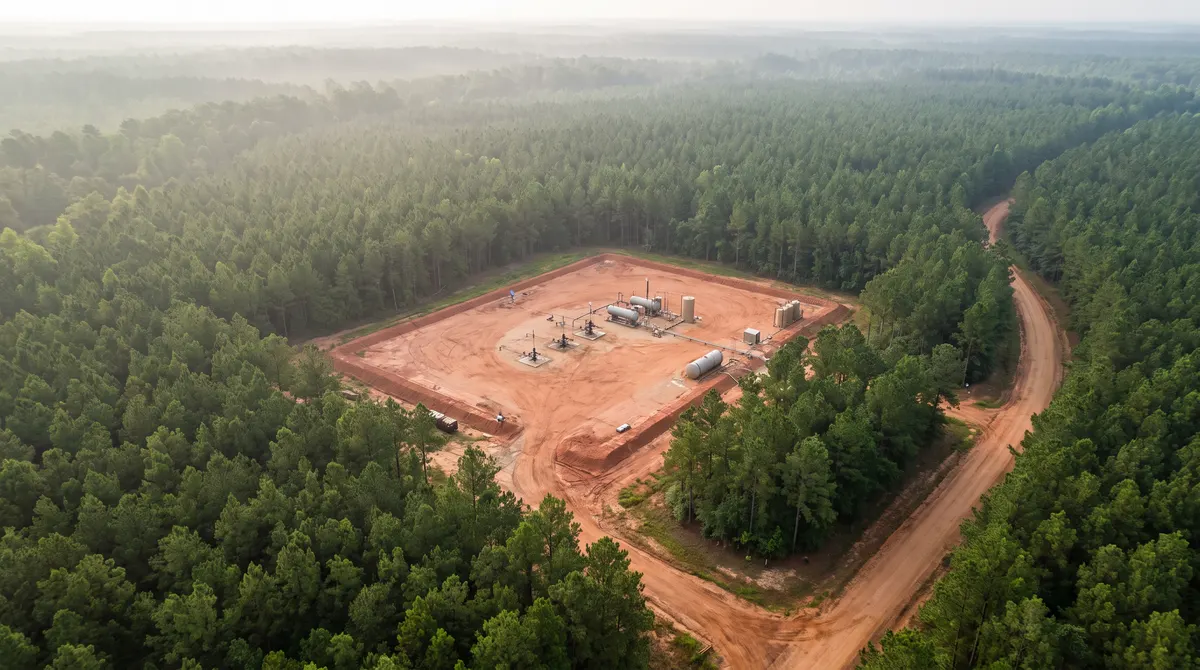
Haynesville wells produce natural gas, with very little oil or condensate. Your royalty statement will show gas volume and price, usually with deductions for gathering, treating and transport. With no oil line to cushion a weak gas price, Haynesville mineral rights income tracks the Henry Hub benchmark closely.
The wells are large. The Bureau of Economic Geology puts the estimated ultimate recovery at 3 to 7 billion cubic feet per well for the Haynesville and Bossier shales (UT BEG), and the USGS estimated in its 2024 assessment that Haynesville Formation reservoirs still hold a mean of 47.9 trillion cubic feet of undiscovered, technically recoverable gas (USGS, 2025). The Bossier shale above the Haynesville gives operators a second target under much of the same acreage.
In 2025, higher Henry Hub prices kept drilling economic even with relatively deeper and more expensive wells (EIA, 2026). When prices fall, Haynesville rigs are often the first laid down, and offers for mineral rights follow.
Why mineral rights buyers compete in the Haynesville
Buyers compete here because of LNG. The region's proximity to liquefied natural gas export terminals and to major industrial gas consumers on the Gulf Coast draws operators (EIA, 2026), and EIA has pointed to new export facilities such as Plaquemines LNG in Louisiana and Corpus Christi Stage 3 and Golden Pass in Texas starting up (EIA, 2025). A buyer of Haynesville mineral rights is betting on that demand, but no buyer can promise you what prices or export volumes will do.
The second reason is scale. Louisiana had permitted nearly 2,000 Haynesville wells by early 2011, and units in the core parishes have been producing since the play took off in 2008 (Louisiana DNR, 2011). A buyer who already owns mineral rights in a DeSoto Parish unit knows the operator, the spacing and the decline, and can price a neighboring interest quickly.
The third is public data. Permits and production are searchable, so buyers can see which units are being redrilled before most mineral rights owners hear about it.
What Haynesville mineral rights are worth
Producing Haynesville mineral rights are priced as a multiple of recent monthly royalty income, adjusted for decline, the gas price after deductions and whether the operator has more locations in the unit. Because the royalty is all gas, offers move with the forward gas curve.
Non-producing mineral rights sell by the net mineral acre. What matters is the parish or county, whether the tract is inside an existing unit, the lease royalty rate, and how close it is to current drilling.
Buyers verify everything. In Louisiana they use the Office of Conservation's SONRIS portal, where anyone can search wells by serial number, operator or section, township and range and read production reports; the office now sits in the Department of Conservation and Energy, renamed from the Department of Energy and Natural Resources on October 1, 2025. In Texas they pull permits and production from the Railroad Commission of Texas. They also read deed records, your lease and your division orders.
How to sell Haynesville mineral rights
Fill in the short form with your parish or county, your interest type and whether it is producing. Your request goes to up to three independent buyers who are active there, and each sends its own offer on your mineral rights.
Compare them, then accept, counter or keep your mineral rights. The service is free to owners because buyers pay for the introduction. We do not buy minerals ourselves, so there is no house bid to steer you toward. If you choose to sell mineral rights, competing offers are the only reliable way to find out what yours are worth. An oil and gas attorney can check the deed before you sign.
How to get offers for Haynesville mineral rights
Tell us the state and county and what you own. We send your request to up to 3 mineral rights buyers who purchase in that part of the Haynesville. They review the public records and contact you with offers, and you choose whether to sell, sell part, or keep.
Haynesville mineral rights questions
Why do Haynesville mineral rights offers change so much from month to month?
Because the royalty is almost all gas. Buyers price Haynesville mineral rights off the gas price they expect to receive, and that curve moves with LNG demand, storage levels and weather. Get your offers in the same week so you are comparing like with like.
Can I sell mineral rights in the Haynesville if my interest is tiny?
Yes. Many Caddo and Bossier Parish interests are a few net acres split among heirs, and buyers who already own mineral rights in the unit will still make offers. A small interest with clean title can be easier to sell than a large one with gaps in the chain.
Does the Bossier shale add value to my Haynesville mineral rights?
It can. Where the Bossier is productive, an operator may drill it as a separate target above the Haynesville, which means more wells on the same unit. Ask buyers whether their offer includes future Bossier wells or only the Haynesville wells already producing.
Haynesville mineral rights sources
- EIA, U.S. natural gas production reached a new record in 2025 (March 2026)
- EIA, EIA expects higher wholesale U.S. natural gas prices as demand increases (January 2025)
- USGS, Assessment of undiscovered oil and gas resources in the Haynesville Formation, 2024 (Fact Sheet 2025-3054)
- University of Texas Bureau of Economic Geology, Haynesville shale-gas study
- Louisiana DNR, Haynesville Shale surpasses Barnett Shale natural gas production (March 2011)
- Louisiana Department of Conservation and Energy (Office of Conservation, SONRIS)
Last reviewed October 13, 2026. This page is general information, not legal or tax advice. Facts come from the official sources listed above; confirm anything that matters to your sale with a qualified professional.
Get offers for your Haynesville mineral rights
Free to you, no obligation. Your details go only to buyers active in your county.
Other basins and plays
Sell mineral rights in the Permian Basin, Sell mineral rights in the Midland Basin, Sell mineral rights in the Delaware Basin, Sell mineral rights in the Bakken, Sell mineral rights in the Eagle Ford, Sell mineral rights in the SCOOP and STACK, Sell mineral rights in the DJ Basin, Sell mineral rights in the Powder River Basin, Sell mineral rights in the Marcellus and Utica, Sell mineral rights in the Anadarko Basin, Sell mineral rights in the San Joaquin Basin, Sell mineral rights in the Barnett Shale