Sell mineral rights in the Eagle Ford
The Eagle Ford is a Cretaceous shale that runs roughly 50 miles wide and 400 miles long across South Texas, from the Mexican border toward East Texas, at depths of 4,000 to 12,000 feet (Railroad Commission of Texas). Its oil, condensate and dry gas windows line up from northwest to southeast, so Eagle Ford mineral rights can mean very different things depending on which county they are in.
This page shows where the play lies, what each window produces, why buyers keep bidding for Eagle Ford mineral rights in a mature play, how offers are priced and how to get several at once.
Where the Eagle Ford lies and which counties matter
The Railroad Commission of Texas lists 27 counties on its Eagle Ford page, from Maverick and Webb on the border to Brazos and Madison in the northeast. Activity is far more concentrated than that list suggests. More than 70% of the horizontal oil wells drilled in the play from 2008 to 2016 were in seven counties: Dimmit, La Salle, McMullen and Webb in the west, and DeWitt, Gonzales and Karnes in the center (EIA).
Karnes County is one of the major areas of development in the play (EIA). Atascosa, Live Oak, Frio and Wilson round out the core, and mineral rights there change hands often. Counties along the northeastern extension, where the carbonate-rich lower Eagle Ford tapers off and the play transitions into the Pepper Shale of the East Texas Basin (EIA, 2015), see much less buyer interest.
The shale sits between the Austin Chalk above and the Buda Lime below, with carbonate making up as much as 70% of the rock in South Texas, which makes it brittle and easier to fracture (Railroad Commission of Texas). Average thickness is about 250 feet across RRC Districts 1 through 6 (Railroad Commission of Texas).
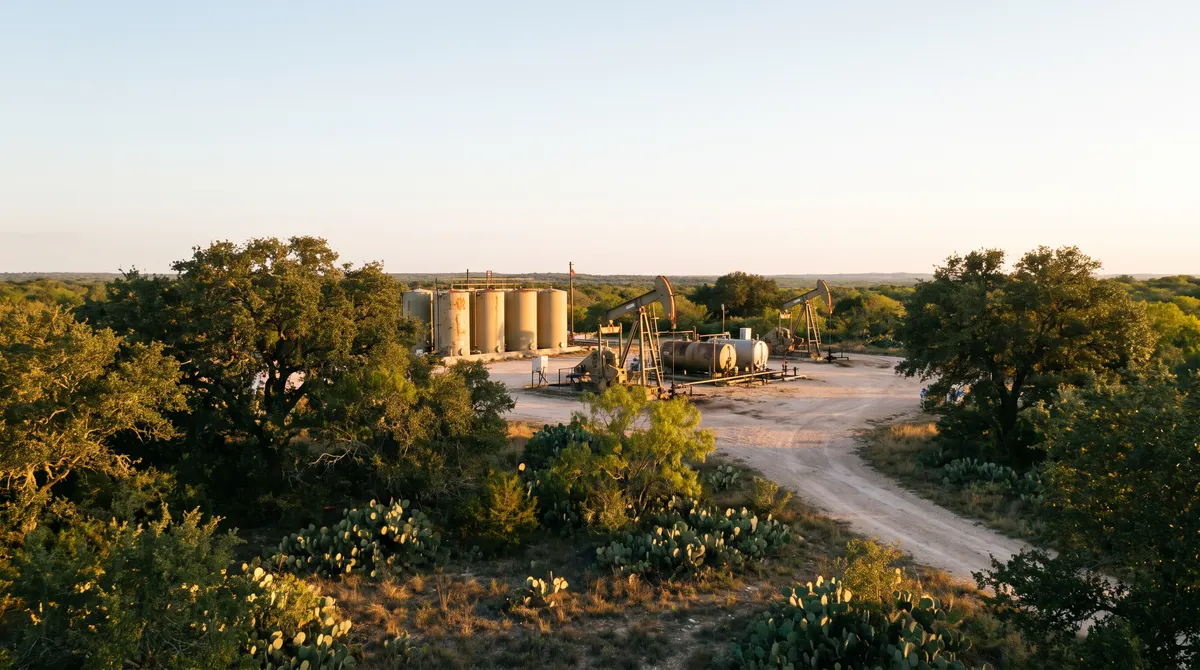
What Eagle Ford wells produce
What comes out of the ground depends on depth. The play is made up of three roughly parallel windows, and production becomes more liquids-rich moving from south to north (EIA, 2011). Deeper wells toward the south, reaching 15,000 feet, have higher initial gas-to-oil ratios, while shallower wells to the north produce more oil (EIA, 2015). In practice that means a dry gas window along the southern edge, a condensate and wet gas window in the middle and an oil window along the northern side.
Across the whole region, natural gas production reached 6.8 billion cubic feet per day in 2024 while crude oil has hovered around 1.1 million barrels per day since 2020 (EIA, 2025). The Eagle Ford play itself supplies 86% of the region's oil, about 1.0 million barrels per day, and 73% of its gas, about 5.5 billion cubic feet per day; the Austin Chalk supplies most of the rest (EIA, 2025). The gas-to-oil ratio is rising as reservoir pressure declines in older wells (EIA, 2025).
The USGS estimated mean undiscovered, technically recoverable resources of 8.5 billion barrels of oil and 66 trillion cubic feet of gas in the Eagle Ford Group and associated strata (USGS, 2018). For mineral rights owners, the mix matters: a Karnes County royalty check is mostly oil, a Webb County check is mostly gas, and a DeWitt County check often carries a large condensate and NGL share.
Why mineral rights buyers compete in the Eagle Ford
The Eagle Ford is a mature play, and that is exactly why mineral rights buyers like it. Years of horizontal drilling have mapped the windows in detail, operators know their well results, and a buyer can forecast cash flow with less guesswork than in a newer basin.
Two things keep new wells coming. Operators are refracturing and infilling older units, and the Austin Chalk directly above the Eagle Ford has seen renewed drilling since 2014, with its oil output nearly quadrupling and its gas output rising nearly 675% since then (EIA, 2025). A mineral deed usually covers both formations, so buyers price the Austin Chalk upside into Eagle Ford mineral rights.
What Eagle Ford mineral rights are worth
Producing mineral rights are priced on a multiple of recent royalty income, discounted for decline and raised for refracs, infill permits or Austin Chalk plans in the unit. Older Eagle Ford wells have flattened out, which makes their income steadier and easier for buyers to value than a brand-new well's.
Non-producing mineral rights are priced per net mineral acre, and the window decides the range. Oil-window acreage in Karnes, DeWitt or Gonzales counties with recent permits nearby draws the highest offers; dry gas acreage in the south moves with gas prices and pipeline capacity; fringe acreage in the northeast draws the least. Leased, held-by-production and open acreage are each priced differently.
Buyers verify through the Railroad Commission of Texas: drilling permits, production data from the Production Data Query system, the public GIS viewer and operator records. They also pull county deed records and your division orders. Keep your lease, a recent check stub and any unit designation handy, and the verification of your mineral rights goes faster.
How to sell Eagle Ford mineral rights
Complete the form with your county, interest type and production status. Your request reaches up to three independent buyers active in that county, each of whom makes an offer on its own.
Weigh the offers, negotiate, or keep your mineral rights if none of them fits. The service is free for owners; buyers pay for the introduction. If you decide to sell mineral rights, you will do it with a market price in hand rather than a single unsolicited letter.
How to get offers for Eagle Ford mineral rights
Tell us the state and county and what you own. We send your request to up to 3 mineral rights buyers who purchase in that part of the Eagle Ford. They review the public records and contact you with offers, and you choose whether to sell, sell part, or keep.
Eagle Ford mineral rights questions
Are Eagle Ford mineral rights still worth selling in a mature play?
Yes, if the price is right. Mature wells provide steady income that buyers can value with confidence, and refracs, infill wells and Austin Chalk drilling add upside. Get several offers and compare them with what you expect to receive by holding your mineral rights.
What if my minerals are in the dry gas window?
Dry gas mineral rights in Webb or southern La Salle counties are still bought and sold. Offers track gas prices and takeaway capacity more than oil prices, so timing matters more here than in the oil window. Buyers active in those counties know that market.
How do I sell mineral rights I inherited in Karnes County?
First confirm the estate work is done and your ownership is recorded in the county deed records. Then submit the form; buyers will run title from those records and the Railroad Commission's production data before they close. Unprobated interests can still get offers, but closing will wait for the paperwork.
Eagle Ford mineral rights sources
- Railroad Commission of Texas, Eagle Ford Shale information
- EIA, Eagle Ford natural gas production increases as crude oil production holds steady (April 2025)
- EIA, EIA updates Eagle Ford maps to provide greater geologic detail (January 2015)
- EIA, Trends in Eagle Ford drilling highlight the search for oil and natural gas liquids (November 2011)
- EIA, Annual Energy Outlook: geology and technology resource discussion (Eagle Ford county drilling shares)
- USGS, Assessment of undiscovered oil and gas resources in the Eagle Ford Group and associated Cenomanian-Turonian strata, U.S. Gulf Coast, Texas, 2018
Last reviewed October 13, 2026. This page is general information, not legal or tax advice. Facts come from the official sources listed above; confirm anything that matters to your sale with a qualified professional.
Get offers for your Eagle Ford mineral rights
Free to you, no obligation. Your details go only to buyers active in your county.
Other basins and plays
Sell mineral rights in the Permian Basin, Sell mineral rights in the Midland Basin, Sell mineral rights in the Delaware Basin, Sell mineral rights in the Bakken, Sell mineral rights in the SCOOP and STACK, Sell mineral rights in the DJ Basin, Sell mineral rights in the Powder River Basin, Sell mineral rights in the Marcellus and Utica, Sell mineral rights in the Anadarko Basin, Sell mineral rights in the San Joaquin Basin, Sell mineral rights in the Haynesville, Sell mineral rights in the Barnett Shale