A severance tax is a state tax on oil and gas at the moment it is taken out of the ground. The operator pays the state, then takes your share out of your royalty before the check is written. If you own mineral rights in a producing state, the tax is already in the gap between the gross value on your stub and the money that reaches your account. This guide explains who pays, how to spot it on a check, whether it is deductible, and what the rate is in each of the 28 states where we connect mineral rights owners with buyers.
What is a severance tax and who pays it?
States charge the tax for severing a non-renewable resource from the land, whoever owns the mineral rights. Some call it a production tax, a gross production tax or a privilege tax, and the base is usually the gross value of the oil or gas at the well. A few states charge a flat amount per barrel or per thousand cubic feet instead.
The legal answer to who pays is: everyone who owns a piece of the production. Oklahoma's statute says the tax attaches to the royalty interest. Kansas says it is borne ratably by everyone with a beneficial interest, and the first purchaser withholds it from payments. North Dakota's gross production tax attaches to the whole production, including the royalty interest. In practice the operator or purchaser remits the whole amount and deducts your share, so you never write a check. Owners of mineral rights only notice the severance tax as a line on the stub.
Colorado works differently. The producer withholds 1% of your gross income and sends you a DR 0021W, and royalty owners file their own Colorado severance tax return to settle the balance. If you own Colorado mineral rights, that return is your job, not the operator's.
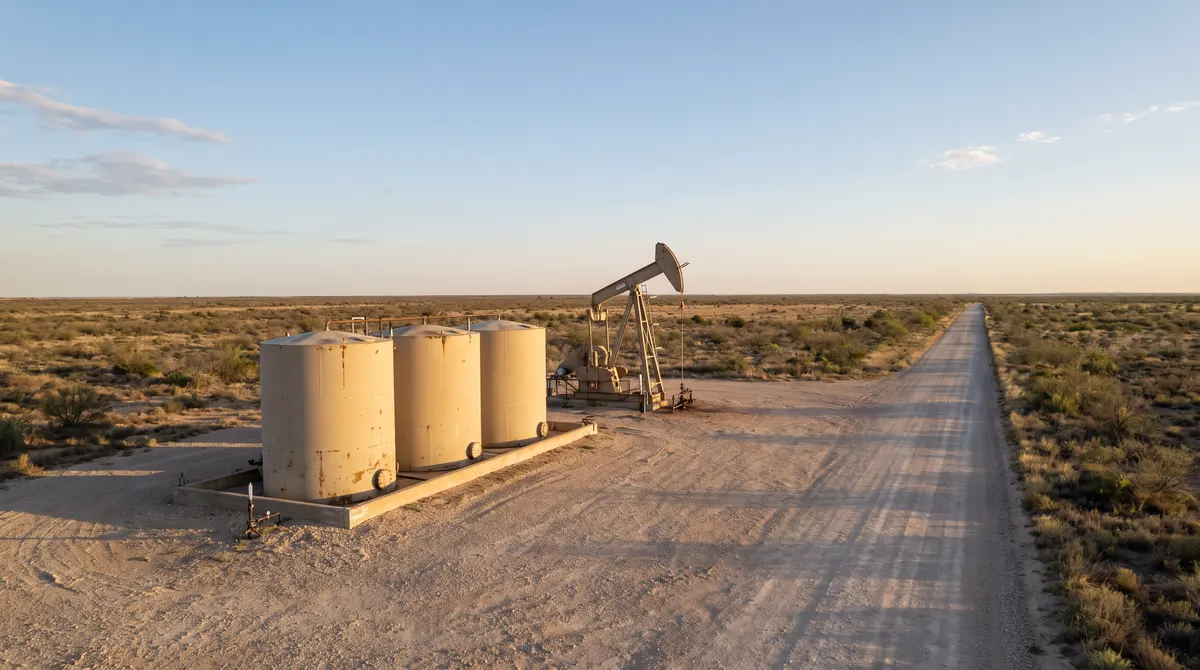
How severance tax shows on your royalty check
Most stubs for mineral rights list the gross value of your share, then a column of deductions, then the net. The severance tax appears as a deduction labeled "sev tax", "production tax", "GPT" or simply "taxes", often split between oil and gas. Divide the tax by the gross value for that product and you should land near your state's rate. If you land well above it, the operator may be bundling post-production costs into the tax column, which is worth a question.
Compare the figure against the table below rather than against last year's stub, because rates and exemptions move. A well that qualifies as a stripper well can drop to a lower rate, and new wells in several states pay a reduced rate for their first months. Our guide on how to read a royalty check walks through the rest of the stub, decimal interest included.
Can you deduct severance tax on your federal return?
Yes, for anyone reporting royalty income from mineral rights on Schedule E. The IRS instructions tell you to report the gross royalty amount on line 4 even if state or local taxes were withheld from oil or gas payments, and to include taxes withheld by the producer on line 16. So the severance tax taken from your check is a deductible expense against your royalty income, not a reduction of the income itself. Your 1099-MISC usually shows the gross figure, which is why the two numbers rarely match.
Keep every stub for your mineral rights for the year, because the 1099 will not itemize the tax. If an operator reports net instead of gross, you still deduct only what was withheld. The wider picture, from depletion to how a sale of mineral rights is taxed, is in our guide to royalty income taxes.
Severance tax rates by state
The table lists the headline rates for oil and gas in each state, with the statute or department behind them. Pennsylvania and New York have no severance tax, California charges an assessment instead, and Virginia leaves it to counties. Several states also stack a conservation tax or a county ad valorem tax on top, which is noted where it applies to mineral rights owners. Each state name links to our page on selling mineral rights there.
| State | Oil | Gas | Notes and source |
|---|---|---|---|
| Texas | 4.6% of market value (2.3% for approved enhanced recovery oil) | 7.5% of market value | Texas Tax Code 202.052 and 201.052 (public.law reproduction). |
| Oklahoma | 7% of gross value; 5% for the first 36 months of a well's production | 7% of gross value; 5% for the first 36 months | 68 O.S. 1001 as amended by HB 1372 (2025). The statute says the tax attaches to the royalty interest. |
| New Mexico | 3.75% severance tax plus 3.15% emergency school tax plus 0.19% conservation tax (0.24% when WTI is above $70), plus an ad valorem production tax | 3.75% severance tax plus 4% emergency school tax plus 0.19% conservation tax, plus an ad valorem production tax | NMSA 7-29-4, 7-31-4 and 7-30-4. Stripper wells pay less. The ad valorem production tax rate varies by district and is not listed here. |
| North Dakota | 5% gross production tax plus 5% oil extraction tax (10% in total) | Flat rate per mcf, reset each July 1; current figure not verified; see the state page | N.D.C.C. 57-51-02 and 57-51.1-02. The gross production tax attaches to the whole production, including the royalty interest. |
| Ohio | 10 cents per barrel | 2.5 cents per mcf | Ohio Revised Code 5749.02; Ohio Department of Taxation severance FAQ. |
| Pennsylvania | No severance tax | Impact fee, not a severance tax: a per-well fee on unconventional wells, $40,000 to $60,000 in year one depending on the gas price, falling with well age | 58 Pa.C.S. 2302. The producer pays the fee per well; it is not a percentage of your royalty. |
| West Virginia | 5% of gross value | 5% of gross value; 2.5% for low-producing conventional wells | W. Va. Code 11-13A-3a. Wells under half a barrel or 5,000 cubic feet a day are exempt. |
| Colorado | 2% to 5% of gross income, by income bracket | 2% to 5% of gross income, by income bracket | C.R.S. 39-29-105. Royalty owners file their own Colorado severance tax return; producers withhold 1% and send a DR 0021W (Colorado Department of Revenue). Wells at 15 barrels a day or less are exempt. |
| Louisiana | 12.5% of value for wells completed before July 1, 2025; 6.5% for wells completed on or after; 6.25% incapable wells; 3.125% stripper wells | Cents per mcf, reset each July 1 and never below 7 cents; current figure not verified; see the state page | La. R.S. 47:633 (FindLaw reproduction). |
| Wyoming | 6% of fair market value | 6% of fair market value | W.S. 39-14-204. |
| Alabama | Privilege tax of 8% of gross value (6% for wells permitted July 1, 1988 or later; 4% for wells at 25 barrels a day or less) plus a 2% production tax | Same privilege tax, with the 4% rate at 200 mcf a day or less, plus a 2% production tax | Alabama Department of Revenue, severance taxes administered. |
| Alaska | Production tax of 35% of production tax value, levied on the producer; a landowner's royalty interest is excluded | Same production tax, levied on the producer | AS 43.55.011; Alaska DNR Division of Oil and Gas. Nearly all Alaska minerals are state or federal, so private royalty owners are rare. |
| Arkansas | 4% of market value for wells at 10 barrels a day or less, 5% above that, plus small per-barrel charges | 1.25%, 1.5% or 5%, depending on how the Commission classifies the well | Arkansas Department of Finance and Administration. The first purchaser withholds it when the producer has no severance permit. |
| California | Assessment, not a severance tax: a uniform per-barrel charge set each year to fund CalGEM; current rate not verified; see the state page | Same assessment per 10,000 cubic feet, charged to operators and royalty owners | Public Resources Code 3402 and 3403. The CalGEM assessment page was not reachable from this machine. |
| Florida | 8% of gross value; 5% for small-well oil; 1% to 9% for tertiary and mature-field oil, by price | Per-mcf rate, base 17.1 cents, adjusted each July 1 | Florida Statutes 211.02 and 211.025 (FindLaw reproduction). |
| Illinois | Hydraulic fracturing wells only: 3% for the first 24 months, then 3% to 6% by daily volume; wells at 15 barrels a day or less are exempt | 3% for the first 24 months, then 6% | 35 ILCS 450/2-15. Conventional wells are outside the Act. |
| Indiana | The greater of 1% of value or 24 cents per barrel | The greater of 1% of value or 3 cents per mcf | Indiana Code 6-8-1-8. |
| Kansas | 8% of gross value; leases averaging 5 barrels a day or less per well are exempt | 8% of gross value; wells with a daily gross value of $87 or less are exempt | K.S.A. 79-4217 and 79-4220: borne ratably by everyone with a beneficial interest, and the first purchaser withholds it. |
| Kentucky | 4.5% of market value, imposed ratably on everyone owning an interest in the oil | 4.5% of gross value | KRS 137.120 (oil) and KRS 143A.020 (gas). |
| Michigan | 6.6% of gross cash market value; 4% for stripper and marginal wells | 5% of gross cash market value | MCL 205.303. A separate annual oil and gas fee applies; the Michigan Treasury page was not reachable from this machine. |
| Mississippi | 6% of value at the point of production; 3% for approved enhanced recovery; 1.3% for horizontal wells for 30 months or until payout | 6% of value; 1.3% for horizontal wells for 30 months or until payout | Miss. Code 27-25-503 and 27-25-703; Mississippi Department of Revenue. |
| Montana | 14.8% of gross taxable value for nonworking (royalty) interests, plus a 0.3% privilege and license tax | Same rates for nonworking interests | Montana Code Annotated 15-36-304. |
| Nebraska | 3% of value; 2% for stripper oil (10 barrels a day or less); plus a conservation tax of 7 mills | 3% of value plus a conservation tax of 7 mills | Nebraska Department of Revenue, Form 61. |
| New York | No severance tax | No severance tax | Producing wells are assessed as real property in the producer's name (Real Property Tax Law 594). |
| South Dakota | 4.5% of taxable value, plus a 2.4-mill conservation tax the operator may not pass on | 4.5% of taxable value, plus the 2.4-mill conservation tax | SDCL 10-39A-1; 2021 session law. |
| Tennessee | 3% of sales price | 3% of sales price | University of Tennessee CTAS summary of T.C.A. 60-1-301. A third goes to the county. |
| Utah | 3% of value up to $13 a barrel, 5% above; stripper wells and the first months of new wells are exempt | 3% up to $1.50 per mcf, 5% above | Utah Code 59-5-102. |
| Virginia | No state severance tax | Local gas severance license tax of up to 1% of gross receipts, plus a local road improvement tax of up to 1%, in counties that adopt them | Code of Virginia 58.1-3712 and 58.1-3713. |
Three patterns matter more than any single figure. First, new-well discounts are common: Oklahoma, Mississippi, Illinois and Louisiana all charge less in the early months, so a check from a young well will show a smaller deduction than the headline rate. Second, stripper and low-volume wells are often exempt or discounted, which is why two owners of mineral rights in the same county can see different rates. Third, states like New Mexico and North Dakota layer two or three taxes, and the total is what comes out of a mineral rights owner's check.
How severance tax changes what buyers offer for mineral rights
Buyers value producing mineral rights on net income, not gross. A buyer pricing an offer starts from your check stubs, which already have the severance tax removed, and applies a multiple to that net figure. A 10% combined rate in North Dakota or a 14.8% rate in Montana lowers the income stream the buyer is buying, so offers in high-tax states are built on a smaller base than offers on the same gross production in Wyoming or Texas. No buyer of mineral rights adds the tax back.
For non-producing mineral rights the effect is indirect. The buyer models future wells, and a higher severance tax trims the modeled cash flow. The rate alone rarely decides a deal on mineral rights; the operator's drilling plans and the royalty rate in your lease matter more. But when you compare an offer in Kansas with one in Ohio, remember that the Kansas check carries an 8% deduction and the Ohio check carries a few cents per barrel.
To see how the tax changes an estimate, enter your net royalty income in our mineral rights value calculator. If you want real numbers rather than an estimate, you can get offers on your mineral rights from up to three independent buyers active in your county. Owners pay nothing.
Rates change: what we checked and when
Every rate above was checked on October 14, 2026 against a state statute, revenue department page or regulator page, named in the notes column. Louisiana cut its oil rate for new wells in 2025, North Dakota and Louisiana reset their gas rates every July, and Colorado's ad valorem credit changed for 2024 and 2025. Where a current per-mcf figure could not be confirmed from an official page, the row says so instead of guessing. Treat the table as a map for your mineral rights, then confirm the figure on your own stub.
Ask a CPA who handles oil and gas clients before you file. The severance tax deduction, depletion and the treatment of a sale of mineral rights interact, and the right answer depends on your state and your other income. This guide is general information, not legal or tax advice.