Sell mineral rights in the SCOOP and STACK
The SCOOP and STACK are the two horizontal plays that revived drilling in central Oklahoma's Anadarko Basin, and SCOOP and STACK mineral rights draw strong buyer interest. STACK stands for Sooner Trend Anadarko Basin Canadian and Kingfisher Counties (Oklahoma Geological Survey, 2018). SCOOP stands for South Central Oklahoma Oil Province and sits to the south (EIA, 2017).
Neither name is a rock formation; both are areas where operators drill the same Mississippian and Devonian layers, chiefly the Meramec and the Woodford. This page covers where each play lies, what the wells produce, how buyers price SCOOP and STACK mineral rights, and how to get competing offers.
Where the SCOOP and STACK lie and which counties matter
Both plays are part of the Anadarko Basin, which the EIA tracks as a region of 24 Oklahoma counties and five Texas counties (EIA, 2017). The STACK runs through Kingfisher, Blaine and Canadian counties, where the Oklahoma Geological Survey has presented core from key Meramec and Woodford wells, and continues west into Custer and Dewey counties (Oklahoma Geological Survey, 2018). All five are in the EIA's Anadarko region (EIA, 2024).
The SCOOP lies south and southwest of Oklahoma City. Its core counties are Grady, McClain, Garvin and Stephens, all in the EIA's Anadarko region (EIA, 2024). SCOOP mineral rights here overlie a deeper part of the basin than the STACK, which affects the mix of oil and gas the wells produce.
The Oklahoma Corporation Commission permits every well in both plays, and its Oil and Gas Conservation Division publishes well records through the RBDMS Data Explorer and the OCC Well Data Finder, plus GIS maps and data files. Buyers of mineral rights use those tools daily; you can use them for free.
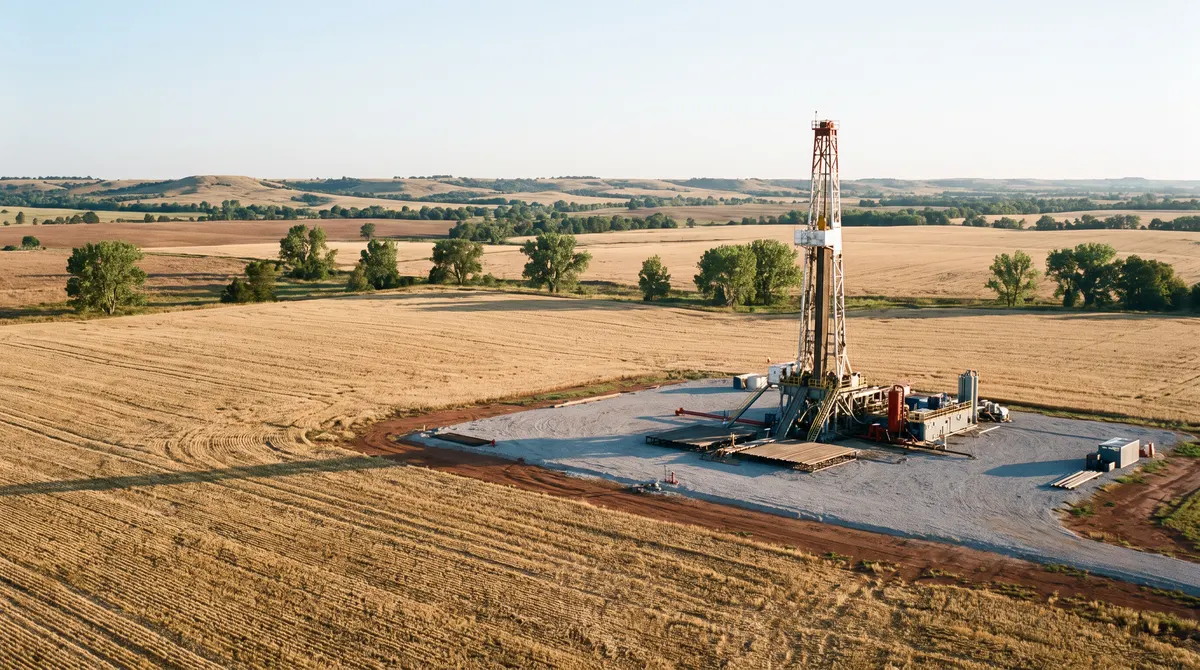
What SCOOP and STACK wells produce
The wells produce oil, natural gas and natural gas liquids in a mix that shifts across the plays. The EIA's Anadarko region, which the SCOOP and STACK dominate, produced about 383,000 barrels of oil per day and 6.5 billion cubic feet of natural gas per day in June 2024 (EIA, 2024). The EIA notes that production comes mainly from the Meramec, Osage and Woodford formations (EIA, 2017).
The Meramec is a Mississippian limestone and shale interval that the Oklahoma Geological Survey calls the Meramec Lime; the Woodford is the Devonian shale beneath it that sources much of the basin's oil and gas (Oklahoma Geological Survey, 2018). The Osage lies between them. The Springer, above the Chester Group in the southern Anadarko Basin's rock column, is a further zone under SCOOP mineral rights (USGS, 2014). The EIA calls these layers thicker than the Bakken and similar to the Eagle Ford (EIA, 2017).
One spacing unit can therefore carry royalty from Meramec wells, Woodford wells and sometimes a third zone, drilled years apart. Royalty statements on SCOOP and STACK mineral rights often show oil, gas and NGL lines from several wells.
Why mineral rights buyers compete in the SCOOP and STACK
Buyers compete here because of stacked pay. Several productive layers under one tract let an operator return to the same unit for infill and deeper wells, and each new well adds royalty to the mineral rights. The USGS estimated the Woodford's mean undiscovered resource across the Anadarko Basin Province at about 16 trillion cubic feet of gas in its gas window, plus 393 million barrels of oil and 2 trillion cubic feet of gas in its oil window (USGS, 2011).
Public data is the other reason. The Oklahoma Corporation Commission publishes permits, completions and well records, so a buyer can see which units are being drilled before calling. Many independent mineral rights buyers work the same nine counties, and when several of them want the same STACK mineral rights, the owner sets the price.
What SCOOP and STACK mineral rights are worth
Producing SCOOP and STACK mineral rights are usually priced as a multiple of recent monthly royalty income, adjusted for how fast the wells are declining and how many undrilled zones remain in the unit. A unit with new permits or an active rig draws stronger offers than a drilled-out unit.
Undeveloped mineral rights are priced by the net mineral acre. Buyers look at distance to active drilling, whether the tract is leased and at what royalty rate, and whether it sits in the oil or gas part of the play. Unleased SCOOP mineral rights in a unit being drilled can be force pooled: the Oklahoma Corporation Commission then sets a cash bonus and royalty from open-market value, which anchors buyer offers.
Buyers verify everything. They check the Oklahoma Corporation Commission's well records and orders, read the county clerk's deed records, and ask for your lease and division orders. For an inherited interest with gaps in the chain of title, talk to an oil and gas attorney before you sell.
How to sell SCOOP and STACK mineral rights
Start with the short form: your county, the type of interest and whether it is producing. It goes to as many as three independent buyers who are active where your minerals sit. They bid separately, so you see real competing numbers.
From there, you choose. Take the best offer, push back on it, or hold your mineral rights if nothing fits. Owners pay nothing; the buyers pay for the lead. Because we are not a buyer, no offer here is ours. When you decide to sell mineral rights, competing bids are the simplest way to find out what the market pays today.
How to get offers for SCOOP and STACK mineral rights
Tell us the state and county and what you own. We send your request to up to 3 mineral rights buyers who purchase in that part of the SCOOP and STACK. They review the public records and contact you with offers, and you choose whether to sell, sell part, or keep.
SCOOP and STACK mineral rights questions
Is it better to sell SCOOP and STACK mineral rights now or wait for more wells?
That depends on how many zones are left in your unit and how long you can wait. Offers already price in the wells a buyer expects, so waiting only pays if drilling comes sooner or heavier than buyers assume. Compare several offers before deciding, so you know what the market is paying for your mineral rights today.
Can I sell part of my SCOOP mineral rights and keep the rest?
Yes. Many owners sell a share and keep the remainder, or sell the royalty on existing Meramec wells and keep the deeper Woodford rights. Spell out what you are keeping and let buyers price the rest.
How long does it take to sell mineral rights in the SCOOP or STACK?
Expect offers within days. Closing takes longer because the buyer runs title at the county clerk and checks production records at the Oklahoma Corporation Commission. Having clean title and current division orders ready speeds that up.
SCOOP and STACK mineral rights sources
- Oklahoma Corporation Commission, Oil and Gas Conservation Division
- Oklahoma Corporation Commission, Pooling
- Oklahoma Geological Survey, Oklahoma Geology Notes, OGS hosts technical and core workshop on the STACK Play (October-December 2018)
- EIA, EIA's Drilling Productivity Report adds Anadarko region (August 2017)
- EIA, Drilling Productivity Report, Anadarko region data through June 2024
- USGS, Undiscovered petroleum resources, Woodford Shale and Thirteen Finger Limestone-Atoka Shale, Anadarko Basin Province (Open-File Report 2011-1242)
Last reviewed October 13, 2026. This page is general information, not legal or tax advice. Facts come from the official sources listed above; confirm anything that matters to your sale with a qualified professional.
Get offers for your SCOOP and STACK mineral rights
Free to you, no obligation. Your details go only to buyers active in your county.
Other basins and plays
Sell mineral rights in the Permian Basin, Sell mineral rights in the Midland Basin, Sell mineral rights in the Delaware Basin, Sell mineral rights in the Bakken, Sell mineral rights in the Eagle Ford, Sell mineral rights in the DJ Basin, Sell mineral rights in the Powder River Basin, Sell mineral rights in the Marcellus and Utica, Sell mineral rights in the Anadarko Basin, Sell mineral rights in the San Joaquin Basin, Sell mineral rights in the Haynesville, Sell mineral rights in the Barnett Shale