Sell mineral rights in Tennessee
Tennessee mineral rights are a small market, and it helps to say so plainly. The state accounts for less than 0.01 percent of US crude oil output and less than 0.02 percent of its natural gas, and crude production has not reached 1 million barrels in any year for more than three decades (US Department of Energy state profile, 2022). What production there is sits along the Cumberland Plateau at the southern end of the Appalachian Basin. If your mineral rights are under one of those wells, buyers will still look. When you sell mineral rights in Tennessee through this site, your request goes to up to three independent buyers who work in your county, and you pay nothing.
Where buyers are most active in Tennessee
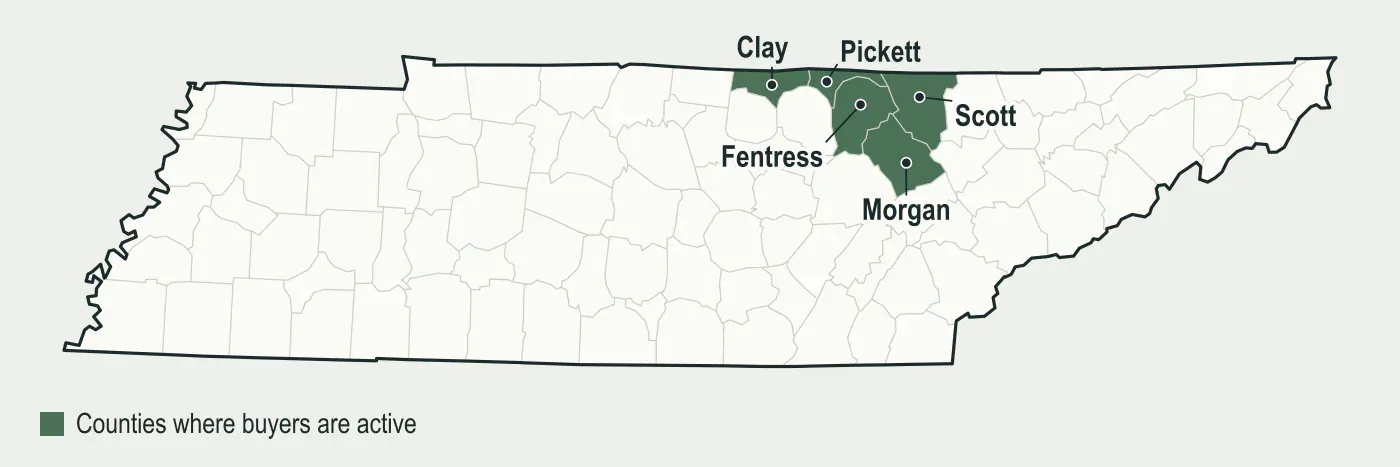
Tennessee mineral rights buyers follow the wells, which sit on a narrow trend in the northeast and north-central part of the state. Most of the state's gas-producing wells are in northeastern Tennessee on the Cumberland Plateau, and the large majority of historical and current producing activity sits in an eight-county area along the north-central border (US Department of Energy, 2022). Morgan, Scott and Fentress counties have produced since at least the 1940s, when Scott and Morgan supplied most of the state's oil from Mississippian limestone and gas was sold from wells in Morgan and Fentress (Society of Petroleum Engineers report, 1944). Pickett and Clay counties on the Eastern Highland Rim have smaller, scattered oil wells.
The scale is modest. Tennessee produced 165 thousand barrels of crude oil in 2025 and 2,667 million cubic feet of natural gas in 2024 (EIA). In 2020 the state had 946 producing gas wells (US Department of Energy, 2022, using TDEC data). Nearly all output comes from conventional reservoirs such as the Monteagle, the Fort Payne Limestone and the Stones River. Buyers pay for Tennessee mineral rights with wells on them or next to them. Mineral rights far from any well rarely get an offer.
What buyers check before a Tennessee mineral rights offer
Buyers start with the regulator's records. The Tennessee Department of Environment and Conservation runs the Oil and Gas Program, which permits wells and holds well records; the Board of Water Quality, Oil and Gas hears cases under the state's oil and gas law, Tenn. Code Ann. 60-1-204 (Interstate Oil and Gas Compact Commission, 2019). A buyer will find the wells on your tract, read the completion and production records, and check whether the operator is still active and bonded.
Next comes the lease. A Tennessee mineral rights offer depends on the royalty fraction, whether the lease is held by production, and what the checks have shown over the past couple of years. With small, old wells, the trend matters as much as the amount: a well in slow decline is worth more than one that has stopped reporting. Buyers also count the producing wells left in your county, because where operators are plugging wells, mineral rights will not gain value by waiting.
Severance tax is already out of your check. Tennessee charges a 3 percent severance tax on the sales price of all oil and gas removed from the ground, and a third of it goes back to the county where the wellhead sits (University of Tennessee County Technical Assistance Service). Buyers value mineral rights on net royalty, after that tax and any lease deductions.
Tennessee mineral rights records and the dormant mineral law
Tennessee has a rule that can take unused mineral rights away. Under Tenn. Code Ann. 66-5-108, a mineral interest that goes unused for twenty years is extinguished and reverts to the surface owner unless the mineral owner files a statement of claim with the register of deeds in the county where the land lies. Producing minerals, receiving rentals or royalties, being pooled with a producing tract, or paying the property taxes on the interest all count as use. The surface owner can ask a court to declare the mineral rights lapsed.
That makes the deed records your first stop before you sell mineral rights in Tennessee. The county register of deeds records mineral deeds and statements of claim. If your Tennessee mineral rights have had no production, no lease and no tax bill for close to twenty years, ask an oil and gas attorney about filing a statement of claim before you market them. A buyer's title check will find the gap, and mineral rights at risk of lapsing are worth far less than clean ones.
Selling Tennessee mineral rights: taxes and closing
Tennessee has no state income tax on a mineral rights sale. The Hall income tax, which applied only to interest and dividends, was fully repealed effective January 1, 2021 (University of Tennessee Municipal Technical Advisory Service). A sale is still a federal taxable event, so ask a tax professional how a lump sum compares with continued royalty income.
Closing follows the same steps as any land sale. The buyer prepares a mineral deed, you sign before a notary, and the deed is recorded with the register of deeds in the county where the minerals lie. If you inherited the mineral rights, expect a request for the probate record or an affidavit of heirship. Owners who use this site compare up to three offers, and none has to be accepted.
How to get offers for Tennessee mineral rights
Tell us your county and what you own. We send your request to up to 3 buyers who purchase in that part of Tennessee. They review the public records and contact you with offers, and you choose whether to sell, sell part, or keep.
Tennessee mineral rights sources
- US Department of Energy: Tennessee oil and gas state profile (2022)
- Interstate Oil and Gas Compact Commission: Tennessee regulatory summary (2019)
- University of Tennessee CTAS: oil and gas severance tax
- University of Tennessee MTAS: Hall income tax repeal
- Tennessee Code 66-5-108: lapse of unused mineral interests
- EIA: crude oil production by state
Last reviewed October 13, 2026. This page is general information, not legal or tax advice. Facts come from the official sources listed above; confirm anything that matters to your sale with a qualified professional.
Where Tennessee mineral rights buyers are active
Buyers concentrate on the counties below, where drilling is heaviest. Minerals elsewhere in Tennessee can still sell; send the details and we'll tell you if a buyer covers your area.
What you can sell in Tennessee
- Mineral rightsProducing or non-producing minerals, all or part of your interest.
- Royalty interestsWant to sell oil and gas royalties? See how buyers value a royalty interest or NPRI, what to have ready, and get offers from up to 3 buyers in your county.
- Overriding royalties (ORRI)Own an overriding royalty interest? Learn how ORRIs work, why lease expiry changes the price, which documents buyers need, and how to get offers.
- Inherited mineral rightsInherited mineral rights or oil and gas royalties? Learn how to get title in your name, why royalties go into suspense, and how to get buyer offers.
Tennessee mineral rights questions
Are Tennessee mineral rights worth anything if there are no wells on my land?
Usually not much. Tennessee production is small and concentrated in a few Cumberland Plateau and Highland Rim counties, and buyers rarely pay for Tennessee mineral rights with no wells nearby. If a well is producing on or next to your tract, or your acreage is pooled with one, the royalty stream has a price. If not, most buyers will pass.
Who regulates oil and gas in Tennessee?
The Tennessee Department of Environment and Conservation's Oil and Gas Program, under the state's Board of Water Quality, Oil and Gas. The program issues drilling permits, keeps well records and requires operators to post bonds for plugging and reclamation. Buyers use those records to check the wells on your mineral rights.
How do I sell mineral rights in Tennessee through this site?
Fill in the form with your county and what you own: a royalty under a producing lease, a mineral deed, or an inherited interest. Up to three independent buyers active in that county receive the request and can each send an offer. You pay nothing, and you can decline every offer.
Get offers for your Tennessee mineral rights
Free to you, no obligation. Your details go only to buyers active in your county.
Other states
Sell mineral rights in Texas, Sell mineral rights in Oklahoma, Sell mineral rights in New Mexico, Sell mineral rights in North Dakota, Sell mineral rights in Ohio, Sell mineral rights in Pennsylvania, Sell mineral rights in West Virginia, Sell mineral rights in Colorado, Sell mineral rights in Louisiana, Sell mineral rights in Wyoming, Sell mineral rights in Alabama, Sell mineral rights in Alaska, Sell mineral rights in Arkansas, Sell mineral rights in California, Sell mineral rights in Florida, Sell mineral rights in Illinois, Sell mineral rights in Indiana, Sell mineral rights in Kansas, Sell mineral rights in Kentucky, Sell mineral rights in Michigan, Sell mineral rights in Mississippi, Sell mineral rights in Montana, Sell mineral rights in Nebraska, Sell mineral rights in New York, Sell mineral rights in South Dakota, Sell mineral rights in Utah, Sell mineral rights in Virginia